



How to increase revenue in your nail salon: practical strategies for 2026
What if more hours at the nail desk is not the solution to a higher income? Plenty of salon owners work harder to hit their targets while the profit leaks away somewhere else: gaps in the diary, clients who never turn up and treatments that leave less on the bottom line than expected. In this article you will learn how to increase revenue in your nail salon along three lines: a higher average spend per visit, fewer no-shows and smarter scheduling. No theory, just measures you can put in place this month.
Why working more hours does not fix your profit

Your revenue comes down to three dials: the number of clients, the average amount per visit and how often the same client returns. Most owners only turn the first one. That happens to be the dial that costs you the most time, marketing budget and energy.
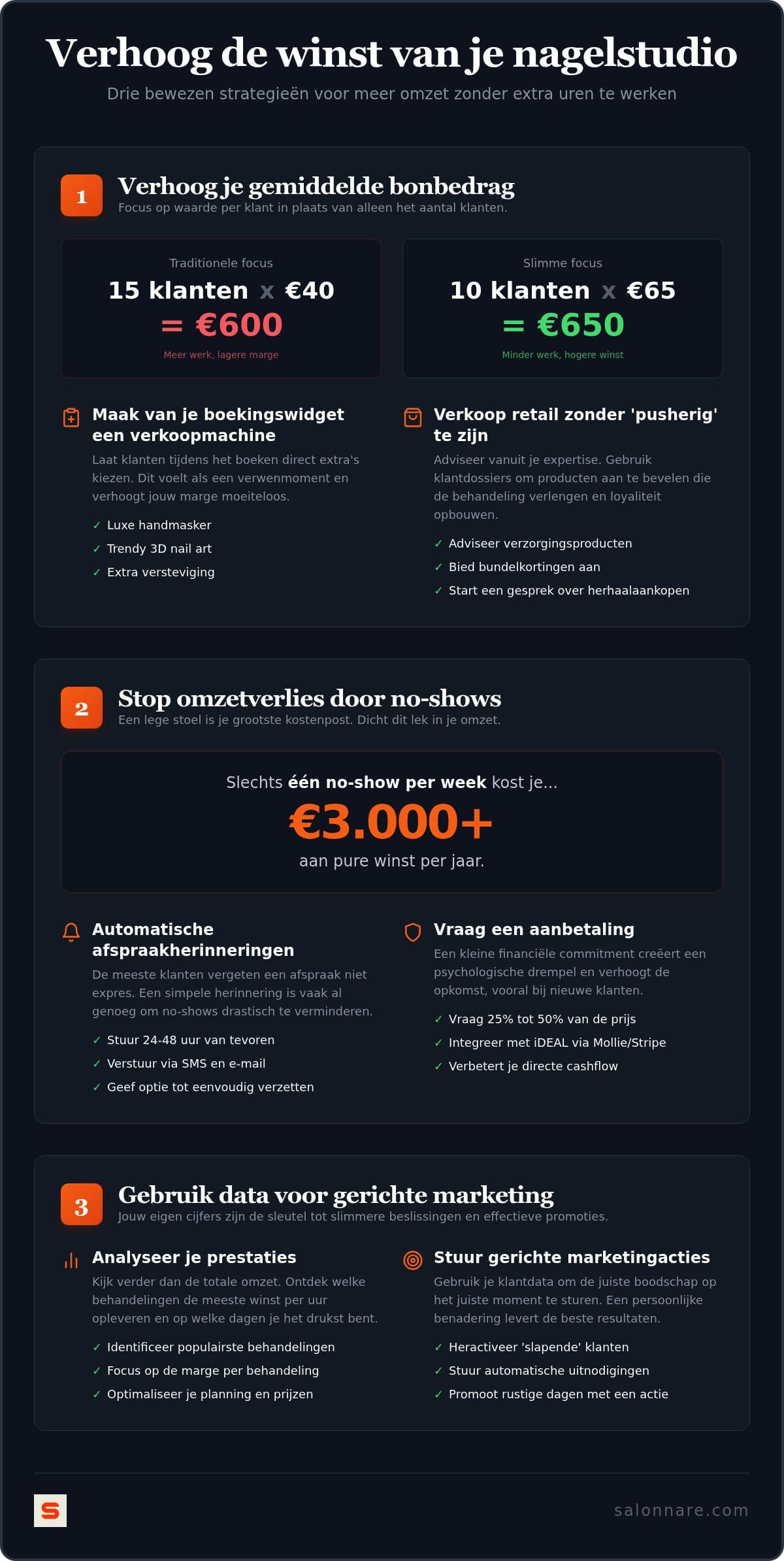
The other two dials cost you no extra hours. Ten clients who spend an average of EUR 65 bring in more than fifteen clients who come for a basic treatment of EUR 40 - and you spend well over an hour less doing it. A classic upselling approach works in a nail salon above all when the extra offer is already visible while the client is booking, not once she is sitting in the chair.
So start by measuring rather than by working harder. If you do not know what your average spend per visit is and what share of your available hours is actually filled, you are steering on gut feeling. Two numbers are enough to begin with, and both of them are sitting in your own diary and till.
Raise your average spend with upsells and retail
The quickest gains sit with the clients you already have. Put your most popular extras in your booking page as tickable options, with a photo alongside. A luxury hand mask, extra reinforcement or nail art then becomes a choice the client makes herself, instead of a question you still have to ask during the treatment. See how booking management with an online booking page solves that with a page that runs alongside your diary 24 hours a day.
Retail sells most easily from your role as the expert. Recommend products that extend the life of the nails or care for the cuticles, and record in the client card what someone took home before. At the next visit you then have a natural follow-up question rather than a sales pitch. In the client management with client cards you keep that history, photos and preferences in one place without any separate admin.
Bundles do the rest. A package of five treatments at a slightly reduced rate gives you immediate cash flow and locks in the coming months. Do check your margin first: a 10 percent discount on a treatment with a thin margin costs you more than it brings in.
Plug the leak: no-shows and empty slots in your diary
An empty chair is the most expensive item in your salon. On an average treatment of EUR 60, one no-show a week costs you over EUR 3,000 in annual revenue, while rent, stock and subscriptions carry on regardless. Plugging this leak is almost always more profitable than chasing new clients.
Most clients do not stay away on purpose, they are simply busy. So send automatic reminders by email, 24 to 48 hours in advance, and put a link in them that lets the client reschedule herself. That is friendlier than a penalty after the fact and it gives you enough time to offer the freed-up slot to someone on your waiting list.
For popular time slots, new clients or long treatments a deposit works best. Through online payments with Mollie or Stripe the client settles part of the amount in advance by card, iDEAL (the Dutch bank-transfer method) or another local payment method, and that money lands straight in your own bank account. Salonnare adds only its own platform fee of 0.5% (min. €0.30) on top of the rates of your own payment provider. If you want the full approach, read collecting deposits in your salon.
Steer on facts. A straightforward piece of market research and competitive analysis within your own client base shows which parts of the day and which treatments produce the most cancellations. The leak often turns out to be concentrated in a single time slot, and then the fix can be targeted too.
Plan smarter: occupancy, treatment duration and margin
The most expensive treatment on your price list is not automatically your most profitable treatment. Work out the yield per hour for each service, including material costs and clean-up time. A complex set that takes three hours sometimes returns less per hour than two briskly executed gel polish treatments. With a point of sale that splits sales and VAT automatically, you have those figures to hand without any manual work.
Next, give every treatment a realistic duration of its own plus a buffer. Overrun time you do not schedule, you pay back yourself in unpaid overtime or in rushed quality. If your diary is structurally too full, that is almost never a busyness problem but a settings problem.
Then look at the weak spots in your week. If you see that Tuesday mornings stay empty, deliberately schedule your longer or less time-critical treatments there, or offer that block specifically to your regulars. In the reporting dashboard you see revenue, occupancy and service mix side by side, so you steer on patterns instead of on gut feeling. If you are curious how larger organisations approach this kind of data analysis at scale: discover SAP Consulting Services from Kagool for their scalable IT solutions.
Data and automated marketing that brings clients back
Your biggest marketing opportunity sits in the client list you already have. A client who has not been in for six to eight weeks has usually not left in anger, she has simply forgotten to book. Let your system send that group an invitation automatically, so you never have to work through lists yourself again. That fits proven growth strategies for small businesses: serve your existing clients better first, and only then buy new ones.
A digital loyalty card reinforces that effect. Clients appreciate not having to keep a paper stamp card, and in the meantime you build up a picture of who really comes in regularly. You will find more ideas in the same direction in customer loyalty in your beauty salon.
Do not forget your stock, because missed retail sales are quiet lost revenue. With inventory management that tracks backbar and retail separately and warns you at a low threshold, you never have to say no to a popular colour. Products that sit on the shelf too long you tie to a targeted promotion, so your working capital starts moving again. Want to dive deeper into data analysis yourself? Discover the Microsoft Fabric Analytics Engineer certification training from Momentum Plus to learn how to put data to work for business growth.
How to build a more profitable nail salon step by step
Do not try everything at once. Pick one dial per month: start with your average spend per visit, then plug the no-show leak and optimise your scheduling last. That way, at the end of the quarter you also know which measure made the difference, and that is exactly the knowledge you will use again next year.
With Salonnare you arrange those steps in one system: online booking with add-ons, automatic reminders, deposits paid straight into your own bank account, a VAT-compliant till and reports that make your margin visible. You pay a fixed monthly price and no marketplace commission, so your subscription does not get more expensive the better things go; only the platform fee of 0.5% (min. €0.30) per online or card payment grows with it.
You start on the Free plan at EUR 0 per month with one team member and up to 50 bookings per month; grow beyond that and you move up to Starter (EUR 29) or Pro (EUR 59). If you want the wider picture for your type of salon first, have a look at the page on software for nail salons or read the comparison best nail salon software. Ready to begin? Create a free account today and turn that first dial. Looking for strategic financial guidance as well? Discover SD Mayer for specialised advisory services.
Ready to get more out of the same hours?
Automate your reminders, ask for deposits paid straight into your own account and see at a glance which treatments really pay off. Start with Salonnare's free plan and take the first step today.
See the pricingFrequently asked questions
How much extra revenue does upselling bring in a nail salon?
A consistently offered add-on typically lifts your average spend per visit by around ten percent or so, but the exact effect depends on your prices, your client group and how visible you make the options. The maths is simple: take your current average spend, add the price of your most-chosen add-on and multiply the difference by the number of clients per month. Present the options with a photo in your booking page, because a visible option is chosen considerably more often than one you have to offer out loud.
Am I obliged to ask for a deposit in my nail salon?
No, a deposit is not a legal requirement, but it is one of the most effective ways to reduce no-shows. You can set it selectively, for example only for new clients or for treatments that cost a lot of time and material. Through a connection with Mollie or Stripe the client pays part of the amount in advance by card, iDEAL (the Dutch bank-transfer method) or another local payment method, and that money lands straight in your own bank account. Salonnare adds only its own platform fee of 0.5% (min. €0.30) on top of the usual transaction fees of your payment provider.
How does salon software save me time on marketing?
Because you tie actions to behaviour instead of to manual work. The system recognises which client has not been in for six weeks and sends her a personal invitation by email at the right moment. You no longer have to work through client lists or type messages: you set the rule once and after that you only check the result. That keeps your diary fuller with clients you already know, without putting hours into it every week.
What is the difference between a free and a paid plan for my nail salon?
The difference comes down to the size of your salon and the features you need. Salonnare's Free plan costs EUR 0 per month and is meant for one team member with up to 50 bookings per month, including the online booking page and client management. If you grow beyond that or work with several people, you move up to Starter (EUR 29 per month) or Pro (EUR 59 per month). All plans have a fixed monthly price with no marketplace commission (only a platform fee of 0.5%, min. €0.30, per online payment), and from Starter you can export your figures to accounting packages such as Moneybird and e-Boekhouden.
Which number should I track first if I want to earn more?
Your average spend per visit, because that is the dial you can influence fastest yourself. Put your occupancy rate next to it: what share of your available hours is actually filled. If your average spend is low but your diary is full, the profit is in your offer and your upsells. If your average spend is fine but your diary is half empty, the profit is in scheduling and in winning back clients who have not been in for a while.