



Increase retail sales in your salon: more revenue from your shelves
You give a client your best advice about her curls or her dry skin, and two days later she orders exactly that bottle from a large web shop. Sound familiar? For many owners, increasing retail sales in the salon feels like a hurdle, because selling is not why they got into this trade. The good news: you do not have to sell. You only have to advise, and you already do that all day long. This article covers how to make product advice a natural part of your aftercare, which numbers decide what belongs on your shelves in the first place, and how follow-up after the appointment brings in revenue without costing you time.
From selling to advising: why product advice belongs to your aftercare

Most salon owners hesitate to offer products because they are afraid of coming across as pushy. That hesitation disappears once you reframe the question. A client is not paying you for an hour in the chair, she is paying for a result. If that result fades at home within two weeks because the aftercare is wrong, she effectively received less than she came for. Aftercare advice is not an add-on to your treatment, it is the final part of it.
That is exactly what separates it from classic sales: you are not closing a transaction, you are finishing your own work. In practice it means explaining what you use and why while the client is still in the chair. That way she understands the value of a product before she sees the price on the shelf.
The conversation gets much easier when you know what someone took home before. In the client CRM in Salonnare, purchase history, preferences and treatment notes sit together in one client profile. You can see at a glance that she bought that hydrating conditioner last time, and pick up the thread instead of starting over.
The advice conversation: asking the right questions and handling objections
Good advice starts at intake, not at the till. Make it a habit to ask about the routine at home: what is in the bathroom right now, and what is she unhappy with? Note concrete complaints such as a sensitive scalp, frizz or dry patches straight into the client record. Sensitive health information belongs in a separate encrypted vault, as the GDPR requires for special categories of personal data.
With those notes at hand you do not have to guess later. During the treatment you come back to precisely the problem the client raised herself, and that reads as attention rather than as a sales pitch.
The objection you will hear most often is price. Reframe it as usage. Professional products are usually highly concentrated, so you need a fraction of what a drugstore alternative requires, and those alternatives are largely water. Just do the maths out loud: a 250 ml bottle that lasts three months costs less per wash than a cheap bottle that is empty in five weeks. Also be honest when a client does not need something. That one 'no' is what makes all your other recommendations credible.
Know your numbers: which products actually carry margin
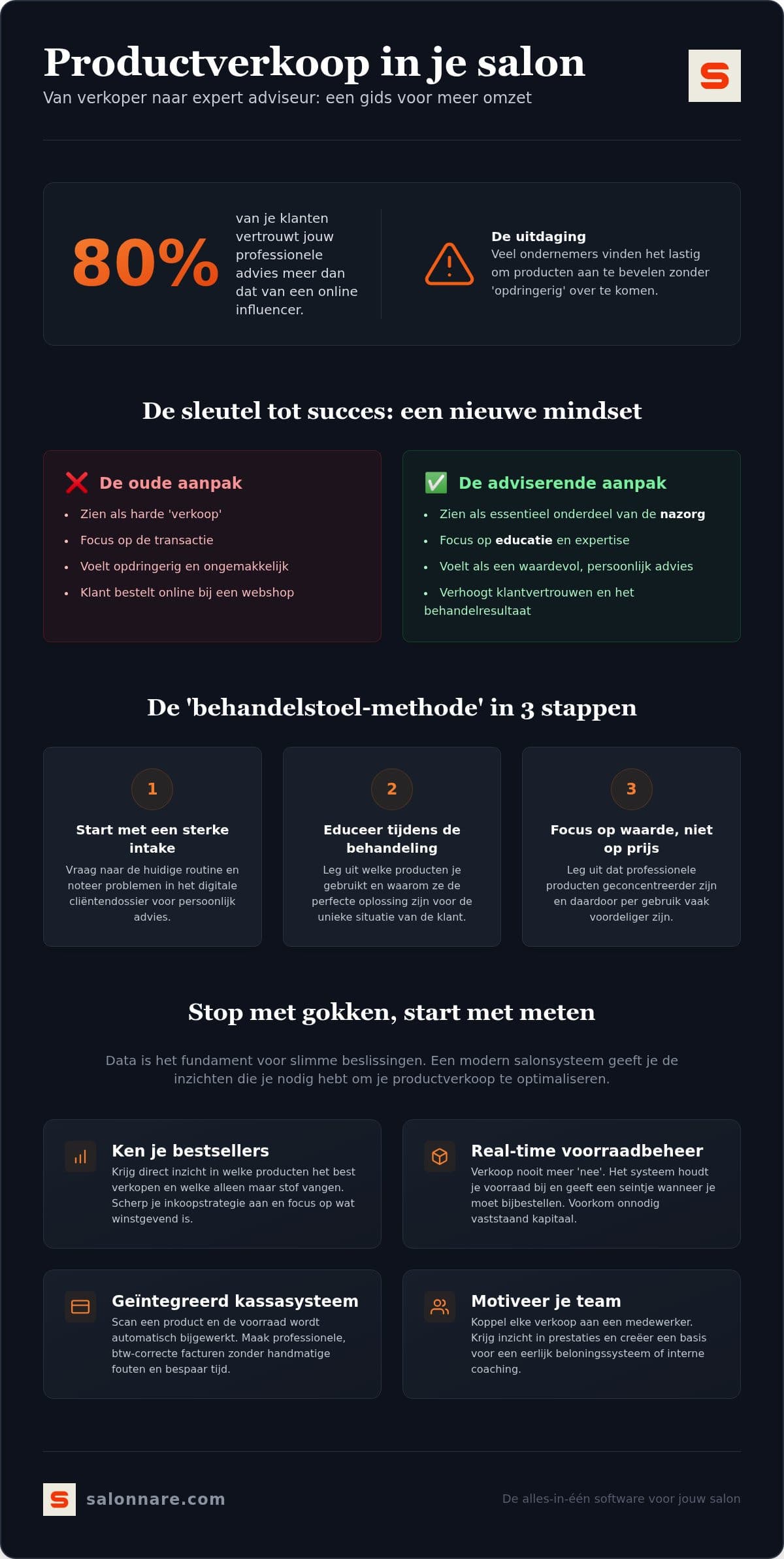
Without numbers your product range is guesswork. You want to know which bottles move and which have been collecting dust on the top shelf for eight months, because the second group is working capital standing still. The reporting dashboard in Salonnare shows service revenue and product revenue separately, so you know exactly which part of your month comes off your shelves.
This way of working is known internationally as consultative selling: you advise based on what you know about the client, and you back your choices with data instead of gut feeling. It cuts both ways. You sharpen your purchasing around what actually sells, and you can see which team member advises best.
Every sale at the till is linked to the person who rang it up. That gives you a fair basis for coaching or for a bonus scheme, instead of a vague sense of who is 'good with clients'. When you judge your margin, watch the VAT difference in your country: in the Netherlands treatments fall under 9 percent while products fall under 21 percent. Mix the two and your retail margin will look better than it is.
Stock that does not get in the way of your sales
There is exactly one moment where you lose a retail sale for good: the client says an enthusiastic yes and you have to tell her it is out of stock. She buys it online that same evening, and from then on the habit is set.
So set a minimum stock level per product and let the system warn you instead of keeping lists yourself. In inventory management in Salonnare you track retail stock and backbar separately, get an automatic low-stock alert and prepare a purchase order without touching a spreadsheet. Your own consumption during treatments is tracked too, so you know what a treatment really costs you in materials.
The link with your till closes the loop: you ring up the product, stock goes down automatically and VAT is split on the receipt. At the end of the quarter you export that to your accounting tool. If you want to know what to look for in a system like this, read our guide on choosing a point-of-sale system for a beauty salon.
Follow-up after the appointment: selling beyond the chair
The client who hesitated today is a warm lead three weeks from now. The problem is that by then you have forgotten the conversation, and so has she. Automated follow-up solves that without costing you time.
A colour client is a good example. Around week four the shine starts to fade, and that is exactly when a colour-protecting shampoo becomes relevant. With automatic reminders in Salonnare a personal message goes out at that point, using her first name and referring to the advice you gave her in the chair. The same rebook nudge brings back clients who stay away longer than their usual rhythm.
On top of that, give clients a reason to buy from you rather than online. With the loyalty programme they collect points per euro spent, including on product purchases, and redeem them on a following visit. It is not a paper stamp card she will lose, it simply lives in her client profile. That makes buying from you the easiest option.
Curious how this works out for your salon? You can start at no cost with a free account and build your retail sales up step by step.
Ready to get more out of your shelves?
Client profiles with purchase history, stock alerts before you run out and reporting that makes your retail margin visible. Start with the free plan from Salonnare and build your retail sales at your own pace.
Start for freeFrequently asked questions
How do I start with retail sales if it makes me uncomfortable?
Start by treating product advice as part of your aftercare rather than as a sales moment. Explain what you are using and why it matters for the result while you are still treating the client, instead of raising products only at the till. That shifts the conversation from selling to advising from your expertise. Clients appreciate it, because it helps them keep the salon result at home for longer.
What margin is common on retail products in a hair or beauty salon?
Salons often work with a factor of roughly 2 to 2.5 on the purchase price excluding VAT, but that is a rule of thumb rather than a standard. What matters more is applying the correct VAT rate: in the Netherlands product sales fall under 21 percent while treatments fall under 9 percent. Check your margins in your reporting regularly, so that more revenue really does mean more profit.
Can Salonnare track which team member sells the most products?
Yes. Every sale at the till is linked to the team member who processed it, and the reporting shows service and product revenue per person. That gives you a factual basis for targeted coaching or a transparent bonus scheme. Role-based permissions let you decide who is allowed to see these figures.
Is inventory management worth it for a small salon or a solo professional?
Especially then, because you handle all the admin yourself and every missed sale is immediately noticeable. Salonnare has a permanently free plan for 1 team member and up to 50 bookings per month, which includes inventory management and the till. When you outgrow it you move to Starter at 29 euros or Pro at 59 euros per month.
How do I stop clients from using my advice to buy online?
Make buying from you the easiest and most attractive option. That means having the product in stock at the moment you give the advice, being able to ring it up right away, and running a loyalty programme where points are only worth something with you. Add the follow-up email with your personal recommendation and the web shop becomes the detour instead of the default.