



Make your hair salon more profitable: 5 steps that raise your margin
Why are you working harder than ever while less is left at the bottom of the page? Wage costs are rising, purchasing is getting more expensive, and every now and then a chair sits empty because somebody did not show up. Most advice on this subject is about winning more clients. This article is about something else: what is left over from each client. More revenue at the same margin solves very little if your costs grow along with it. Below you will find how to calculate where the money leaks away, five steps that raise your margin per treatment without touching your base rates, and why your software pricing model affects your profit more than most owners realise.
Start with the maths: where is the money leaking?

Profitability is the gap between your revenue and all of your costs, your own hours included. Many owners only look at the bank balance, and that distorts the picture: a good month in the bank can be a bad month on margin.
So start with two calculations. The first is your cost per minute: add up your fixed costs, materials and wages, then divide by the minutes you can genuinely sell. Put that next to the duration of your treatments and you see immediately which services pay their way and which merely ride along.
The second is the cost of a no-show. Use your own average ticket: two missed appointments a week adds up over a year to a figure you do not simply earn back. As a rule of thumb the trade works with a net margin of roughly 10 to 20 percent after all costs and your own salary. If you sit below that, the problem is usually not your rates but your occupancy.
To steer with any precision you need client history. A client CRM records preferences and past treatments, which is the basis for well-established marketing principles such as a targeted recommendation rather than a blanket promotion. If you note allergies or scalp conditions along the way, those belong in the separate encrypted vault for Article 9 GDPR data, not in an ordinary notes field.
Steps 1 and 2: close the gaps in your calendar
The fastest gain is not in new clients but in the appointments you already have. Every empty slot you prevent is one hundred percent margin: the rent and the energy bill run regardless.
Step 1 is the automatic reminder. Send a message 24 to 48 hours ahead by email or WhatsApp. Clients forget less often, and those who cannot come tell you sooner - which leaves you time to fill the gap.
Step 2 is the deposit. Once someone has paid a small amount upfront, the appointment stops being a loose intention. You connect your own Mollie or Stripe account, clients pay by card or local methods, and the money arrives directly in your account. You can try these features for free before committing to anything.
Also review your week for quiet hours. Make sure your bookings management is configured so no unnecessary gaps fall between treatments: fifteen minutes here and there adds up across a week to a full appointment.
Steps 3 and 4: more margin per client without raising prices
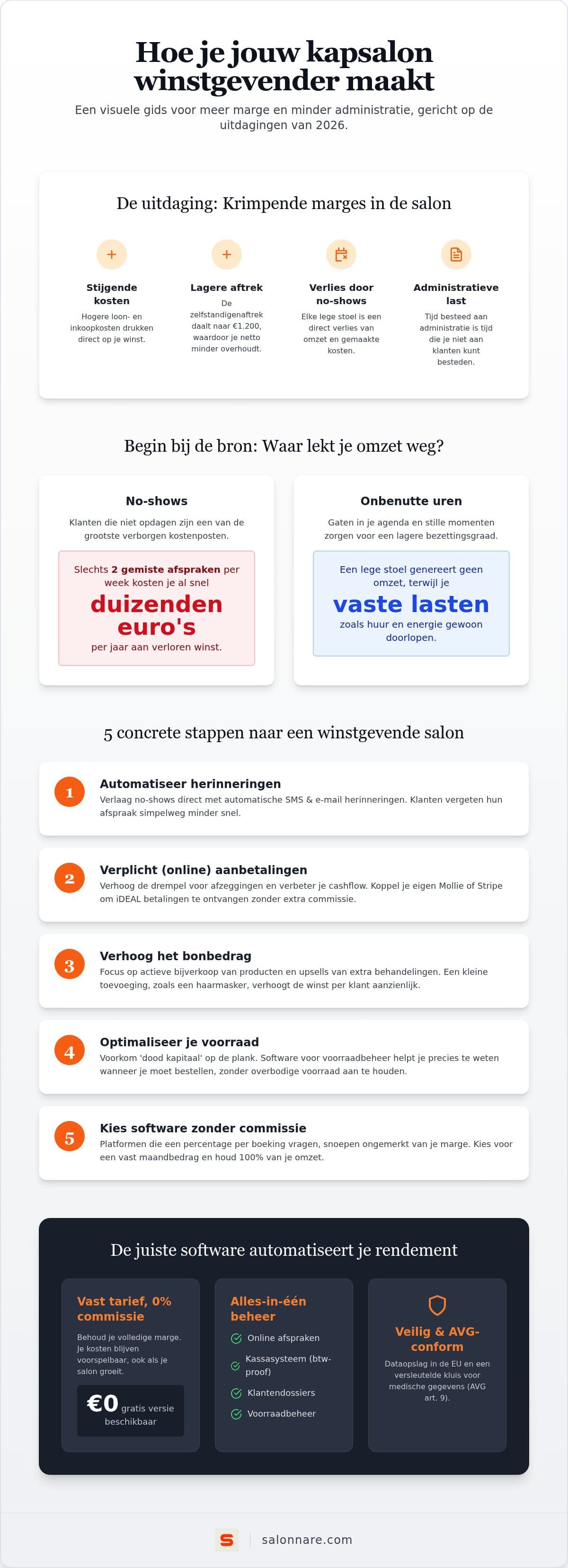
Step 3 is the average ticket. An intensive mask while the colour develops costs you almost no extra time but noticeably lifts the margin on that client. The same goes for retail products: the client buys them anyway, the only question is where. How to do that without becoming pushy is covered in our article on increasing retail sales in your salon.
Step 4 is your stock. Products sitting on the shelf for months are not inventory, they are frozen cash. With inventory management you see what genuinely moves and what you over-order. You never run out on a client, but you also stop tying up capital in bottles nobody takes home.
Many owners lock these choices into a solid business plan. It does not need to be a thick document: one page with your cost per minute, your target margin and your occupancy goal is enough to test decisions against.
Step 5: do not let your software model eat your margin
The fifth step is the one most often overlooked, and it works in exactly the wrong direction as you get busier. Platforms that take a percentage of every booking cost you the most in your best month.
Make the sum concrete. At 5 percent commission on a 60 euro treatment that is 3 euro per appointment. At 100 appointments a month that is 300 euro, and the figure grows with every client you add. A fixed monthly fee does the opposite: the busier you are, the lower your software cost per treatment.
Salonnare therefore works with fixed amounts that do not scale with your revenue: Free at 0 euro per month (1 staff member, 50 bookings), Starter at 29 euro and Pro at 59 euro per month, plus only a 0.5% platform fee (min. €0.30) per online or card payment. Payments run through your own Mollie or Stripe account straight to your bank.
On the admin side an integrated point-of-sale saves you hours every month. Instead of retyping receipts you export your revenue to your accounting tool. If you work with staff, you decide per person who gets to see which figures.
What these steps do to your year-end figures
Taken separately these steps are small. Together they change the structure of your result. Prevented no-shows are one hundred percent margin. A higher average ticket lands almost entirely in profit, because your fixed costs do not move with it. A fixed software model keeps your costs predictable while your revenue climbs.
More importantly, you start steering on numbers instead of instinct. You know which treatment pays its way, which hours sit structurally empty, and what a missed appointment genuinely costs you.
That also makes the next question easier. Considering an extra pair of hands or longer opening hours? You run it against your own cost per minute rather than hoping it works out.
Start with the leak you can close today
Switch on automatic reminders, ask for a deposit and keep your software cost fixed per month instead of per booking. The Free plan costs 0 euro per month for 1 staff member and 50 bookings. Starter is 29 euro and Pro 59 euro per month, always with the same 0.5% platform fee (min. €0.30) per payment.
Start free and run the numbers yourselfFrequently asked questions about hair salon profitability
How do I make my hair salon more profitable without raising prices?
By steering on margin per client rather than on your rate. Lift the average ticket with an extra treatment or a retail product, prevent no-shows with reminders and deposits, and keep stock tight so no money sits frozen in products that do not move. Those three together raise your net margin without a client paying a euro more for the same treatment.
What is a healthy profit margin for a hair salon?
As a rule of thumb the trade works with a net margin of roughly 10 to 20 percent of revenue, after all costs and your own salary. More important than the percentage is your cost per minute: add up fixed costs, materials and wages and divide by the minutes you can genuinely sell. That shows you per treatment whether it contributes or merely rides along.
How much is there to gain from cutting no-shows?
Run it against your own average ticket: two missed appointments a week adds up to a substantial figure over a year. That money is pure profit too, because rent, energy and other fixed costs run regardless. Automatic reminders and an upfront deposit are the two measures that do most about it.
Why is a fixed monthly price better than commission per booking?
Because commission is most expensive exactly when you are doing best. At 5 percent on a 60 euro treatment you pay 3 euro per appointment, at 100 appointments 300 euro a month, and that figure grows with your success. With a fixed monthly fee your software cost per treatment falls as your calendar fills. Salonnare therefore charges 0, 29 or 59 euro per month, plus only a 0.5% platform fee (min. €0.30) per payment, and no marketplace commission on your bookings.