



Comparing salon software: which criteria actually matter for your type of salon
Comparison lists for salon software all look alike: online calendar, point of sale, reminders, stock, reports. Yet two salon owners working from the same list regularly end up with different providers, and both of them are right. The difference is not which features appear in the list, but how heavily each one counts for your situation. Staff permissions are irrelevant when you work alone and decisive the moment four people share one till. This article flips the order around: first you define your salon profile, then you give the criteria their weight. That is how you avoid paying for features you never touch, or switching to something that feels cramped a year from now.
Why the same comparison plays out differently for two salons

A comparison table pretends every row carries the same weight. In practice it never does. A hairdresser who only cuts and sells no products has little use for advanced stock control. A beauty salon doing peels and injectables cannot function without a secure place for health data. Both look at the same list and should reach different conclusions.
The classic mistake is starting with the providers instead of with yourself. You open five websites, see five impressive feature lists, and end up choosing on gut feeling, price or the prettiest dashboard. Three months later you trip over something that appeared on no comparison page at all: that your second stylist should not be able to see revenue figures, or that you are still retyping receipts by hand.
The alternative takes half an hour. You first decide what kind of salon you are and which three criteria are decisive because of it. Everything after that is just filling in the blanks. If you would rather work through a systematic checklist afterwards, the guide on comparing salon software step by step sets out the order for you.
Define your salon profile with four questions
Together these four questions decide almost entirely which criteria weigh heavily for you. Answer them honestly for where you expect to be in twelve months, not for today.
- Do you work alone or with a team? The moment a second person joins, staff permissions, a shared roster and per-stylist revenue become relevant. Working solo, all of that is ballast. - Do you sell products alongside treatments? If so, the link between till and stock counts heavily, and so does the VAT split, because services and retail rarely fall under the same rate. - Do you record health data? Allergies, medication, skin conditions and pregnancy fall under GDPR article 9. A separate encrypted store then stops being a luxury and becomes an obligation. - Where do you want to be in a year? A system that gets more expensive per staff member or per booking feels cheap with one chair and acts like a brake with four.
Write the answers down and add three criteria you refuse to compromise on. Those three are your yardstick. Everything else is a bonus.
One practical trick: look back at your last two working weeks and note which task irritated you most often. That is almost always the criterion that weighs heaviest in your profile, and it rarely sits at the top of a standard feature list.
The pricing model: where the weighting bites hardest
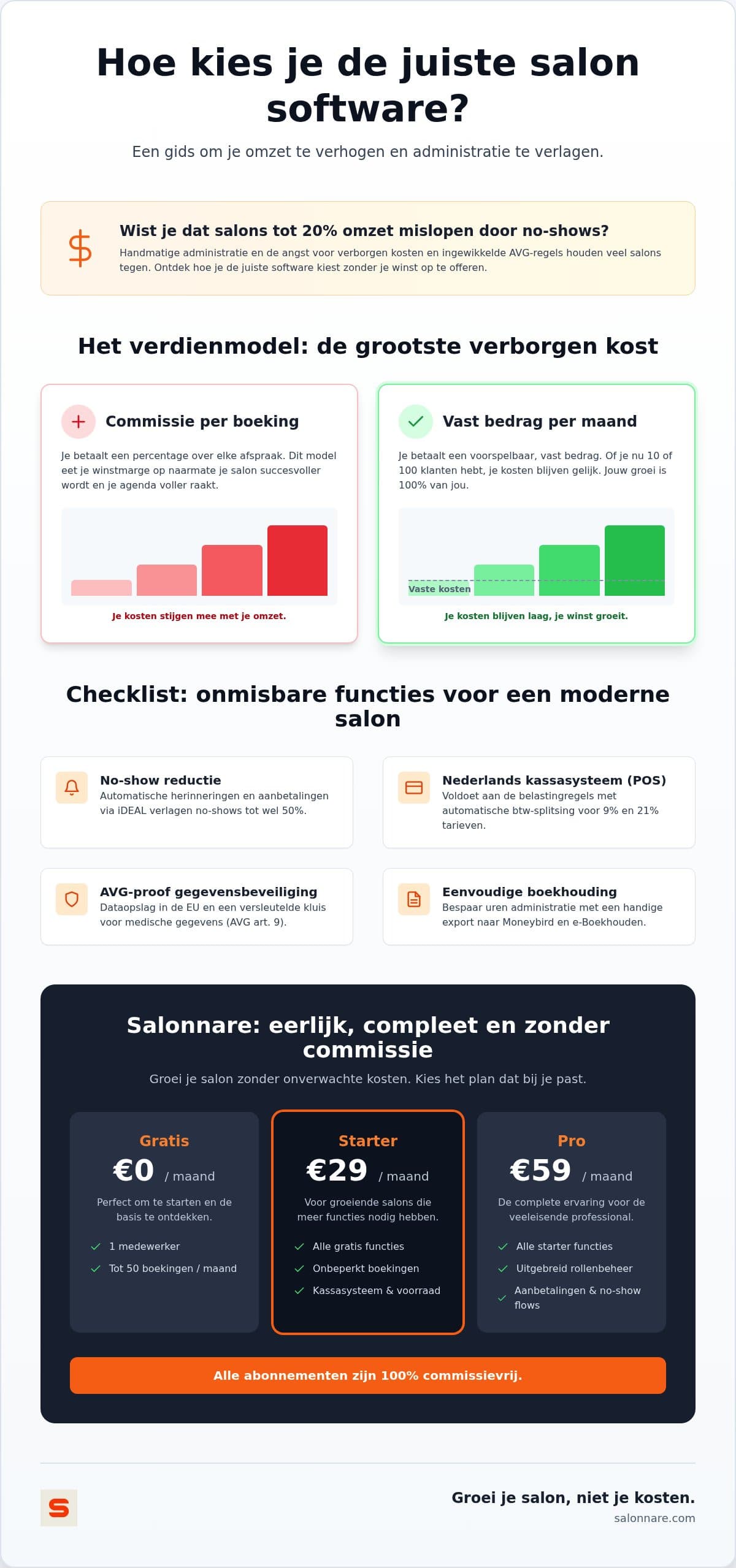
Of all comparison points, the pricing model is the only one that grows heavier every year precisely because you are doing well. A feature you never use costs you nothing. A percentage on every booking costs you more as soon as your calendar fills up.
So always separate three cost items, because they are rarely shown together on a pricing page:
- The subscription. A fixed monthly amount, or an amount per staff member. That second model scales with your team rather than your revenue, which can work out badly with part-timers. - Commission per booking. Some platforms charge a percentage on appointments arriving through their marketplace, and sometimes on your own returning clients too. That last part is where it gets genuinely expensive. - Transaction costs. Almost every provider charges something on online and card payments, whether that is the payment provider, the platform, or both. Ask explicitly about the percentage and about the minimum amount per transaction.
With Salonnare you pay a fixed monthly price: Free costs €0 per month for one staff member and 50 bookings per month, Starter is €9.99 per month and Pro is €14.99 per month. There is no marketplace commission on new clients coming in through the marketplace, that one is €0. There is a platform fee of 0.5% with a minimum of €0.30 on every online or card payment. Those payments run through Mollie or Stripe straight into your own bank account, so you are not waiting on a payout from an intermediary.
The sum you want to make is simple: take last month's number of appointments, your average ticket and your number of staff, and put those three figures into every provider on your shortlist. With a fixed amount your cost per appointment drops as you grow; with a percentage it stays flat. The full breakdown of what each plan includes is on the pricing page.
Hard requirements: VAT, GDPR and your bookkeeping
Part of the comparison is not negotiable, because the law is watching. These points weigh heavily for every salon, whatever your profile.
A VAT split in the till. In the Netherlands hairdressing services fall under the reduced 9% rate, while beauty treatments and retail sales sit at 21%; other countries have their own split. If you do both, you want a till that applies the right rate per line on the receipt instead of you unpicking it afterwards. During a demo, ask for a receipt with a service and a product on it. The Dutch trade association ANKO makes the same point: sound bookkeeping is the basis of a healthy business.
Store health data separately. If you note allergies, medication use or skin conditions, you are processing special category data under GDPR article 9. A note field on the client record does not cover that. Salonnare keeps this in a separately encrypted vault with per-staff access and logs who opens it. All data stays in the EU.
Export to your bookkeeping. Do not ask whether there is an accounting integration, but what exactly comes out and in which format. Salonnare provides an export compatible with packages such as Moneybird and e-Boekhouden. That is an export rather than a live integration, and in practice it saves you retyping receipts at month end.
Want to see how this works before committing to anything? You can start for free and enter your own service list, rates included, to check whether the receipt comes out right.
Your client list: who owns it, and can you take it with you?
This criterion weighs heavily for everyone and is almost always examined too late. Your client list is the most valuable asset your salon has, and the question is whether you keep hold of it yourself.
A good system is at heart your customer relationship management: treatment history, preferences, formulas, appointments and contact details in one place, yours. Under marketplace models that relationship is sometimes arranged differently, because the platform treats the client as its client. You only notice when you want to leave.
Three questions to ask any provider before you start:
- Can I import my existing clients? A CSV or Excel import saves you days of retyping during the switch. - Can I get back out, and in what format? A full export of clients, appointments and revenue should be standard, not something you have to request. - Where do new bookings come in? A booking widget on your own site and on your Google profile brings in clients who are yours. A marketplace booking is a client you share.
How to keep that data usable afterwards is covered in the overview of client management. Practically speaking it comes down to this: record properly once what you will want to find again later.
Salonnare against the three profiles
Salonnare is a young platform and we are not hiding that. It means we have a smaller customer base than the established players, but also that the product was built around what salons need today rather than ten years ago.
What it comes down to per profile:
- Working alone? The Free plan costs €0 per month for one staff member and 50 bookings per month. You get an online booking page on your own site and through Google, automatic reminders and a till with the right VAT rates. No credit card, no trial that expires. - Running a team? From Starter (€9.99 per month) you set permissions per staff member, so not everyone can reach revenue figures or sensitive client data. The platform is available in Dutch, English, German, French, Spanish, Italian, Polish, Portuguese and Turkish, which helps with a mixed team. Sign-in works through Google, Microsoft, Apple or Facebook. - Handling health data or retail? The encrypted vault for special category data and the link between point of sale and stock are part of the product itself, not a paid add-on (stock control from Starter).
Deposits (Pro) and online payments via iDEAL (from Starter) run through Mollie or Stripe into your own account. There is no marketplace commission on new clients from the marketplace (€0); every online or card payment carries the platform fee of 0.5% with a minimum of €0.30.
The honest conclusion: if you need a feature today that we do not have yet, an established provider is the better choice. If a fixed monthly price, owning your client data and a GDPR-proof vault weigh heaviest for you, Salonnare is built for exactly that.
How heavily does each criterion weigh per salon profile?
| Criterion | Solo, one chair | Team of 2 to 5 | Salonnare | |
|---|---|---|---|---|
| Fixed monthly price instead of % per booking | Weighs heavily | Decisive | Free €0, Starter €9.99, Pro €14.99 per month | |
| Permissions per staff member (RBAC) | Not needed | Decisive | Yes, configurable per staff member | |
| VAT split on the receipt | Weighs heavily with retail | Weighs heavily | Yes, per line on the receipt | |
| Encrypted vault for health data | Required for beauty | Required for beauty | Yes, separately encrypted, data in the EU | |
| Deposit via iDEAL into your own account | Weighs heavily | Weighs heavily | Yes, on Pro, through Mollie or Stripe | |
| Marketplace commission on new clients | Weighs heavily | Weighs heavily | €0 | |
| Fee on online and card payments | Calculate it | Calculate it | 0.5%, minimum €0.30 per payment | |
| Export to your bookkeeping | Convenient | Weighs heavily | Export for Moneybird, e-Boekhouden and others | |
| Multilingual team (9 languages) | Rarely needed | Weighs heavily with a mixed team | Dutch, English, German, French, Spanish, Italian, Polish, Portuguese, Turkish |
Last verified: 2026-09-10
Put your own requirements list next to a free account
You now know which criteria weigh heaviest for your type of salon. Write down your three most important points and test them yourself: enter your services, check the VAT on a test receipt and switch the reminders on. The Free plan costs €0 per month for one staff member and 50 bookings per month.
Start for freeFrequently asked questions about comparing salon software by salon type
Which criteria matter most if I work on my own?
In a solo salon, staff permissions and team rosters drop away and three things remain: an online booking page that catches appointments outside opening hours, automatic reminders to cut no-shows, and a pricing model that does not grow with your revenue. Stock control only starts counting once you sell products. Start small and mainly check whether the system can grow with you without you having to enter everything again later.
What changes on my requirements list once I hire staff?
Three criteria move up. First, permissions per staff member, so not everyone can reach revenue figures or sensitive client data. Second, a shared roster with per-stylist availability, otherwise double bookings appear. Third, the pricing model: a system that charges per staff member becomes relatively expensive with part-timers, while a fixed monthly amount stays put. Do that calculation before you hire, not after.
I do both hairdressing and beauty treatments. What should I look for?
The VAT split in the till. In the Netherlands hairdressing services fall under the reduced 9% rate, while beauty treatments and retail sales fall under 21%, and other countries apply their own split. During a demo, ask for a receipt showing a service and a product together and check that both rates come out right automatically. If they do not, you will be correcting it by hand every month, which is precisely the work you wanted to hand over.
Do I need to worry about the GDPR vault if I only cut hair?
Only if you record health data. If you note a scalp condition, an allergy to a colouring product or medication use, you are processing special category data under GDPR article 9, and stricter requirements apply than for an ordinary client note. If you do not, this criterion weighs lightly. When in doubt, assume it applies: an allergy note is jotted down faster than you think.
What does Salonnare cost, and are there commissions?
Salonnare works with fixed monthly prices: Free at €0 per month for one staff member and 50 bookings per month, Starter at €9.99 per month and Pro at €14.99 per month. There is no marketplace commission on new clients arriving through the marketplace, that one is €0. Every online or card payment does carry a platform fee of 0.5% with a minimum of €0.30 per payment. Payments run through Mollie or Stripe straight into your own bank account.