



Efficient salon software: less admin, a fuller schedule
How much time went into messages about appointments this week, while you were actually meant to be with a client? That is not poor planning - it is a structural leak. Every message costs two minutes, every phone call interrupts a treatment, and by Friday you have no idea where the hours went. This article is not about which package looks nicest. It is about four places where time and revenue drain out of a salon, and which automation plugs each one. You will also read what it costs, including the amount that genuinely does come off a payment - because that is where a lot of hand-waving happens in this market.
Where your week actually leaks

Most salons do not lose time on the craft itself, but on everything around it. Four leaks come back again and again: messaging back and forth about a time slot, clients who do not show up, cashing out and sorting VAT, and client details that live on scraps of paper and in your head instead of in a system.
Underneath the first leak sits appointment scheduling software: a system that knows how long each treatment takes and which slots in your week are still free. Once that is accurate, a client can claim a slot themselves without you lifting a finger.
Run the numbers for your own business. Twenty messages a week at two minutes each is over forty minutes. Two no-shows at 50 euro is 100 euro. One evening per quarter sorting out VAT is four evenings a year. Individually it is small; together it is a working day a month plus a few thousand euro a year.
Leak 1: the back-and-forth about a time slot
As long as clients can only book by phone or WhatsApp, you are the calendar. Every appointment costs a handful of messages: which moment suits, is that slot still free, how long does it take. A booking widget on your own site removes that entire exchange, because the client sees which slots are open and takes one.
A large share of those bookings arrives outside opening hours - exactly when you cannot pick up, either because your hands are busy or the shop is closed. Without an online option you push that client to a call-back moment, and a portion of them never comes back.
Do pay attention to where the booking lands. Some providers place you inside their own marketplace, where your client scrolls past competitors first. Booking on your own domain and through your Google listing keeps the client relationship with you. You can see how bookings management works in practice on the feature page.
Leak 2: the slot that stays empty
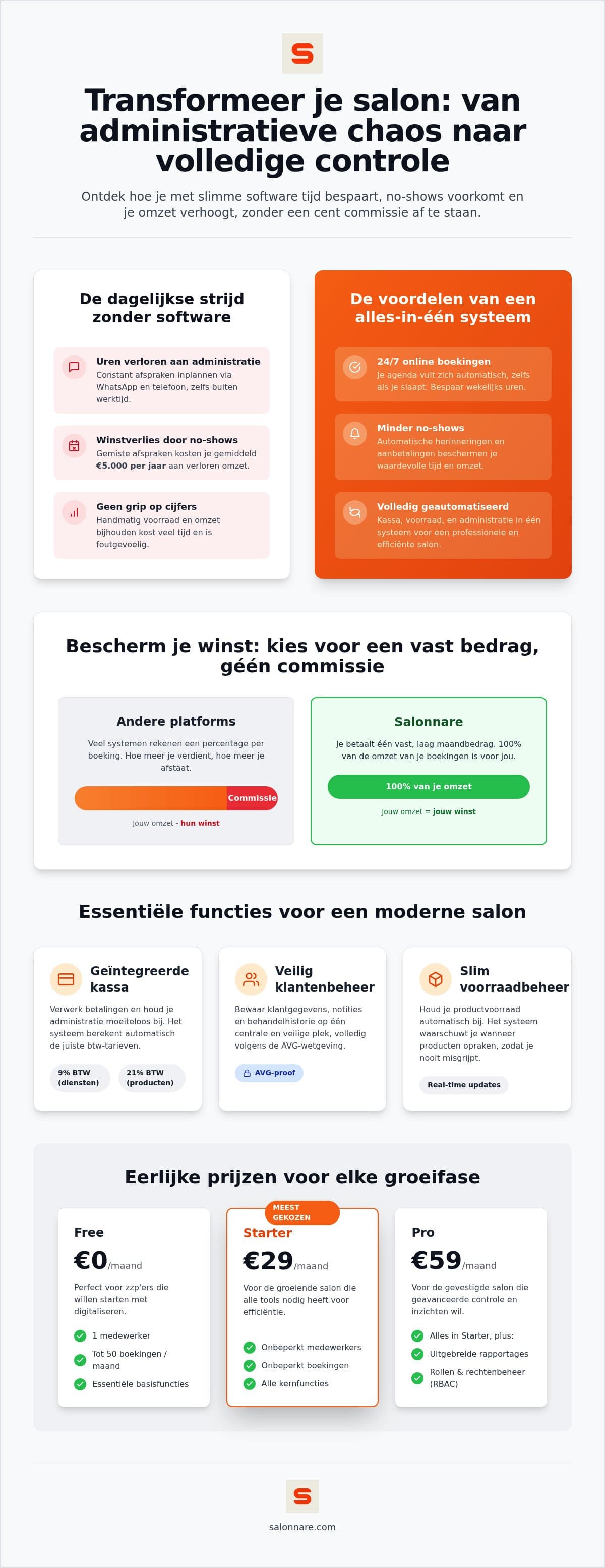
A no-show costs more than a cancellation, because you can no longer sell that slot. Two missed appointments a week averaging 50 euro adds up to something close to 5,000 euro a year in revenue you had scheduled but never invoiced.
An automatic reminder by email removes a good part of that. Timing matters: twenty-four hours ahead is usually the best compromise. Early enough that you can still fill the slot if someone cancels, late enough that it has not been forgotten again. Put the address and duration in the message and you will save phone calls too.
For the appointments you really cannot afford to lose, add a deposit. Through Mollie or Stripe the client pays part of the amount at the moment of booking. That raises commitment noticeably, especially for long treatments and first-time clients. The page on automatic reminders shows how to set the wording and the timing.
Leak 3: cashing out and the quarterly VAT evening
A treatment that has happened still needs to be paid for. Do that in a separate till or on a paper receipt book and you are keeping two sets of records that will not reconcile at the end of the quarter. A point of sale attached to your calendar knows which treatment was given and has the receipt ready in one action.
For Dutch salons the real work sits in the VAT rates. Hairdressing services fall under the low rate of 9 percent, while products you resell fall under 21 percent. A till that makes that distinction while you ring it up saves you an evening of sorting per quarter and prevents corrections afterwards.
Your bookkeeping does not have to be manual after that. Salonnare offers an export function that puts your revenue data into a file for Moneybird or e-Boekhouden. Note the word export: you push the data across when it suits you, it is not a continuous live integration that syncs everything by itself. That technology mostly pays off for small businesses in exactly these everyday actions is also the thread running through this research on fintech and small business.
Leak 4: client details that live in your head
Colour formulas on a note, allergies in your memory and preferences buried in a chat from eight months ago: it works right up until the day you are ill or take on a second pair of hands. In a digital record the treatment history sits in one place, and a colleague can take a client over without having to ask you what was used last time.
One category needs extra care. If you record allergies, medication, skin conditions or a pregnancy, you are processing special category data under article 9 of the GDPR. An ordinary notes field is not enough: that information belongs in a separately encrypted vault with its own access rights, so not every staff member sees it by default. At Salonnare that vault is built into client CRM, and your data sits on servers inside the EU.
Those per-staff rights are useful in their own right. You set what each person can see: a trainee does not need the revenue figures, and a freelancer renting a chair does not need access to your clients' records. Once your admin is in order you can also start using it - think of a targeted email to clients who have not been in for four months.
What it costs, and what does come off a payment
At Salonnare you start on the Free plan at 0 euro a month: one staff member, up to 50 bookings a month. That is not a trial that stops after two weeks. If your business grows past it, Starter is 29 euro a month and Pro is 59 euro a month, keeping your calendar, client records and settings.
Be precise about the word commission, because that is where providers differ. Salonnare charges no marketplace commission on new clients who reach you through the platform: that percentage is 0. What does come off is a platform fee of 0.5 percent with a minimum of 30 cents on every online or card payment. On a 60 euro treatment that is 30 cents. Settle up in cash at the till and the payment falls outside it.
The payment itself runs through Mollie or Stripe straight into your own bank account, so your revenue does not sit with an intermediary until a payout date. That optimising your technology is one of the most effective ways for a small business to grow also comes back in this overview of salon software options. To put the plans side by side, look at the pricing per plan.
How to start this week
You do not have to move everything at once. Start with your five most-booked treatments: name, duration and price. Duration is the field that matters most, because it decides how large the slots in your calendar become. Book a cut at thirty minutes while it actually takes forty-five and your day runs late from the second client onwards.
Then switch on online booking and share the link in your Instagram bio and on your Google listing. Set two limits straight away: how far ahead clients may book, and how close to the appointment. Without them you will find a quarter-past-eight appointment appearing in your calendar at eight on a Saturday morning.
Switch on reminders last - it takes five minutes and pays for itself immediately. Fill your client list as you go: enter only the clients who came in over the past year and let the rest arrive on their next appointment. You can start today on the free plan.
Take the admin out of your week
Put your five most-booked treatments online, let clients claim a free slot themselves and send an automatic reminder a day ahead. The Free plan costs 0 euro a month, covers one staff member with 50 bookings a month and does not expire.
Start free with SalonnareFrequently asked questions
What does efficient salon software cost per month?
At Salonnare you start free: the Free plan costs 0 euro a month and covers one staff member with up to 50 bookings a month. Grow past that and Starter is 29 euro and Pro is 59 euro a month. Alongside that fixed monthly amount there is a platform fee of 0.5 percent with a minimum of 30 cents on every online or card payment. There is no marketplace commission on new clients who arrive through the platform: that percentage is 0.
What is the most effective way to prevent no-shows?
Combine two things. Switch on automatic reminders by email around twenty-four hours ahead, so a client can still cancel in time and you can fill the slot. On top of that, ask for a deposit on the appointments where an empty chair costs you most: long treatments and first-time clients. That deposit runs through Mollie or Stripe and noticeably raises commitment.
Is salon software required to comply with the GDPR?
Software is not required, but it makes it considerably easier to demonstrate that you are in order. Health data such as allergies, medication or a pregnancy falls under article 9 of the GDPR and needs extra protection. Salonnare keeps it in a separately encrypted vault with its own access rights per staff member, on servers inside the EU. That is easier to account for than a paper card index or a shared notes file.
Can I move my existing client list across?
Yes. If you are coming from another system, export your clients as a CSV file and import it in one go. If you work from paper, do not retype your whole card index: enter only the clients who came in over the past year and let the rest arrive on their next appointment. That way you are up and running in an hour instead of a weekend.