



Chair rental for hairdressers: costs and admin explained
Renting a chair does not mean you share one set of books. With [chair rental](https://www.kvk.nl/starten/wat-is-stoelverhuur/), self-employed hairdressers work in the same salon, but each one keeps their own clients and income. This article shows what a chair can cost, with a worked example you can check yourself, and how to keep rent, client data and payments separate.

What does renting a chair in a hair salon cost?
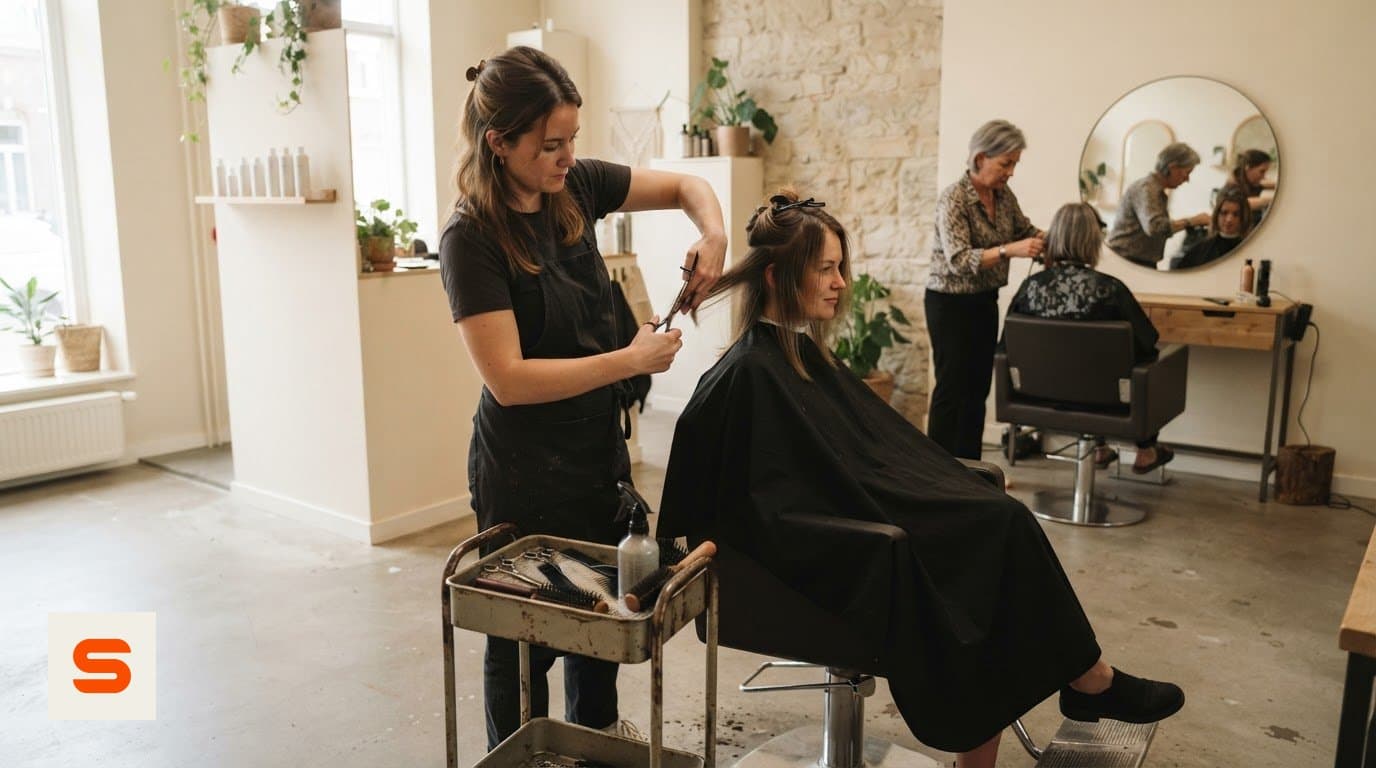
There is no fixed rental price: landlord and renter agree it together, often as a fixed amount per day or as a share of revenue. Write down what the rent includes (chair, equipment, basin, coffee, internet) and how extra costs are split. Local rules for the premises are a separate matter; the rental agreement does not settle them.
In the Netherlands the salon owner usually charges 21% VAT on the rent. Agree whether the price includes or excludes VAT, so the landlord's invoice matches the renter's books.
Worked example: fixed rent or revenue share?
These are example figures, not market prices. Swap in your own deal.
Fixed rent: a chair renter works 4 days a week at €35 per day, excluding VAT.
- 4 days x 4 weeks = 16 days per month - 16 x €35 = €560 rent - 21% VAT on €560 = €117.60 - Total on the invoice: €677.60
Revenue share: say the renter hands over 40% of revenue.
- Break-even: €560 / 0.40 = €1,400 revenue per month - Below €1,400 the revenue share is cheaper for the renter, above it the fixed rent is cheaper
Fixed rent gives certainty in quiet months, a revenue share moves with income. Use your own expected revenue before you sign.
Your own software: an account with Salonnare costs €0 (Free), €9.99 excl. VAT (Starter) or €14.99 excl. VAT (Pro) per month, excl. VAT and cancellable monthly. Online and card payments carry a 0.5% fee with a minimum of €0.30. On a €45 online payment, 0.5% is €0.225, so the €0.30 minimum applies.
Admin: keep rent, treatments and client data separate
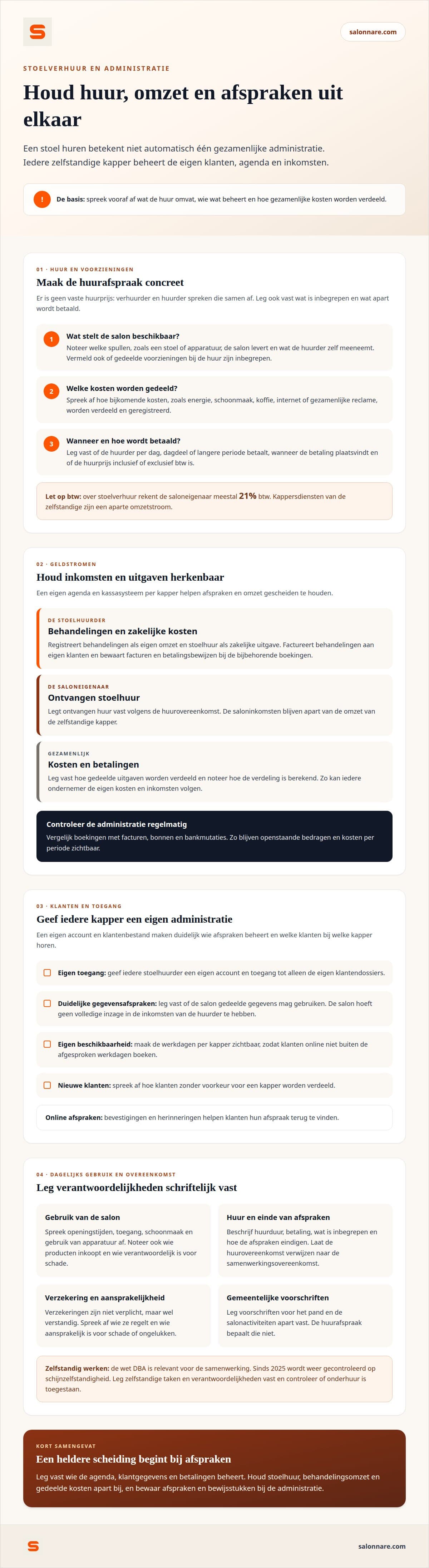
The self-employed hairdresser records treatments as their own revenue and the chair rent as a business expense. The landlord records rent received as set out in the rental agreement. State who invoices the rent and when it is paid, and keep invoices and proof of payment with the related bookings.
Give each chair renter their own calendar and till, with access to their own client records only. That makes clear which revenue belongs to whom, without the salon needing full insight into someone else's income. Own availability per hairdresser also stops clients booking online outside agreed working days. More on running your own practice: admin for the freelance hairdresser and our booth rental page.
Agreement, Dutch DBA law and false self-employment
Put use, costs and money flows in the rental and cooperation agreement: duration, payment per day or period, cleaning, equipment, insurance and liability. Insurance is not mandatory but sensible. Also check whether subletting is allowed and keep that permission with the agreement.
The Dutch DBA law is relevant: since 2025 false self-employment is checked again. A chair renter sets their own availability and manages their own clients, and in practice is not managed like a salon employee. For legal questions, consult a lawyer or accountant.
How Salonnare helps
Salonnare helps keep the admin clear when you work with chair renters: a till with VAT handling, client records and stock management, and online booking on your own website. Health data goes in an encrypted GDPR vault. The software does not replace a rental agreement; you still set those terms yourself. Questions about your situation? Get in touch or start free.

About the author
Nick van Iersel · founder of Salonnare (VanIersel Development, Waalwijk)
Nick builds Salonnare together with the salons that use it. He writes about scheduling, point of sale, privacy and everything a salon runs into as a business.
More about Nick and his articles →Get your salon admin ready
Start with one clear process for bookings, payments and client data. Start free with Salonnare and adjust it when the arrangement changes.
Start freeFrequently asked questions about chair rental
What is chair rental?
With chair rental, a self-employed hairdresser pays to use a workstation in a salon. They see their own clients on the rented chair while the salon owner serves others. Record how clients recognise the self-employed hairdresser and who to contact with questions about a treatment.
How do you set the rent?
Landlord and renter agree it together, often as a fixed amount per day or a share of revenue. For a revenue share, the market information supplied puts the usual share between 30 and 50 percent. Weigh up which facilities and products are included and work out a break-even as above.
How do I stop the tax authority seeing this as disguised employment?
Make sure the agreements match daily practice. A chair renter sets their own availability and manages their own clients. The Dutch DBA law is relevant; if the self-employed person and the salon are not clearly distinct, false self-employment can be a risk. Describe each party's responsibilities in the agreement.
How do I know I have chair rental set up properly?
You have a solid base when the terms are in the agreement and match the books. Keep later changes, compare rent payments with the agreement regularly and track changes in client access and responsibilities.
Chair rental: a risky gamble or a great opportunity?
It suits hairdressers who want to serve clients independently, but it needs clear terms. Fixed rent gives certainty up front, a revenue share moves with income. The choice depends on expected client flow, included facilities and the independence you want.