



Building client profiles and sharing them with your team: a salon approach
Single pieces of client data say little, but together they show who your clients are and what they need. In this article you build a usable client profile, work through a simple scorecard and learn how to share profiles with everyone who works with clients, without storing more than necessary.
What a client profile is in a salon

A client profile is a practical overview of what you know about a client or a client group: preferences, behaviour and needs. It comes in two forms. The profile of an existing client prepares your next contact. An ideal client profile describes the group you want to reach and decides what you highlight on your booking page or in a campaign.
Base it on real information from conversations, appointments and purchases, not on assumptions like 'all young clients want the same thing'.
Which data to record and what GDPR asks
Start with data that explains why someone books: the reason, the result they want, earlier treatments, questions and contact preference. Leave out anything without a clear purpose.
Tell clients what you record and why. According to the Dutch Autoriteit Persoonsgegevens, consent must be freely given, specific, informed and unambiguous. The EU explains that consent has to come through an active action, not a pre-ticked box. For how to handle this in your salon, read the client consent form explained.
Worked example: a scorecard with three numbers
A scorecard based on the RFM model (recency, frequency, spend) makes a profile measurable. You can check this example yourself. Score each item from 1 to 3:
- Recency: last visit at most 4 weeks ago = 3, 5 to 8 weeks = 2, longer = 1. - Frequency: 4 or more visits a year = 3, 2 or 3 = 2, 1 = 1. - Spend per visit: EUR 60 or more = 3, EUR 35 to 59 = 2, under EUR 35 = 1.
Noor (fictional): last visit 6 weeks ago (2), 3 visits this year (2), average EUR 45 per visit (2). Total 2 + 2 + 2 = 6 out of 9.
A second client (fictional): last visit 10 weeks ago (1), 1 visit (1), EUR 30 (1). Total 3 out of 9.
Rule: 8 to 9 points = regular, 5 to 7 = nurture, 3 to 4 = reactivate. Noor falls in 'nurture', so a reminder around week 8 fits. If you send a reactivation email to 40 clients with 3 or 4 points and 10% rebook, that is 40 x 0.10 = 4 bookings. At EUR 45 per visit that is 4 x 45 = EUR 180 of revenue. Salonnare's Free plan costs EUR 0 a month, so you can try this without a subscription.
How to share profiles with your team
Agree which fields you record, what they are called and who may see them. Fixed field names make everyone fill in data the same way. A plain Excel file can do for a small overview, but a client record in your salon software keeps notes, appointments and sales together.
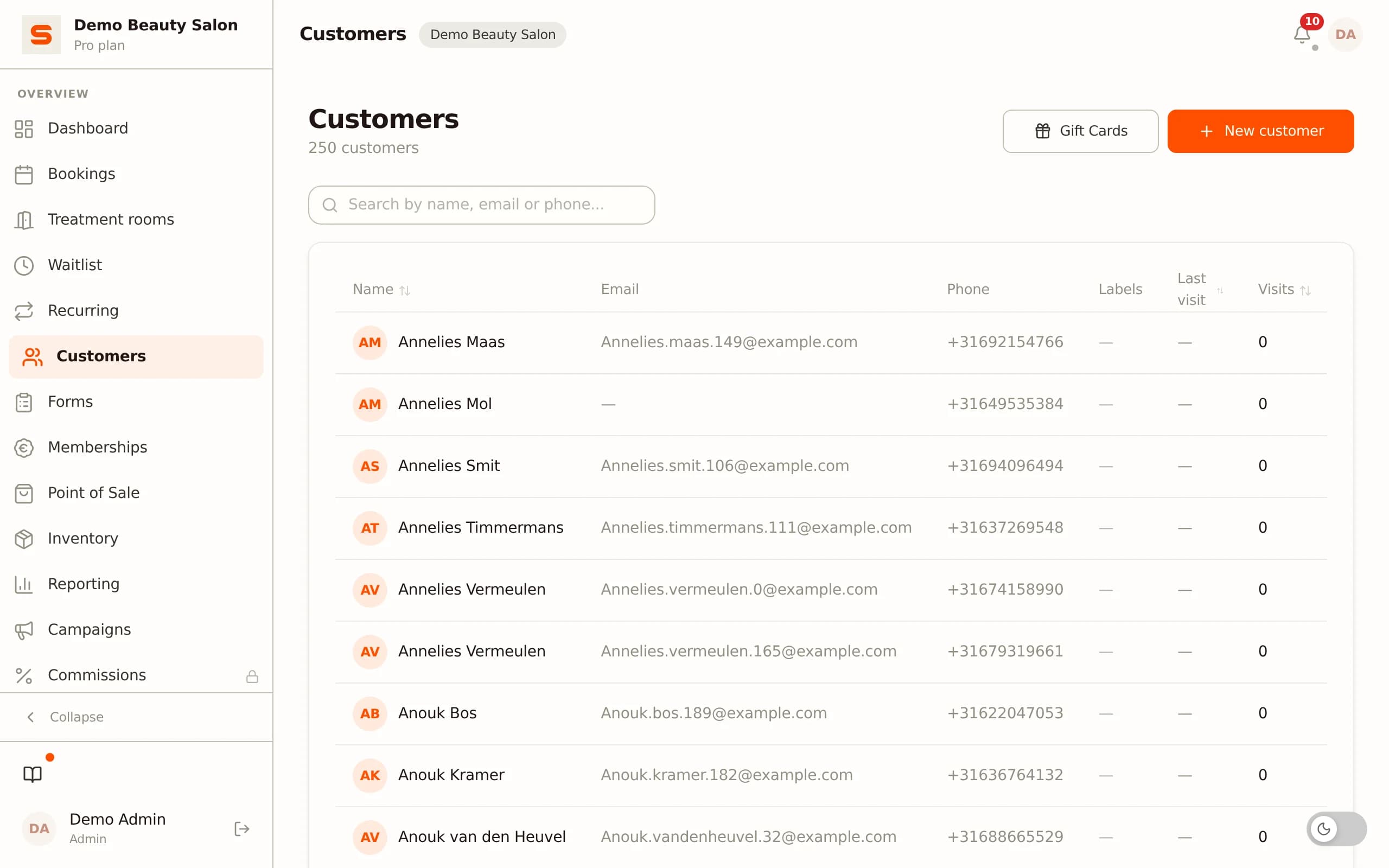
In Salonnare you find this in client management. Sensitive health data goes in the separate GDPR vault, so only staff with the right permissions can see it. For more on setting up your database, read building your salon client database.
Updating, measuring and adjusting
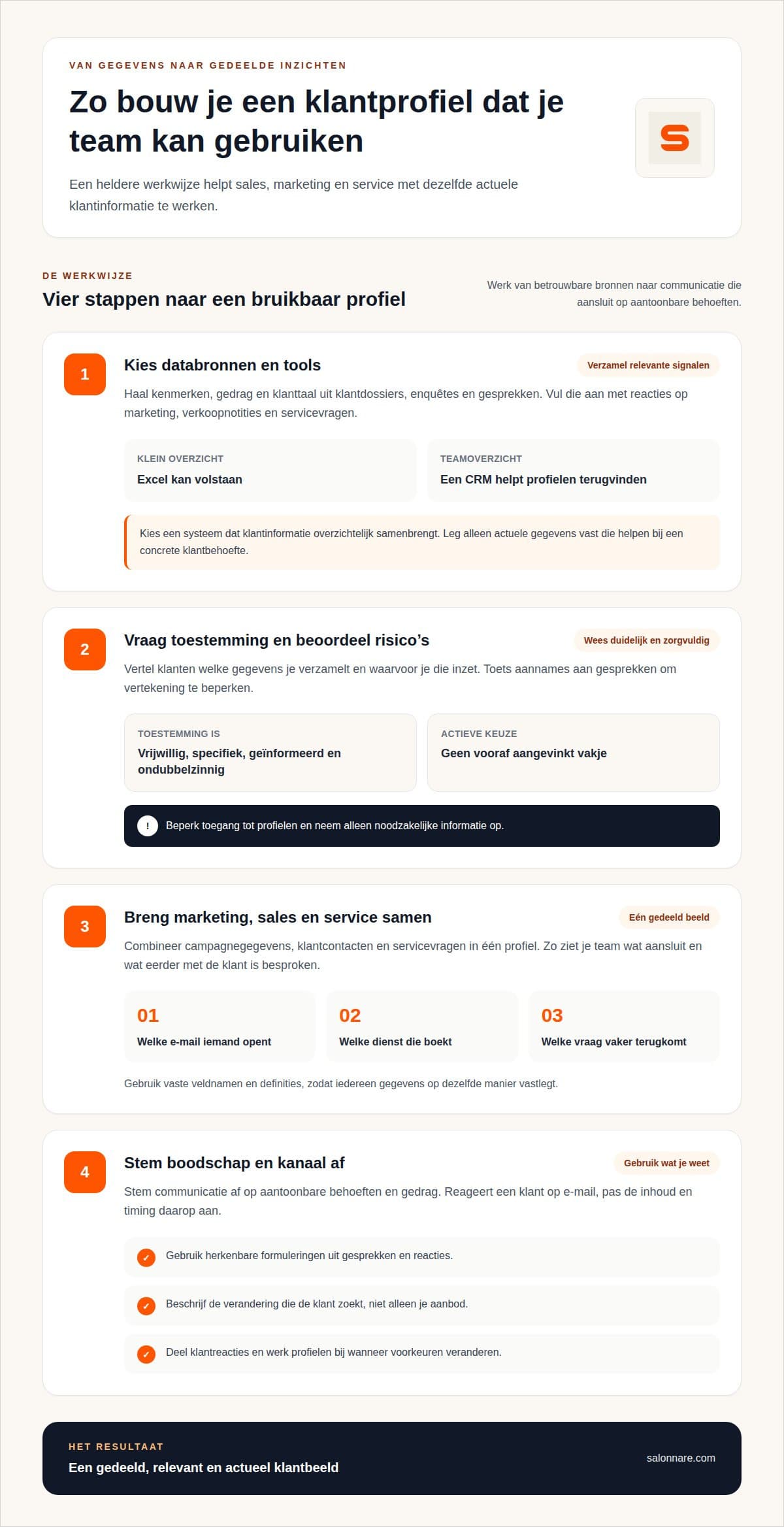
Update a profile as soon as something changes: a new preference, a new booking, a recurring question. Compare campaign responses and repeat visits before and after a change, and test subject lines with an A/B test. If a message gets little response, question the assumption behind the profile.
Your till feeds the profile too: with the point of sale you record sales and VAT, so spend per client does not need to be tracked separately.
Start with your first client profiles
Keep client records in one overview and share them with your team. The Free plan costs EUR 0 a month.
Start freeFrequently asked questions about client profiles
What is a client profile?
A practical overview of what you know about a client or client group. Use it to understand questions better, not to pin someone to a single expectation.
What mistakes do business owners make with client profiles?
Building profiles on hunches, making them so long nobody uses them, leaving outdated information in place and treating a fictional persona as a description of every real client.
What data do you need?
The reason for contact, the wanted result, earlier treatments and purchases, questions and contact preference. Leave out data without a clear purpose.
What is the difference between a client profile and an ideal client profile?
A client profile summarises an existing client, an ideal client profile describes the group you target. Use the first to prepare a contact, the second to decide what to highlight in a campaign.