



Salon Software in the Netherlands 2026 - the complete guide
Salon software in the Netherlands is no longer optional in 2026 - it is the infrastructure the modern salon runs on. Whether you are a solo hairdresser cutting three days a week or a chain owner running five locations with fifteen staff, without a central system for online bookings, VAT-correct POS, client records, inventory and marketing you lose time and revenue every year. This guide - written by the Salonnare team - covers everything you need to know: what salon software does, why a Dutch-first solution with iDEAL, VAT compliance and GDPR actually matters, the 8 core features that cannot be missing, how to pick between the 7 largest providers in the Dutch market, and how to migrate without chaos. Where relevant we reference our own product [Salonnare](/features) and competitors like [Salonized](/vs/salonized), [Treatwell](/vs/treatwell) and [Fresha](/vs/fresha), with public pricing and facts so you can make a fair comparison.
What does salon software actually do?
Salon software replaces paper agendas, loose Excel sheets and handwritten client cards with a single digital platform. The core is an online booking calendar where customers book 24/7 from your website, Instagram bio or Google Maps - without you answering the phone.
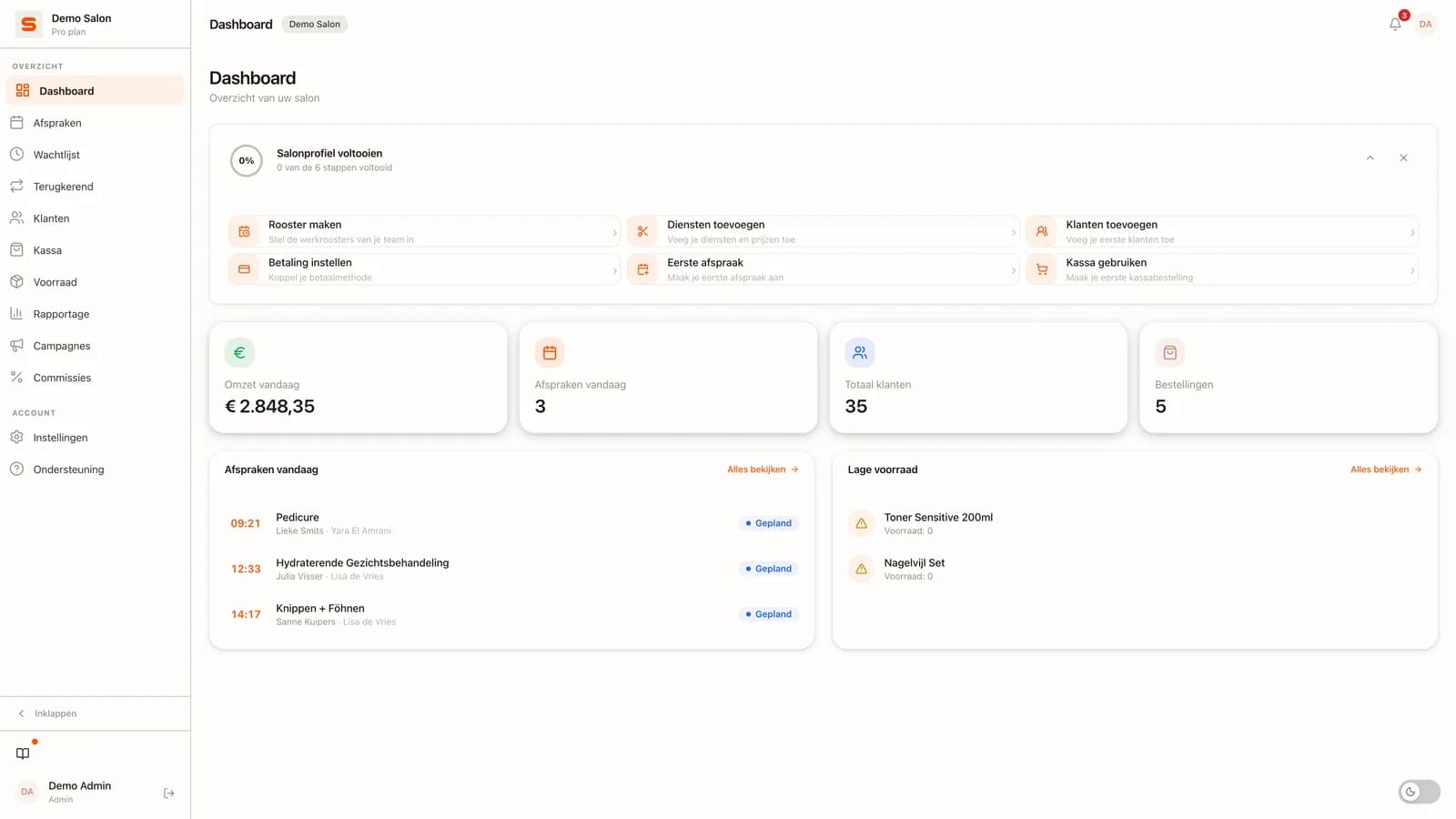
Good salon software handles four things at once. First a POS that settles services and products with the correct VAT rate (9% on services, 21% on retail in the Netherlands) and automatic receipts. Second a client record with treatment history, allergy notes, birthdays, staff preferences and consent logs for GDPR. Third inventory management for products you sell or use, with automatic deduction on POS sales and low-stock alerts. Fourth marketing automation: email reminders (and optional WhatsApp) against no-shows, birthday mailings and reactivation campaigns for inactive clients.
Modern platforms add reporting, staff rostering, multi-location support, loyalty programs and no-show fees.
The difference with generic calendar apps is the integration: one click on an appointment shows you who the client is, what treatment is booked, whether any balance is open, how much stock you have, and which campaign attracted them. That is why salon software is indispensable in 2026.
What to look for in salon software in the Netherlands
Short on time? Use this checklist - in priority order for a Dutch salon - to score any provider before you commit.
1. iDEAL support: native via Mollie or Stripe, because 70%+ of Dutch online payments run on iDEAL.
2. VAT split 9% / 21%: applied automatically on the receipt, services at 9% and retail at 21%.
3. Belastingdienst audit trail: every receipt traceable with a unique ID, date, time and unchangeable history.
4. EU data and GDPR: client records on EU servers with consent logs and on-request export.
5. Transparent pricing: a fixed monthly fee beats per-booking commission once your agenda fills up.
6. Dutch-language support: real help in Dutch, ideally within 24 hours.
7. Easy migration: CSV import for clients, services and inventory, not manual re-typing.
Score every option on these seven points, then compare the largest providers side by side on the comparison overview and check what each plan includes on the pricing page. Running a specific vertical? See hair salon software, nail salon software or beauty salon software. Ready to try it yourself? Start free with no credit card.
Why Dutch salons need an NL-first solution
The Netherlands has its own payment and compliance rules that generic international platforms often implement only partially. iDEAL is the dominant online payment method - over 70% of Dutch online payments run via iDEAL. Software that treats iDEAL as an afterthought forces customers to higher-fee credit card payments with higher drop-off.
VAT compliance is split: services (haircuts, treatments) fall under 9%, retail products under 21%. A POS that enforces one rate or requires manual switching leads to corrections that cost your accountant hours.
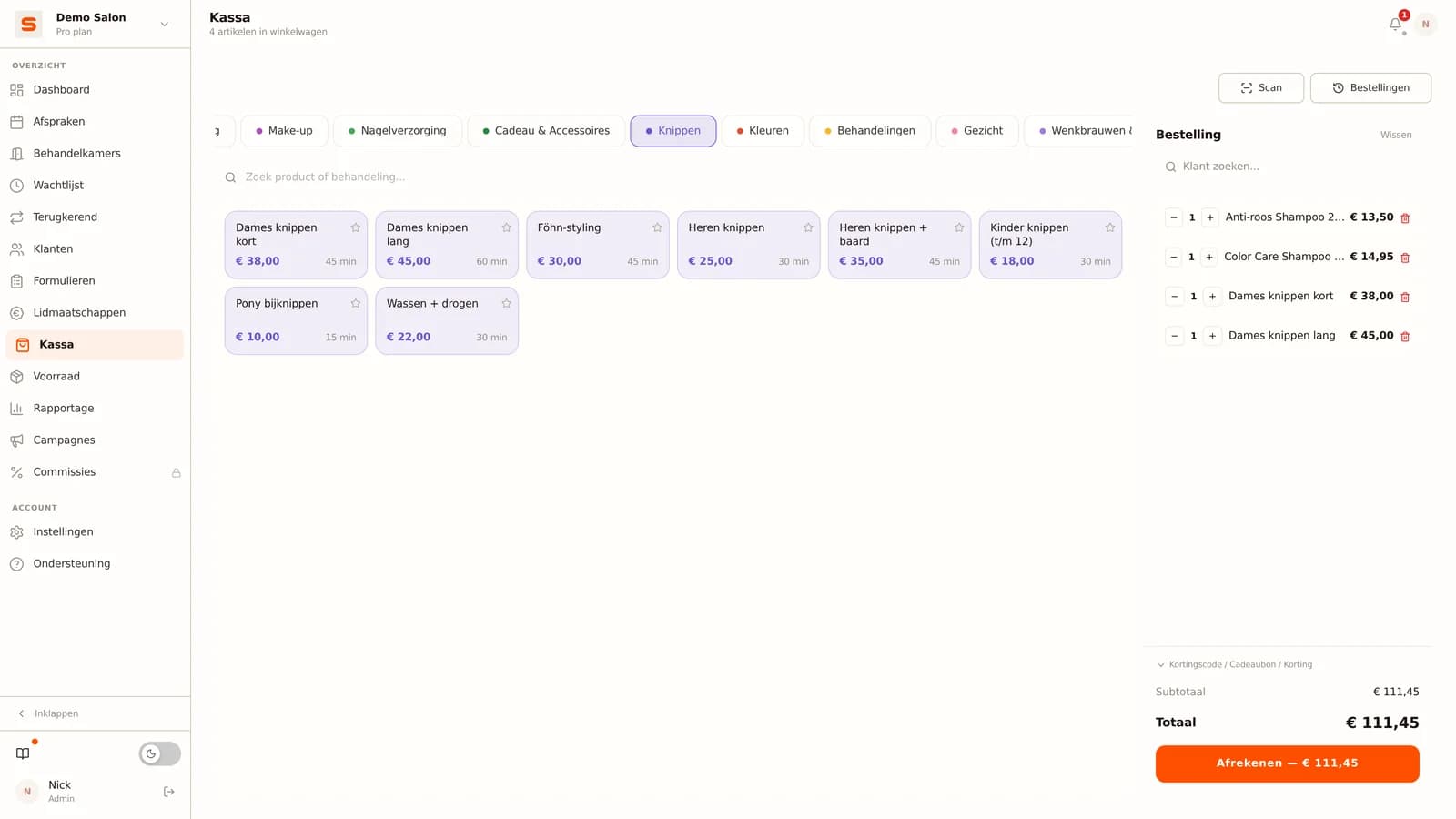
The Dutch tax authority (Belastingdienst) requires an audit trail: every receipt must be traceable to a unique transaction ID with date, time, cashier and unchangeable history. SEPA direct debit for subscriptions and memberships is the NL norm (not credit-card-first like in the US). GDPR requires client data on EU servers, consent logs preserved and on-request export working.
Dutch-language support seems trivial but is not: a 1pm Tuesday call from a client needs handling in Dutch, not via a chatbot respecting "PST business hours." All these points combined make an NL-first solution - like Salonnare or Salonized - significantly less hassle in practice than a localized version of Fresha or Mindbody.
The 8 core features compared
Not every salon needs every feature on day one, but you do want to know where each package is strong or weak.
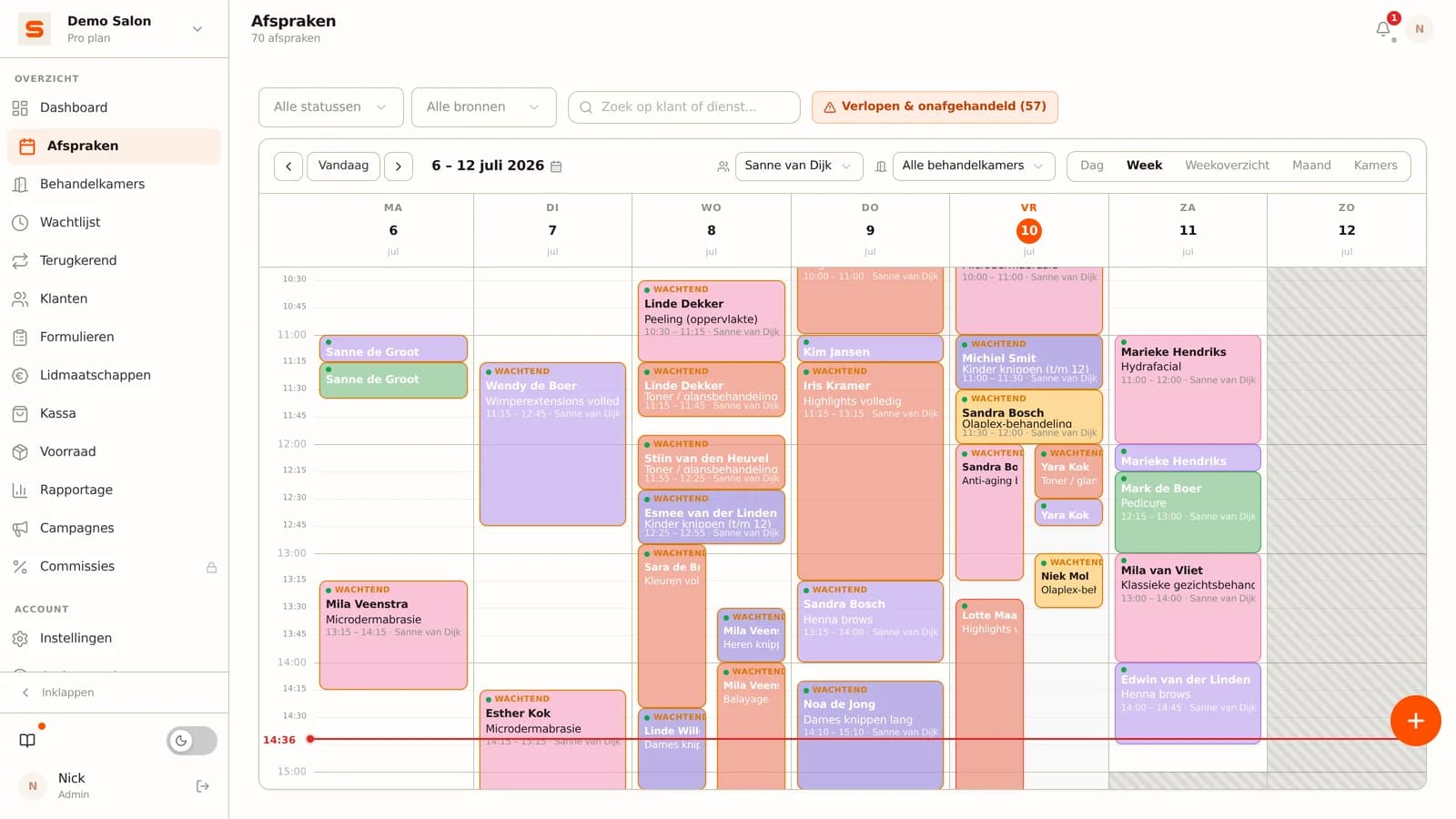
1. Online booking calendar: 24/7, mobile-responsive, with buffer between appointments, double-booking prevention and staff selection. Check: does the widget embed directly in your Instagram bio?
2. POS: VAT split 9%/21%, receipts (paper + email), payments via iDEAL, Apple Pay, card and cash, gift cards and credits. Check: own Stripe/Mollie account or forced via provider?
3. Client record (CRM): history, notes, allergies, birthday, tags, consent log, SAR export (Subject Access Request for GDPR). Check: can you merge duplicate clients?
4. Inventory management: SKUs, purchase prices, sale prices with margin, automatic deduction on sale, low-stock alerts, incoming deliveries. Check: does multi-location inventory sync?
5. Marketing automation: email + WhatsApp, 24h/2h reminders, birthday mails, 60-day reactivation. Check: custom templates or only defaults?
6. Multi-location + staff: rostering per location, commissions per staff member, performance dashboards. Check: separate tier or included?
7. Reviews + reputation: post-treatment automatic Google review link, negative feedback intercept, review widget on website. Check: reviews land on Google or on the software's own marketplace?
8. Memberships + loyalty: recurring billing via SEPA, points system, VIP tiers, subscription clients with inclusive treatments. Check: money direct to your account via SEPA or through a middle layer?
These eight form the 95% solution for nearly every salon. See the complete feature list for how Salonnare handles each point.
How to pick the right salon software: 7 questions
Picking is easier when you ask the right questions.
Q1: what is my real monthly budget including transaction fees? Many salons compare on monthly subscription and forget 1.19% + €0.20 per online payment at 80 bookings of €45 average already adds €73/month in extra fees. Always calculate total cost at your volume.
Q2: do I scale up smoothly or hit walls? Check whether going from 1 to 5 staff forces you into a tier twice as expensive.
Q3: how NL-compliant is the software really? Ask specifically about VAT split, iDEAL primacy, Belastingdienst audit trail and EU server location.
Q4: do I get Dutch-language support within 24 hours? Test this before switching - send a question on a Friday afternoon and see when the reply lands.
Q5: which integrations will I need now or soon? Google Business review automation, WhatsApp Business, accounting (Moneybird, Exact), payroll - not every package has all.
Q6: what does migration look like? CSV import for clients, services, inventory should work out of the box. Manual data entry for 2000 client cards is a red flag.
Q7: am I locked into an annual contract or monthly cancelable? Modern SaaS is monthly without penalty; enterprise platforms like Shortcuts and Mindbody often use annual contracts with implementation fees.
Shortlist on these seven questions and you rarely fall for glossy demos that miss your actual workflow.
Pricing models explained
Salon software roughly uses three pricing models you need to keep separate.
Model 1: subscription (fixed monthly fee). You pay for instance €29 or €59 per month, regardless of booking volume. Pro: predictable. Con: relatively expensive with low volume. Examples: Salonized (€30+/mo), Salonnare (€0/€29/€59), Da Vinci (€27.95/mo).
Model 2: commission per booking. You pay a fixed amount or percentage per booking through the platform. Pro: no fixed cost in a quiet month. Con: adds up fast in busy months and part of the customer relationship is often platform-owned. Examples: Treatwell (€2.50-3.50 per booking + new-client extra fee), Booksy Boost (up to 20% on marketplace bookings).
Model 3: transaction markup. Software is free or cheap but you pay a surcharge on every online payment. Pro: low barrier. Con: heavy online volume ends up pricier than a subscription. Example: Fresha, which was free for years and since 2025 charges a paid subscription plus 1.19% + €0.20 per online transaction.
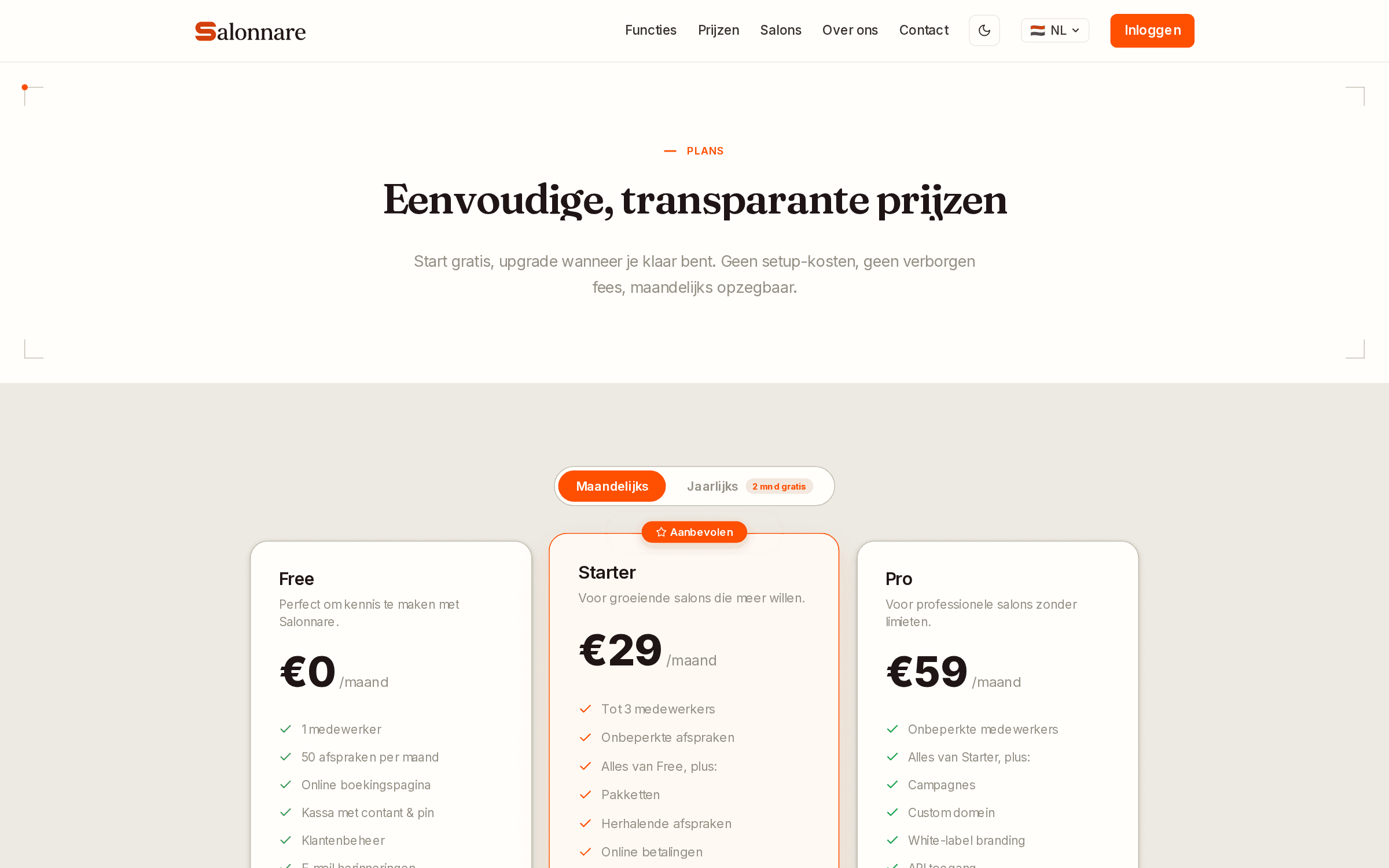
Hybrids exist: Booksy combines freemium + Pro subscription + Boost commission. Salonnare deliberately chose flat-fee with only a low, fixed platform fee of 0.5% (min. €0.30) per online payment: you connect your own Stripe or Mollie account and negotiate processing fees directly with your bank. For most NL salons with reasonable online volume this is the cheapest total cost.
Top 7 providers in the Netherlands 2026
Salonnare (disclosure: our own product): Dutch SaaS since 2026, flat-fee €0/€29/€59, own Stripe/Mollie account, modern warm V2 UI, native VAT split, forever free tier with 1 staff member and 50 bookings/month. Based in Waalwijk, support in 5 languages. Best for starters and growing salons wanting flat-fee.
Salonized (NL-based since 2013, ~10,000 salons): most well-known NL player, pricing from €30/month without a free tier, advanced marketing and memberships in higher tiers, dated UI. Best for established salons trusting brand recognition. See Salonnare vs Salonized.
Treatwell: marketplace + software combo, software from €50/mo plus €2.50-3.50 commission per booking + new-client fees. Best if you purely want acquisition and are willing to share some customer relationship. See Salonnare vs Treatwell.
Fresha: international (450,000+ salons), software paid since 2025 (per independent overviews around €14.95/mo), monetization via 1.19% + €0.20 per online payment, app-first, English support. Best for low-online-volume salons or international clientele. See Salonnare vs Fresha.
Booksy: mobile-first from Poland/US, freemium + $29.99/month Pro + Booksy Boost commission (up to 20% on marketplace bookings). Best for phone/tablet-first workflow with younger audience. See Salonnare vs Booksy.
Da Vinci: Dutch, Windows desktop legacy, €27.95/mo, strong hair-industry roots but limited mobile and online-booking is an add-on. Best for desktop-only salons without much online demand. See Salonnare vs Da Vinci.
Mindbody: US enterprise platform, €130-140+/month, deep functionality for spa chains and wellness studios, English support, annual contracts. Best for large chains with their own IT team. See Salonnare vs Mindbody. For a complete listicle including alternatives, see Salonized alternatives.
For which salon size is Salonnare the logical choice?
No single package is best for everyone, and we would rather say that honestly. Salonnare is built for solo salons, growing salons and small chains - as a guideline up to about 10 staff and 1 to 3 locations. For that group it is the logical choice: a free entry point, a fixed monthly price with no per-booking commission, native iDEAL and VAT split, an encrypted GDPR health vault and a modern interface that new staff pick up quickly.
Do you run a large chain with dozens of locations across several countries, need class scheduling for 50+ group classes per week, or work with your own IT team and complex franchise reporting? Then you can deliberately look at an enterprise platform like Mindbody - it is built for that scale. For the remaining roughly 90% of the Dutch salon market - the independent hairdresser, the nail studio, the beauty salon and the small chain - a lighter, NL-first platform like Salonnare delivers less hassle and lower costs in practice. The right question is not "which package has the most features", but "which package fits my size, growth stage and market". Start free with the Free plan if you like and grow into Starter or Pro when your salon calls for it.
Migration: how to switch without chaos
Switching from old software or paper to a new system looks scary but with a set playbook it is usually done in one business day.
Step 1: export your data from the current system. Salonized, Da Vinci and most platforms allow CSV export from the dashboard - clients, appointments, services, products, staff.
Step 2: create a free account on the new software. Salonnare Free or Fresha are handy test environments where you configure without paying.
Step 3: import clients and services via CSV uploader. Mapping issues (different column names) take 10 minutes to resolve.
Step 4: configure your basics - opening hours, staff, rostering, service menu with prices and duration, VAT rates, email templates.
Step 5: connect payments via Stripe Connect or Mollie OAuth. Done once with your business number and bank account; after that iDEAL payments land directly in your account.
Step 6: place the booking widget on your site (a copy-paste `<script>` snippet) and update booking links in Google Business, Instagram bio and WhatsApp Business.
Step 7: notify regular clients via one email: "Our booking system has been upgraded; book here." Salonnare can send this automatically on your first campaign.
Step 8: run the old system 30 days in parallel for historical reference, then cancel. Most salons switch on a quiet Friday evening and are fully live by Monday morning.
Don't hesitate to reach support - at Salonnare we help with CSV mapping and first setup for free.
Common mistakes when choosing salon software
The five recurring mistakes we see.
Mistake 1: comparing on starting price instead of total cost. €0/month sounds great until you calculate that 1.19% per transaction at your volume is €80/month. Always calculate total cost including transactions.
Mistake 2: underestimating commissions. Marketplace platforms look cheap per booking (€2.50) but 80 bookings × €2.50 = €200 on top of any software subscription. For established salons with their own client base a flat-fee is almost always cheaper.
Mistake 3: skipping Dutch-language support. On a busy Saturday with a customer unable to pay you do not want an English chatbot. Test support responsiveness before switching.
Mistake 4: forgetting the migration path. Not every software accepts CSV imports for every field (notes, birthdays, consent logs). Check before buying - nothing is pricier than manually retyping 2000 client cards.
Mistake 5: neglecting inventory in your choice. Salons selling products lose revenue on inventory errors (sold out when a customer asks, dead stock in slow SKUs). Good inventory integration with POS measurably helps.
Salonnare's complete feature list shows how we address these pitfalls, but the principle applies to every vendor: compare on your actual workflow, not on the marketing page.
Trends 2026: what is changing in salon software?
Four trends define salon software in 2026 and beyond.
Trend 1: AI-driven no-show prediction. Systems analyze historical client behavior (booking pattern, last-minute cancellations, payment history) to score no-show risk per appointment. On high risk the system automatically requests a pre-authorization fee via Stripe. Salonnare rolls this out in 2026 as part of the Pro plan.
Trend 2: WhatsApp-first booking. Over half of Dutch clients aged 25-45 prefer booking via WhatsApp. Software integrating WhatsApp Business API - with automatic confirmations, reminders and reactivations - gains ground on classic email reminders in 2026.
Trend 3: booth rental economy. More hairdressers and therapists work as self-employed in a shared salon (booth rental) instead of employees. Software must support this with per-stylist Stripe Connect payouts, separate VAT filings and per-therapist commission calc.
Trend 4: marketplace consolidation. Treatwell and Fresha consolidate booking traffic but a counter-movement grows of salons wanting bookings via their own Google Business + site without commission. That pressures pure marketplace models. Coming years we expect a clear split: marketplaces for pure acquisition, own software for retention and margin.
Choosing salon software in 2026 you do well to weigh these trends.
What makes Salonnare different?
| Salonnare | Other NL players | |
|---|---|---|
| Pricing | €0 / €29 / €59 flat-fee | €30+/mo without free tier |
| Transaction fees | Own Stripe/Mollie | Often forced markup |
| iDEAL + VAT | Native NL-first | Often localized |
| Support languages | NL/EN/DE/FR/ES | NL/EN (most NL players) |
| UI | Modern warm V2 design | Dated or app-first |
| Multi-location | Coming soon | Higher plan at competitors |
| Google review automation | Coming soon | Add-on or missing |
| Cancel anytime | Monthly, no penalty | Often annual contracts |
Start free with Salonnare today
Salonnare is built for Dutch salons: iDEAL, VAT-correct, GDPR-compliant and multilingual support. Free tier forever, no credit card, live within an hour.
Start freeFrequently asked questions
What is salon software?
Salon software is a central digital platform combining online bookings, POS, client records, inventory and marketing for a salon. It replaces loose agendas, Excel sheets and paper cards with one system where clients book 24/7, payments settle with correct VAT and client data stays GDPR-compliant.
What does salon software cost in the Netherlands?
Prices range from €0/month (Salonnare Free) to €130+/month (Mindbody enterprise). The most common range for small to mid Dutch salons is €29-59/month. Always calculate total cost: a free plan with 1.19% transaction fees can be more expensive at high online volume than a €29/month flat-fee.
Can I use iDEAL in salon software?
Yes, Dutch salon software like Salonnare and Salonized supports iDEAL natively via Mollie or Stripe. International platforms like Fresha and Mindbody have limited iDEAL support. For a Dutch salon where 70%+ of online payments run via iDEAL, native support is essential for low checkout drop-off.
Which salon software is best for a small salon?
For solo salons and 1-2 staff, Salonnare Free (€0) is the logical free start; Fresha was once free but since 2025 charges a paid subscription. Salonnare wins for the Dutch market thanks to iDEAL, VAT split and Dutch-language support. Scaling to 2-3 staff, move to Salonnare Starter (€29). See [Salonnare vs Salonized](/vs/salonized) for details.
Does my client data need to be in the Netherlands or EU?
Under GDPR client data must sit on EU servers at minimum unless you have explicit consent for transfer outside the EU. Salonnare runs fully on EU data centers. US platforms like Mindbody and Booksy often use Standard Contractual Clauses; allowed but requires extra documentation in your processor register. Always verify the DPA before choosing.
How long does migration to new salon software take?
For a standard salon with fewer than 2000 clients and 5000 historic appointments, migration usually takes 4-8 hours: export (30 min), import (30 min), configuration (2-3 h), widget on site (30 min), client notification (1 h). Large chains with 10,000+ clients typically plan a week with vendor support.
Does salon software support NL VAT split 21% / 9%?
Dutch salon software (Salonnare, Salonized, Da Vinci) supports VAT split natively - per service or product you pick 9% (most services) or 21% (retail products) and the POS calculates automatically. International platforms often require manual per-service config, which is error-prone during tax audits.
Can I connect my own Stripe or Mollie account?
Salonnare and Shortcuts let you connect your own Stripe or Mollie via OAuth, so transaction fees are negotiated directly with the bank and iDEAL payments land immediately in your account. Fresha and Treatwell force payments through their own processor with a 1-2% markup.
What is the difference between salon software and a marketplace like Treatwell?
Salon software (Salonnare, Salonized) is your own system for bookings and backoffice - clients come via your own channels (Google, Instagram, site). A marketplace (Treatwell, Fresha Marketplace) is a platform where clients search by location and service; you pay commission per booking in exchange for access to their audience. Many salons combine: own software as backoffice, marketplace purely for acquisition.
Does salon software work on my phone?
Yes, modern salon software is web-based and works on any device with a browser. Salonnare ships a Progressive Web App installable on iOS and Android that feels like a native app. Booksy and Fresha have true native apps; Salonized and Da Vinci are primarily desktop-oriented with limited mobile UI.