



VAT for the beauty salon: which rate applies to cosmetic treatments?
Many beauty specialists assume they charge the same low VAT rate as a hairdresser. In most countries that is not the case: cosmetic treatments in a beauty salon usually fall under the standard VAT rate, while genuine hairdressing work often qualifies for a reduced rate. That difference surprises salon owners regularly, and a wrong rate on your receipts can lead to an assessment during a tax audit. This article explains how VAT works for the treatments and products in a beauty salon, where the line runs with hairdressing, which special cases apply around medical and pedicure treatments, and how to set up your till so every rate is correct automatically. We use the Netherlands as a worked example throughout. VAT rules and percentages differ per country, so if you operate elsewhere, always check your local rate with your tax authority or accountant. This is not tax advice.
Standard or reduced rate: why the beauty salon differs from the hairdresser
Most VAT systems have a standard rate that applies to almost everything, plus one or more reduced rates for specifically designated goods and services, and sometimes a zero rate for cross-border trade. The core rule is the same everywhere: everything falls under the standard rate unless a service or product is expressly designated for a reduced rate or is exempt.
The Netherlands illustrates this well. There the standard rate is 21%, the reduced rate is 9%, and hairdressing work is explicitly named on the reduced-rate list: cutting, washing, blow-drying, colouring, perming, shaving and trimming hair all qualify for 9%. Cosmetic treatments are not on that list. In fact, the Dutch tax authority names facial treatments, applying make-up, colour and make-up advice, tanning-bed hire, and manicure and pedicure work as examples of services that fall under the standard 21% rate.
So the rule of thumb for a beauty salon is: your treatments carry the standard rate unless you are demonstrably doing hairdressing work or a treatment falls under an exemption. A facial, a waxing session, a lash treatment or a manicure is therefore charged at the standard rate as a rule.
That the beauty specialist pays a higher rate than the hairdresser has been a point of debate in the industry for years, with trade bodies lobbying for parity. Until the rule officially changes, assume the standard rate for cosmetic treatments. Keep an eye on updates through your tax authority, but do not price ahead on a lower rate that does not yet exist. And remember: the exact percentages here are the Dutch ones - confirm the numbers that apply in your own country.
Per treatment and product: which VAT rate applies?
The list below covers the most common situations in a beauty salon, using the Dutch standard rate (21%) and reduced rate (9%) as the example. Use it as a starting point and check your concrete offering with your tax authority or accountant.
Standard rate - cosmetic treatments (the rule): - Facials and skincare treatments - Hair removal and waxing (legs, face, brazilian) - Lash extensions, lash lift, tinting of lashes and brows - Manicure, gel polish, acrylic and gel nails - (Non-medical) pedicure and foot care - Applying make-up and bridal make-up - Colour and make-up advice - Tanning-bed hire - Massages that are purely cosmetic or relaxing in nature
Standard rate - products you sell separately: - Skincare products, serums and creams the client takes home - Make-up, nail polish and accessories at the till - Gift packaging and loose retail
Reduced rate - only genuine hairdressing: - Cutting, washing, blow-drying, colouring, perming and styling hair - Shaving and trimming beards
If your salon also does hair, you charge that part at the reduced rate and the cosmetic treatment at the standard rate. It comes down to the nature of the service, not the sign above your door. A salon that both cuts hair and gives facials simply runs two rates side by side.
Products you consume during a treatment (the mask you apply to the face, the wax, the gel polish you use) are part of the service and follow its rate. Sell that same product to take home and it becomes a separate retail sale at the standard rate.
Exception: medical treatments and (medical) pedicure
Besides the standard and reduced rates there is a third option: exemption. Certain treatments with a medical character are exempt from VAT under the healthcare exemption. Exempt is not the same as a zero rate: you charge no VAT to the client, but you also cannot deduct the VAT on your purchases.
The best-known example is the medical pedicure. Foot care can take on a medical character, for instance with a diabetic or rheumatic foot, or when the treatment is needed to prevent health risks. In those cases the treatment may be exempt instead of taxed at the standard rate. In the Netherlands the tax authority aligns this with healthcare legislation and case law from the Supreme Court. An ordinary, cosmetic pedicure stays at the standard rate.
For some specialist skin treatments there is ongoing discussion about a medical exemption where not treating would pose a health risk to the client. This is a sensitive and evolving topic: whether an exemption applies depends on the precise treatment, the training and registration of the practitioner, and an individual assessment by the tax authority.
Handle this carefully. Do not label a treatment as exempt simply because it suits you: an unjustified exemption gets corrected with an assessment. Unsure whether part of your offering is medical and possibly exempt? Have each treatment assessed by your accountant, or seek certainty from your tax authority before you change the rate.
Mixed transactions: splitting a treatment and a retail product
In practice many salon visits end with both a treatment and a product purchase. A client books a facial and takes home a serum, or has a haircut and buys a care product. Such mixed transactions require you to give each item on the receipt its own rate.
The core rule is: every line on the receipt has its own VAT rate. The client pays one total, but underneath the receipt splits the VAT neatly per rate. That is exactly what you need for your VAT return, where you report turnover per rate.
Where it goes wrong is with salons that set the till to one fixed rate, or that bundle a product into the treatment price without watching the split. Ringing up quickly on a busy day without separating the rates produces a return that does not reflect reality.
So always put a separately sold product as its own line on the receipt, not hidden in the treatment price. Do that consistently and record it in your till configuration, and every team member rings it up the same way, keeping your books correct by default. For more on the numbers side, read our article on beauty salon accounting.
How Salonnare sets your till up VAT-correct
In Salonnare you set the right VAT rate per service and per product. You assign the standard rate to a facial, the reduced rate to a haircut, and the standard rate to a retail product. After that the point-of-sale system applies the correct VAT split automatically on every checkout, with no manual calculation.
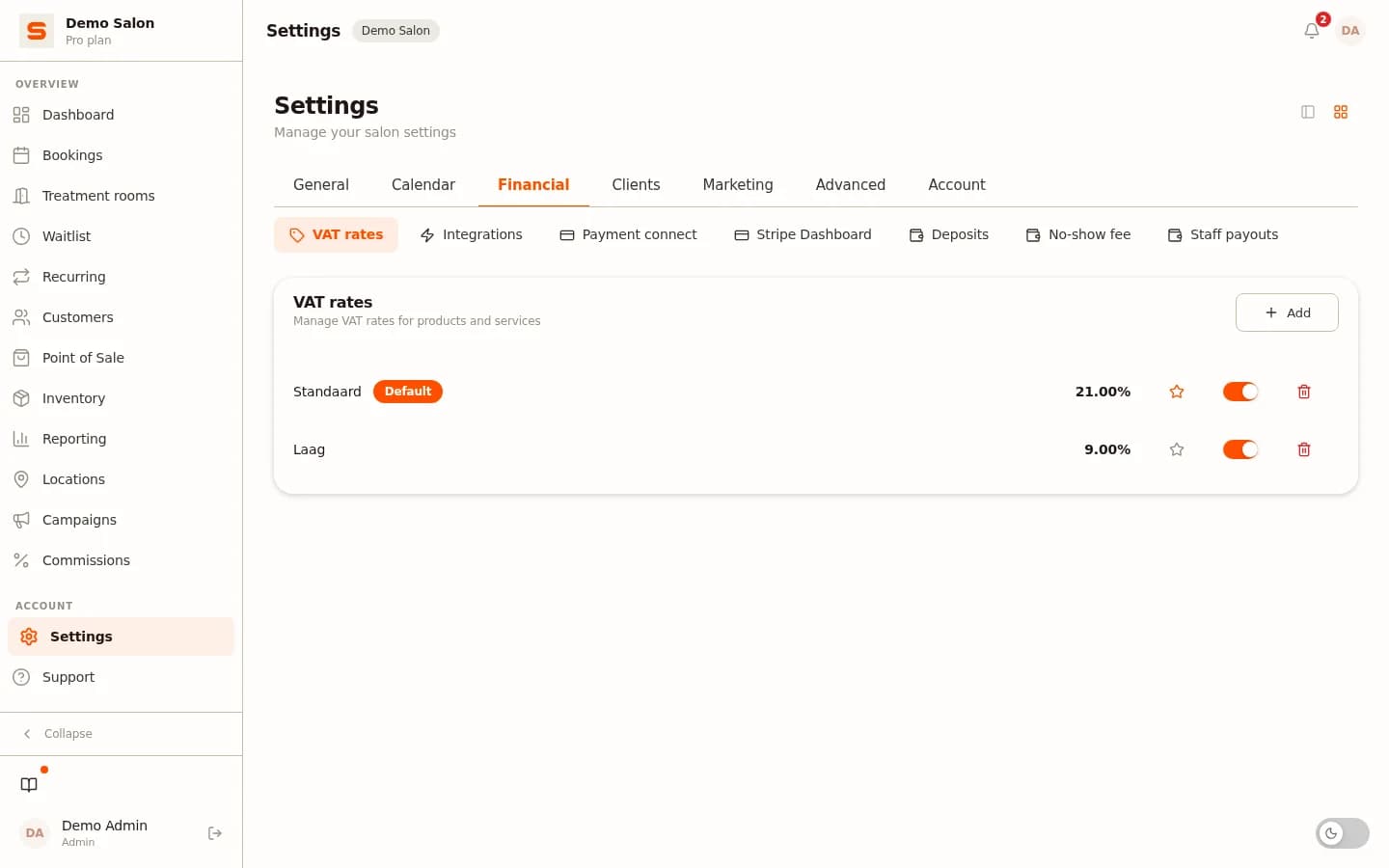
Rate per service and product. Through the settings you pick the rate per treatment and product. A beauty specialist ringing up a facial and a serum at once gets the correct combined receipt with the VAT neatly split.
Receipt with VAT breakdown. Every receipt shows the VAT amounts per rate in the footer: how much was charged at each rate. That applies both to the print and to the digital receipt emailed to the client. Transparent for the client, and for you the basis of your remittance per rate.
Reporting per VAT rate. In the reports you see how much turnover was realised per rate for each period. That overview lines up with the layout of the VAT return, so you fill in the boxes from your till figures without adding up by hand. Your books are audit-ready.
Unsure whether your configuration is right? During the trial period, ring up a test transaction with a mixed receipt: one treatment and one product. Check that the split is correct before you go live with clients. Payments via iDEAL and card go to your own account, and your data sits GDPR-compliant in the EU.
Three tips to avoid VAT mistakes
Even when the theory is clear, mistakes creep into daily practice. These are the three most common causes and how to prevent them.
1. Check the rate for every new treatment. When you add a new service, set the correct VAT rate straight away. Do not rely on a default, especially if you took over a till system or have just started. A cosmetic treatment gets the standard rate, genuine hairdressing the reduced rate.
2. Put retail products on a separate line. A team member who sells a product alongside the treatment must put it as its own line on the receipt, not merged into the treatment price. Under time pressure at a busy front desk this regularly goes wrong. Cover it briefly when onboarding new staff.
3. Do a quarterly spot check. For the VAT return you need turnover per rate. Each quarter, review a few receipts and confirm the split is correct. Five minutes of checking per quarter saves a lot of correction work later.
Conclusion: charge cosmetic treatments correctly
For most beauty salons the rule is clear: cosmetic treatments fall under the standard VAT rate, not the reduced rate that applies to hairdressing. Products sold separately are charged at the standard rate too, while certain medical or medical-pedicure treatments may fall under an exemption. When in doubt about your specific offering, have it assessed by your tax authority or accountant, and confirm the exact percentages for your own country.
The good news: with a till that knows the right rate per service and product, you no longer have to think about this while ringing up. Salonnare splits the VAT automatically, puts it on the receipt and reports it per rate, ready for your return.
You can simply try it. Salonnare has a permanently free plan (Free, EUR 0 per month, for 1 team member and 50 bookings per month). As your salon grows you move to Starter (EUR 29) or Pro (EUR 59) per month, a fixed price with no marketplace commission per booking (just a platform fee of 0.5%, min. €0.30, per online payment). The interface comes in five languages, and there is both a web app and a native app.
Set your till up VAT-correct this week: create a free account and ring up your first test receipt before you go live.
Frequently asked questions
Which VAT rate applies to a facial in my beauty salon?
As a rule, the standard rate. Cosmetic treatments such as facials, waxing, lashes and manicure fall under the standard VAT rate. They are not on the list of services that qualify for the reduced rate; that list is for hairdressing work. In the Netherlands, for example, the standard rate is 21% and the reduced rate 9%. If you are unsure about a specific treatment, for instance because it has a medical character, check it with your tax authority or accountant, and confirm the exact percentage for your own country.
Why does a hairdresser pay a lower rate than a beauty specialist?
Because hairdressing work (cutting, washing, blow-drying, colouring, perming, shaving, trimming) is expressly designated for the reduced VAT rate. Cosmetic treatments are not on that list and therefore fall under the standard rate. This difference has been a point of debate in the industry for years, but until the rule officially changes, the standard rate applies to the beauty salon.
Can a pedicure or skin treatment be exempt from VAT?
Sometimes. Treatments with a medical character can fall under the healthcare exemption, for example a medical pedicure for a diabetic or rheumatic foot. Exempt means you charge no VAT but also cannot deduct the VAT on your purchases. An ordinary, cosmetic pedicure stays at the standard rate. Whether an exemption applies depends on the treatment and the assessment by the tax authority, so have this checked per case before you change the rate.
How do I set the right VAT rate per service in my till?
In Salonnare you pick the rate per service and per product: the standard rate for cosmetic treatments and retail products, the reduced rate for any hairdressing work. At checkout the till applies the split automatically, shows the VAT per rate on the receipt and collects turnover per rate in the reports, ready for your VAT return.
What if I applied the wrong VAT rate in the past?
If you structurally remitted too little VAT, that can lead to an assessment; VAT you overpaid you can reclaim through a correction return. In both cases it is wise to report this to your tax authority yourself before they discover it, which gives you a more favourable position. An accountant helps you map the scope and choose the right approach.