



How to increase the average spend per client in your salon: break the receipt into three parts
A full diary shows how many clients come in, but not what a single visit earns on average. That number, the average spend per client, is one of the few levers you can pull without extra chairs, extra hours or extra clients. And you do not need to sell harder to move it. In this article you first calculate the average spend cleanly. Then you break the receipt into three parts: the treatment, an add-on and a product. That shows you which part is lagging, so you can pick one lever per period, with advice that fits what the client tells you.
What you actually divide: visits, not clients
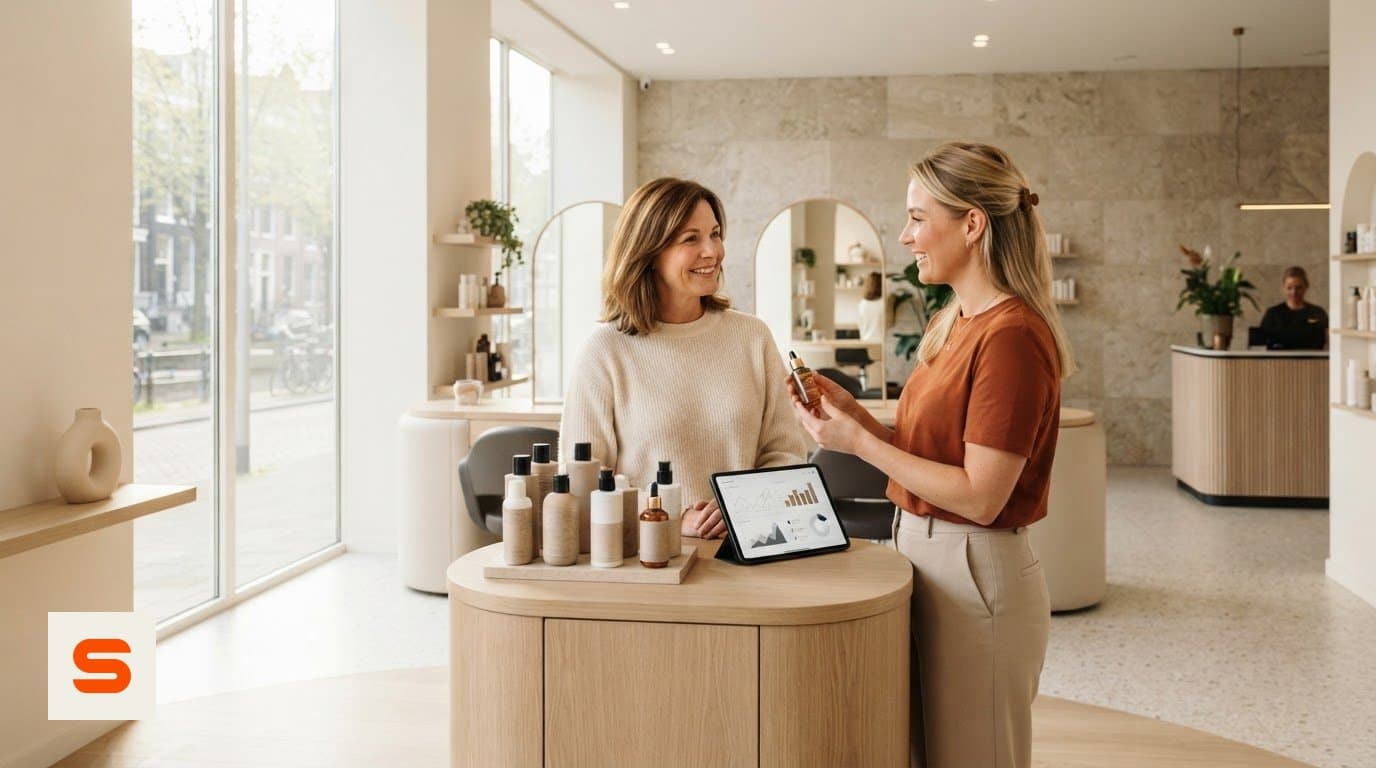
The average spend per client is the revenue from visits in a period, divided by the number of visits in that same period. The name says "per client", but you count visits. Someone who comes in twice in a month counts twice. If you count unique clients instead, you are measuring something else: what one client brings in over several visits.
What counts as revenue? Agree on one basis and stick to it: including or excluding VAT, with or without products, and what you do with a gift card (count it when sold or when redeemed). A change in that agreement looks exactly like a change in client behaviour in your figures.
Fictional example: your salon takes €2,400 from 40 visits in one month. The average spend is then €2,400 ÷ 40 = €60 per visit. This only shows the calculation and is not an industry average. A good amount does not exist apart from your own treatments and prices, so compare mainly with your own earlier periods.
Keep this number apart from two others. Revenue per period is the total, and it also rises when there were simply more visits. Client value adds up what one client spends over a longer relationship. The average spend only tells you something about a single visit, and that is exactly why it shows whether your advice at the chair changes anything.
The receipt in three parts: treatment, add-on and product
One average does not tell you where the issue is. So break down the receipt. Almost every salon receipt has at most three kinds of lines:
1. The treatment. What the client booked. This part depends on your prices and on the mix: lots of short treatments give a lower average than lots of long ones.
2. The add-on. An extra treatment added on the spot to the booked service, such as a mask, a brow shape or a gloss.
3. The product. Home care. Split this part once more: in what share of visits a product is bought, and how much is spent on products on those receipts.
As a formula: average spend = average treatment amount per visit + average add-on amount per visit + (share of visits with a product × average product amount on those receipts).
The same fictional example, broken down: of the €60 per visit, €48 is treatment and €2 is add-on. In 10 of the 40 visits (25%) someone bought a product, on average for €40. That is 25% × €40 = €10 per visit. Together €48 + €2 + €10 = €60.
Now you can see where the room is. The amount spent per product receipt is not the problem here; the fact that three out of four clients leave without home-care advice might be. Another salon might see a low treatment amount instead. Then the lever is your prices and your service mix, and for that you can read how to calculate the profit margin per treatment.
Three moments for advice without sales pressure
A higher spend does not come from a sales pitch at the till, but from advice that fits what the client tells you. There are three natural moments in a visit.
At the welcome. Briefly ask what the client wants to achieve and what they struggle with at home: dry hair, sensitive skin, little time in the morning. What you hear here decides whether an add-on or product makes sense later. Without that question, every suggestion is a guess.
During the treatment. Name what you see and what could help. For example: "Your ends are quite dry. I can add a mask today, it takes ten extra minutes." Mention the price and leave the choice to the client. If it does not fit the wish or the time, leave it out.
At checkout. Sum up in two sentences what you did and what the client can do at home to keep the result. Mention at most one product that fits, with the reason. "If you like" is not a courtesy phrase here but the core: the client decides.
If you want to develop the product side further, a home-care plan per client helps. More on the advice conversation, margin and stock is in increase retail sales in your salon.
Pick one lever per period and measure fairly
Do not pull three levers at once. Pick the part of the receipt that is lagging and change only that, for one month or one quarter. Then you also know afterwards where a difference came from.
Decide in advance which part you are improving, what you will do differently (for example: every colour client gets one home-care tip at checkout), which period you measure and which period you compare it with.
Write down the same figures each period: revenue from visits, number of visits, the average spend, and for the part you are working on its own sub-figure, such as the share of visits with a product.
Look beyond the amount. A higher spend only pays off if clients come back. Watch reactions at the chair and repeat visits in the months after. If the number of returning clients drops, the advice may have been too much.
Watch out for false differences. A price increase, a discount promotion, a month with many gift cards or a few days of closure change the average without your advice doing anything. How to compare periods fairly, with opening days and holidays included, is covered in financial reports for hairdressers.
Where to find the numbers in Salonnare
An average is only as reliable as the records behind it. So put every treatment, add-on and product on the receipt as its own line, even when the client pays for everything at once. Then you can break the average down later without recounting receipts. Salonnare's point-of-sale for salons works this way, with Dutch VAT rates per line, and is already included in the free Free plan (€0, 1 staff member, 50 appointments per month).
From the Starter plan (€29 per month) you get the reporting dashboard. It shows the average order as a fixed tile, with the change compared with the previous period. Salonnare divides revenue by the number of receipts, plus completed work without a receipt; a refund does not count as an extra receipt. You also see revenue per treatment and per product, and in the daily report the average receipt of that day. Which other reports matter is covered in salon reporting software, and how to get from daily takings to profit in salon revenue reporting.
On costs: Salonnare charges a fixed monthly price (Free €0, Starter €29, Pro €59) and no marketplace commission on new clients. Online and card payments do carry a transaction fee of 0.5%, with a minimum of €0.30. See the prices per plan or start free with Salonnare and set up your first receipts properly from day one.
Make average spend a fixed monthly number
Till, diary and client records in one system, so every treatment and every product is its own line on the receipt. Start with the free Free plan and move to Starter when you want to use the reports.
Start freeFrequently asked questions about average spend per client
How do you calculate the average spend per client in a salon?
Divide the revenue from visits by the number of visits in the same period. First decide whether you include treatments, products or both, and whether you calculate with or without VAT. Count visits, not unique clients: someone who comes in twice counts twice.
What is a good average spend per client for a salon?
There is no amount that is right for every salon. The result depends on your treatments, your prices and whether you sell products. So compare mainly with your own earlier periods, always with the same counting method, and check whether a difference comes from different services or a different number of visits.
How do you increase the average spend without pressuring clients?
Link every suggestion to what the client tells you or to the chosen treatment, mention the price and leave the choice to the client. Change one thing per period and look at reactions and repeat visits as well as the spend.
Why break the receipt into treatment, add-on and product?
Because one average does not tell you where the issue is. If the treatment amount is fine but few visits include a product, you know the lever is home-care advice and not your prices.