



Hair salon software for small business owners: the minimum you need and how to switch
You are finishing the last cut of the day when your phone buzzes again: two messages asking for an appointment and someone who wants to move tomorrow's slot. Half an hour after closing you are still typing. For a lot of small salons that is simply how the week goes. Software solves it, but most comparisons are written for salons with eight chairs and a receptionist. This article looks at the other end: one or two chairs, very little spare time and no appetite for a subscription that grows with your revenue rather than with your needs. You will read which features you genuinely need, which ones you can safely ignore for now, where the hidden costs sit and how to switch in three steps without retyping your client list.
What a small salon actually needs, and what you can skip

When you work alone or with one colleague, the test is simple: does a feature save you time this week, or only three years from now? Four things earn that first place.
A calendar clients can book into themselves. Not just a digital copy of your paper book, but a booking page you place on your own website or in your Instagram bio. The whole point of appointment scheduling software is that part of your calls and messages disappear by themselves, because people pick a slot from the sofa at nine in the evening. Here is what bookings management looks like in practice.
Automatic reminders. A forgotten appointment in a two-chair salon is a 45-minute gap you will not refill. An automatic email reminder the day before takes five minutes to set up once and nothing after that.
A client card with history. Colour formulas, allergies, what was done last time. Without it you stay dependent on your memory and loose notes.
A till that splits VAT correctly. More on that below, because it is the item small business owners underestimate most often.
What you can comfortably leave alone at the start: staff rostering, per-stylist commission calculation and detailed stock forecasting. It helps if the package offers them, so you do not have to move again later, but do not let them decide today's choice.
Till and VAT: the job that quietly costs you hours every month
For a small salon the biggest time saving is rarely in the calendar itself, but in the admin around it. You sell treatments at one VAT rate and products that do not always fall under the same one, and you have cash, card and the occasional gift card in the same drawer. Sorting that out by hand at the end of the month costs you an evening every single time.
A point-of-sale that books every receipt against the right VAT rate straight away removes the work at the source. At month end you export your revenue and VAT as a file and send it to your accountant or load it into your bookkeeping tool. Note the distinction: this is an export, not a live integration that writes into your ledger by itself. For most small salons that is exactly enough, and it saves you the connection fees a live link usually carries.
If you also sell shampoo and styling products, there is one more thing. In most European countries a trader has to keep records from which the stock position can be established, and the Dutch tax code makes that explicit in article 52 of the General Tax Act. Software that deducts sales from stock automatically settles that without any effort on your part.
Look at the revenue model, not just the price tag
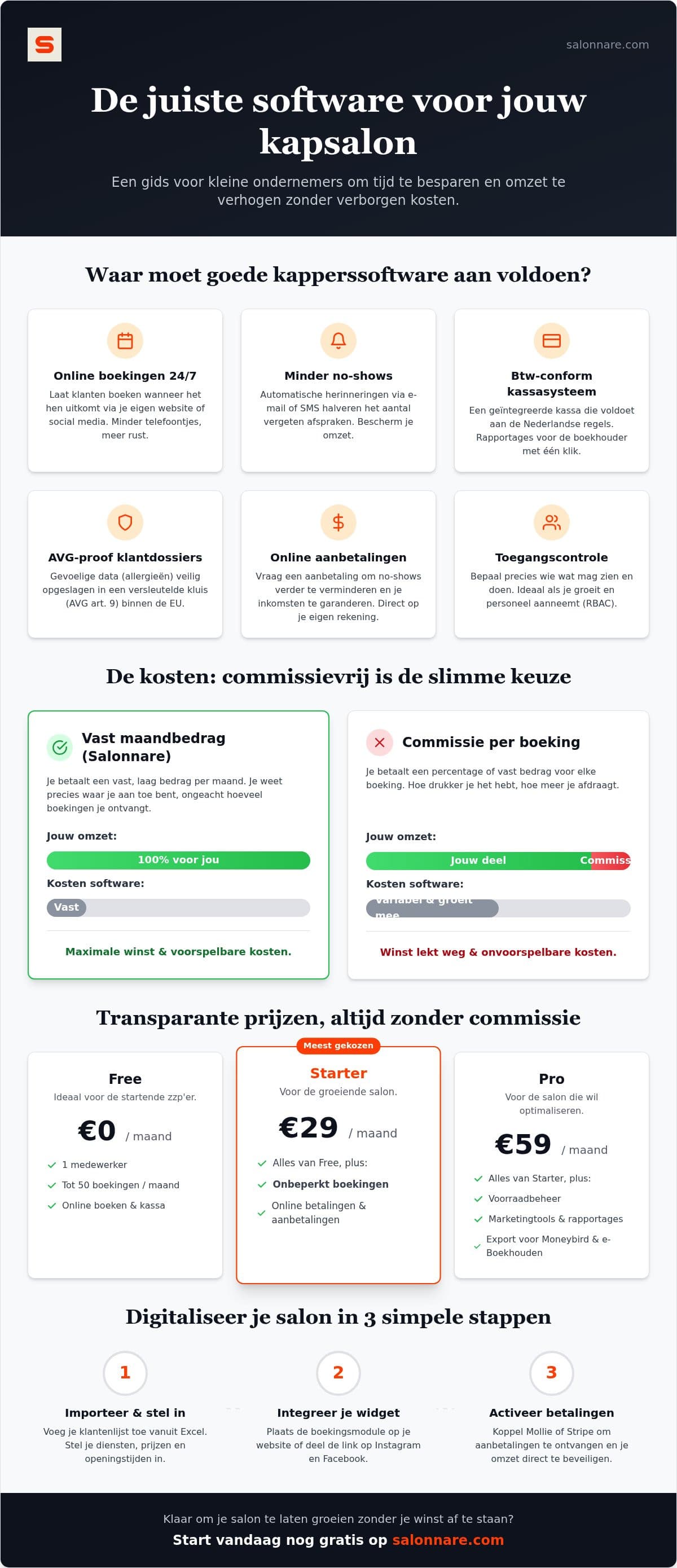
Two packages that both advertise "from zero" can differ by hundreds of euros after a year. The difference is in how the vendor earns. Broadly there are two models: a fixed monthly fee, or a percentage per booking or per new client. The second feels free at the start and gets more expensive the better you do.
Run the numbers with your own figures once. Say a platform charges 20 percent on a 45 euro treatment, that is 9 euro per booking. At five of those a week you are down almost 2,400 euro a year, precisely in the months when business is good. A fixed monthly fee does not move with it. When comparing, work through a checklist for choosing business software and ask the same three questions of every package: what does it cost per month, what is withheld per transaction, and what happens to that percentage as I grow?
Also check where the money lands. With Salonnare you connect your own Mollie or Stripe account, so online payments and iDEAL arrive directly in your own bank account. You pay the usual transaction fee to that payment provider and no per-booking commission to Salonnare on top. It also makes your revenue easier to follow, because there is no intermediary payout cycle in between.
From paper diary to online bookings in three steps
The switch itself is usually a quiet morning rather than a project week. Three steps are enough.
Step 1: get your data in without retyping. Download a CSV template for clients, services, products or appointments, fill it in using Excel or Numbers and upload it again. You see a preview of exactly what will be created before anything is saved, so a mismatched column cannot make a mess of your database. Keep your old diary around for a few weeks as a reference.
Step 2: make your availability visible. Set your opening hours and the duration per treatment, then put the booking page on your own website or in your Instagram and Facebook bio. Connect your Google Business Profile and people can book straight from search results and Maps, which is exactly the moment someone thinks about a haircut.
Step 3: connect your payment provider. With a Mollie or Stripe account you can ask for a deposit on long or expensive treatments. That is the single most effective brake on no-shows there is: someone who has paid ten euro upfront either shows up or calls to cancel.
You do not need more than that to begin with. For the Dutch market specifically, the trade association ANKO publishes material on running a hair salon as a business, from pricing to employment terms.
Privacy, access rights and what it costs
The moment you note that a client is allergic to a particular dye, or that there is a scalp condition or a pregnancy, you are recording health data. Those are special category personal data under article 9 of the GDPR, with stricter requirements than a name and phone number. In Salonnare those notes live in a separately encrypted vault, apart from your ordinary client notes, and all data sits on servers inside the EU.
If you hire someone later or rent out a chair, you decide per staff member which parts are visible. Someone can manage the calendar without seeing revenue figures or health notes. Useful to have in place now, even if you are still on your own today.
Pricing is straightforward: Free costs 0 euro per month for one staff member and 50 bookings per month, Starter costs 29 euro per month and Pro 59 euro per month. No percentage of your revenue on any of the three. Have a look at the full pricing to see what each plan includes. The app runs in five languages and works on your phone, so you can check something quickly between two clients.
Want to simply try it with your own services and prices? Start free with Salonnare and put your booking page online tonight. No credit card required, and the free plan stays free.
Frequently asked questions
Is Salonnare really free to use for a small hair salon?
Yes. The Free plan costs 0 euro per month and covers one staff member with up to 50 bookings per month. You do not need a credit card to start and the plan does not expire after a trial period. If you run into the 50-booking limit, you move up to Starter at 29 euro or Pro at 59 euro per month.
Can I move my existing client list across without retyping everything?
You can, through a CSV import. Download a template for clients, services, products or appointments, fill it in using your spreadsheet program and upload the file. Before anything is saved you see a preview of exactly what will be created, so you can still correct a column that was filled in wrongly.
Do I pay commission on bookings or iDEAL payments?
No. You connect your own Mollie or Stripe account, so payments arrive directly in your own bank account. You pay the usual transaction fee to that payment provider. Salonnare does not add a percentage per booking or per new client on top, only the fixed monthly price of your plan.
What about GDPR if I record client allergies?
Allergies, medication and skin conditions are health data and fall under article 9 of the GDPR. Salonnare stores them in a separately encrypted vault, kept apart from ordinary client notes, and you decide per staff member who may view them. All data sits on servers inside the EU.