



Difficult clients in your salon: handling negativity and anger
You don't have to accept angry behaviour to stay professional. Three principles help: take the complaint seriously, keep the conversation to the facts and protect your boundaries. This article shows how to investigate a complaint, show understanding without absorbing the negativity and respond calmly to anger. You'll also calculate what a free fix costs, so you can decide with a clear head.
1. Investigate a complaint instead of defending yourself

A client can be upset about a treatment, a haircut or the bill. Start by listening and acknowledge what they feel: "I understand this is frustrating." Then ask what exactly is wrong. They feel heard, and you find out which solution could help.
In the Netherlands, if work was not done as agreed and that is your doing, you have to fix it free of charge. So calmly review what you agreed and what went wrong.
Ask precise questions: "Which part would you like to see differently?" and "What solution would help you?" For a cutting mistake you can offer a correction; for a treatment, a new appointment, a redo or a refund. Choose what fits the complaint and explain the next step straight away. Only promise what you can deliver.
If the complaint comes by phone, let the client finish the story first. Summarise and ask if you understood correctly. If you need to look into it, say when you'll call back. Also hear the staff member involved, so you know both sides.
2. Listen and show understanding without joining the negativity
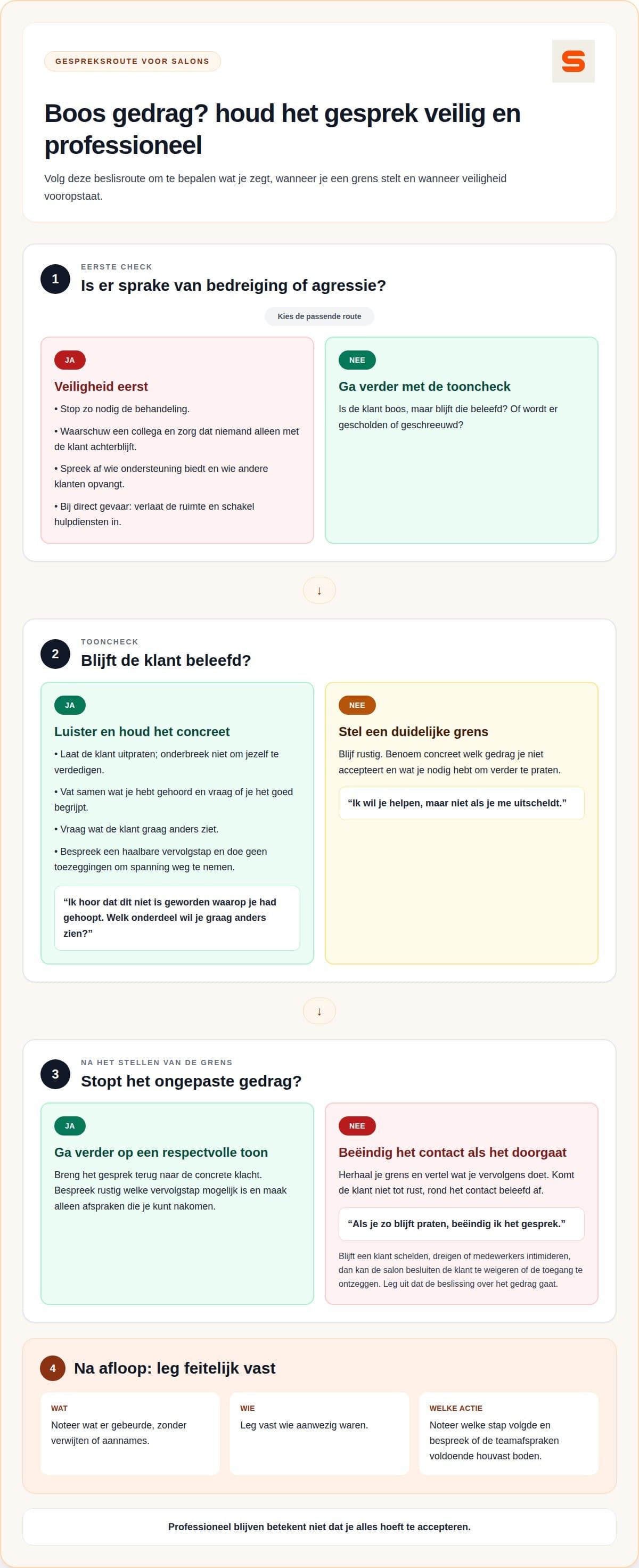
Let the client tell the story first. Don't interrupt to defend yourself or jump to a solution. When someone says the result is not what they expected, they often mainly want to explain what they had in mind.
Show you're paying attention: open posture, eye contact, calm voice. Ask "What exactly did you expect?" Then summarise in your own words: "If I understand correctly, you wanted a softer colour and now find it too dark." The client can add or correct, and you don't react to an assumption.
Empathy doesn't mean agreeing with every complaint. You can show understanding and calmly say what you did and what was discussed beforehand. Avoid lines like "that's not my fault", which shut the conversation down. Say what you hear and ask what matters to the client. With long personal stories, stay friendly and steer back to the treatment: "I hear you, shall we look at what you'd like adjusted?"
3. Dealing with angry or rude clients
If a client raises their voice or insults a team member, don't answer in the same tone and don't take it personally. Keep your voice steady and say concretely what is happening: "I want to help you, but not while you're shouting at me."
If it continues, repeat the boundary and say what you'll do next: "If you keep talking like this, I'll end the conversation." If the client doesn't calm down, close the contact politely. A salon can refuse a client who keeps swearing, threatening or intimidating staff. Explain that the decision is about behaviour, not about a person or an opinion.
Avoid sarcasm and arguments about who is right. Say instead: "I'm happy to discuss the complaint, but in a respectful tone." Don't make promises just to take the tension away.
With threats or aggression, safety comes first. Stop the treatment if needed, alert a colleague and never leave one employee alone with the client. In immediate danger, leave the room and call emergency services. Afterwards, note factually what happened, who was present and what action followed.
4. Worked example: what does a free fix really cost?
A free fix feels like a loss, but do the maths. Say a colour came out too dark and you correct it free of charge. You can repeat this with your own rates.
- Time: 45 minutes at €80 per hour = 0.75 x €80 = €60 of revenue you don't bill. - Product: €8 of colour and care. - Total: €60 + €8 = €68.
Suppose the client spends €65 per visit and comes five times a year: 5 x €65 = €325 a year. The fix costs €68 against €325 of yearly revenue, about 21%. Lose the client and you lose €325 a year plus their referrals. This is no reason to give in to every demand: for unreasonable behaviour, the boundary from the previous section applies. But for a reasonable complaint, the number helps you decide without emotion.
5. Record the complaint and agreements in the client file
After the conversation, record the complaint, your summary and the agreements in the client file. Note which adjustment was agreed and when you'll follow up, so you or a colleague can pick it up carefully. After the fix, ask whether the client is satisfied and use the feedback to clarify expectations earlier next time.
In Salonnare you keep preferences and notes on each client, see client management. Health data goes in a separate, encrypted GDPR vault. With the free plan you can try it at no cost. Software doesn't replace the conversation: it mainly helps you find what was agreed. Questions about what suits your salon? Get in touch.
Turn every client conversation into a learning moment
Choose words with your team for setting boundaries and agree who takes over a conversation. After a conflict, hold a short debrief: what helped you stay calm, and when did it become clear the conversation had to stop?
Start with one agreement you apply from the next client contact. You don't have to handle every conversation perfectly. Keep practising and give yourself and your team room to grow.
Keep client notes and appointments organised
Start free with Salonnare (Free €0, Starter €9.99 and Pro €14.99 per month, excl. VAT; online and card payments carry a 0.5% fee, minimum €0.30).
Start freeFrequently asked questions
How can a hairdresser deal with difficult clients in the salon?
Before you start, make clear what is achievable and how you'll approach the result. Discuss a reference photo, the desired length and colour, and explain what you'd adjust if it doesn't suit the hair. Agree on a moment during the treatment to check the result, so the client can react in time rather than only at the till.
Why should you always take difficult clients seriously?
It helps you tell a misunderstanding, an unexpected result and a recurring weak spot in your process apart. Note which part the client felt was wrong. If the same point returns, adjust your intake or your check moment. That is more useful than labelling the client as difficult straight away.
How do you handle this as a beauty professional?
Adapt your communication to the treatment. For a facial, ask beforehand which products or steps the client would rather avoid; for nails, let them check the shape along the way. Keep the client's wishes and limits in view without taking on their personal problems.
How do you deal with clients who drain your energy?
Notice when contact becomes a burden, for example long messages outside appointments or constantly changing wishes. Decide when you answer client questions and keep communication businesslike and friendly. Talk through recurring situations with a colleague, without mocking the client.
How do you deal with clients who are not satisfied?
Ask the client to name one concrete thing that should have been different. Discuss what matters to them from now on, such as a shorter length or a subtler colour, and repeat that preference before the next appointment. That stops words like "natural" or "subtle" being understood differently.