



Beauty clinic software: what to look for
A beauty clinic works differently from an ordinary beauty salon. Where a salon revolves around care and relaxation, a clinic revolves around results-driven, aesthetic treatments: peels, microneedling, skin improvement, hair removal and courses of treatment that stretch across several sessions. That places higher demands on your software - on the way you plan appointments, keep client records and handle sensitive health data. This guide explains what beauty clinic software should be able to do, from multi-session treatment plans to a GDPR-safe vault for health notes. And it is honest about where the line lies: Salonnare is salon software with an encrypted vault for health data (GDPR Art. 9), not a medical records system. For the calendar, client administration, consent forms, payments and reporting of an aesthetic clinic, that is exactly what you need. For formal medical record-keeping you still need a dedicated system.
What exactly is beauty clinic software?
The short answer: beauty clinic software is a system that supports the full operation of an aesthetic clinic - online appointments, client records, intake and consent forms, a point of sale with deposits and reporting - with extra attention to the safe storage of health-related data.
The difference from ordinary salon software comes down to three things. First, you work with treatment plans across several sessions rather than isolated, one-off appointments.
Second, you record sensitive health data - allergies, medication, skin conditions, pregnancy - which has to be stored separately and encrypted, and must not be visible to everyone on the team. Third, you have to be able to prove that consent was recorded before a treatment begins.
An honest boundary up front: Salonnare is not an electronic health record (EHR) or medical records system. It is salon software with a health-data vault that meets the requirements of GDPR Art. 9 for special categories of personal data.
For a clinic that performs cosmetic, non-medical treatments, that covers the operational and administrative side completely: planning, client management, consent, checkout and steering by the numbers.
If you work with regulated medical care that legally requires a formal patient record, you will need a dedicated medical system alongside it. This guide is about the first category.
Appointments and treatment plans across multiple sessions
A clinic rarely sells a single treatment. A skin-improvement course, for example, is a series of six peels at fixed intervals, or a hair-removal course of eight sessions. Your software has to handle that reality, otherwise the follow-up appointments end up in a separate notebook after all.
Appointments with the right duration and buffers. Every treatment gets its own duration and, where needed, clean-up or recovery time afterwards. The online calendar calculates availability based on that actual duration, so a client can never book a slot that overlaps with the treatment before it. You can combine several treatments in a single appointment, each optionally tied to a different practitioner.
Series and follow-up appointments. Treatments that return at a fixed cadence can be booked as recurring appointments in one go. That fixes the whole course in the calendar and shows at a glance when the next session is. The rebook reminder automatically nudges clients to make their follow-up appointment if it is not yet scheduled.
Selling courses as a package. For a course of several sessions you can create a package that the client pays for up front - a course of six treatments, for instance. Each session is deducted as it is used, so you always see how many treatments are still outstanding.
Be realistic here about what the software is: Salonnare has no formal "treatment plan module" with medical protocols. What it does offer is the combination of recurring appointments, prepaid packages and a complete client record showing the full history. That lets you follow the progress of a course across sessions, without loose lists.
See how the online calendar and appointments work in practice.
Client records and health notes in an encrypted vault
This is the point where a clinic carries the most risk - and where the right software makes the biggest difference. A beauty clinic processes health-related data, and that falls under the strictest category of the GDPR.
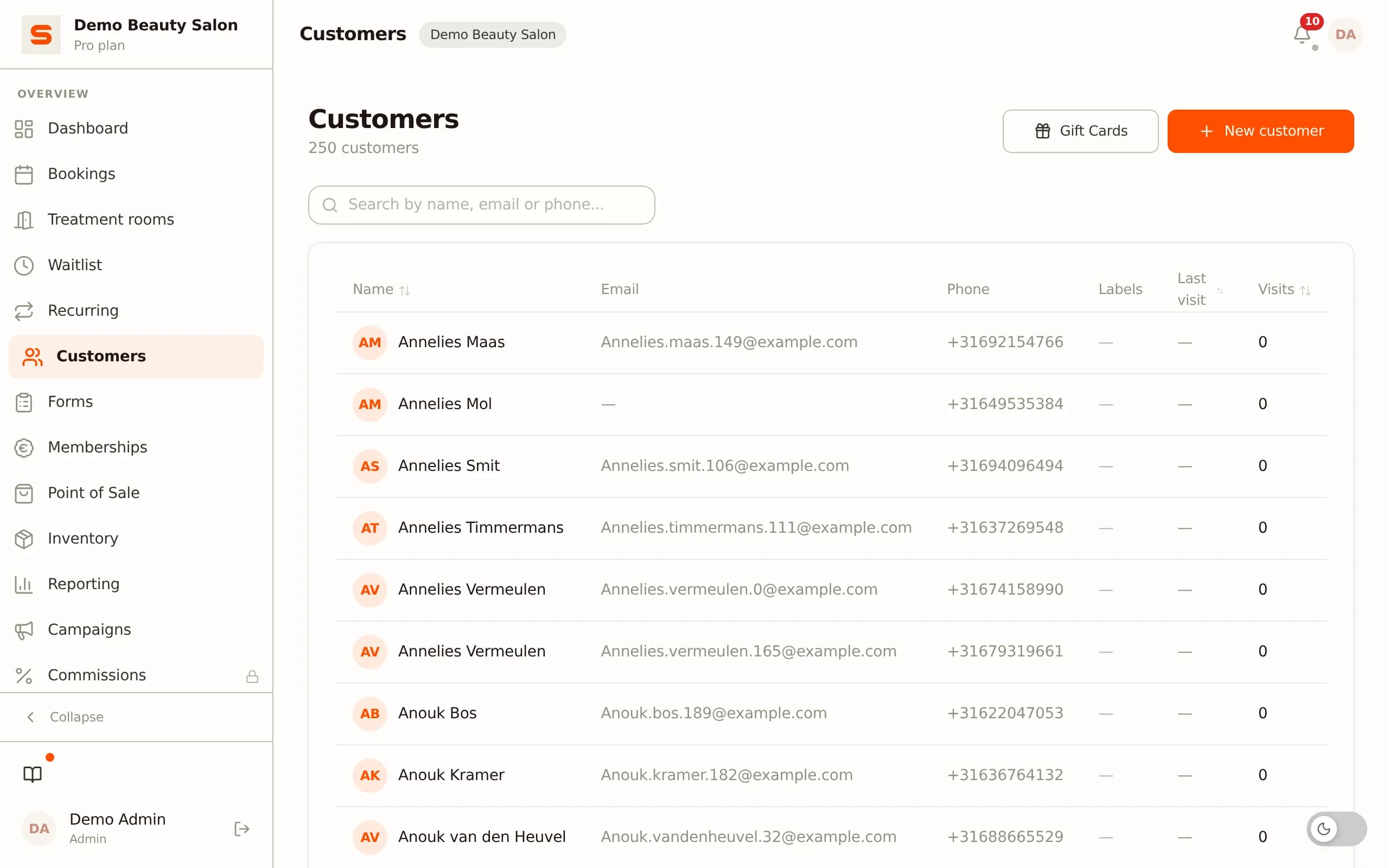
The ordinary client record. For each client you have a complete profile: contact details, appointment history, products used, notes and before-and-after photos per treatment. That gives every practitioner the context needed for a safe, well-informed treatment.
The separate vault for health data. Allergies, medication, skin conditions and pregnancy do not belong in the ordinary notes field. In Salonnare they live in a separate, encrypted vault, apart from the regular client notes. The content is encrypted with AES-256-GCM, and access is managed per staff member: only those with explicit permission can view the health notes.
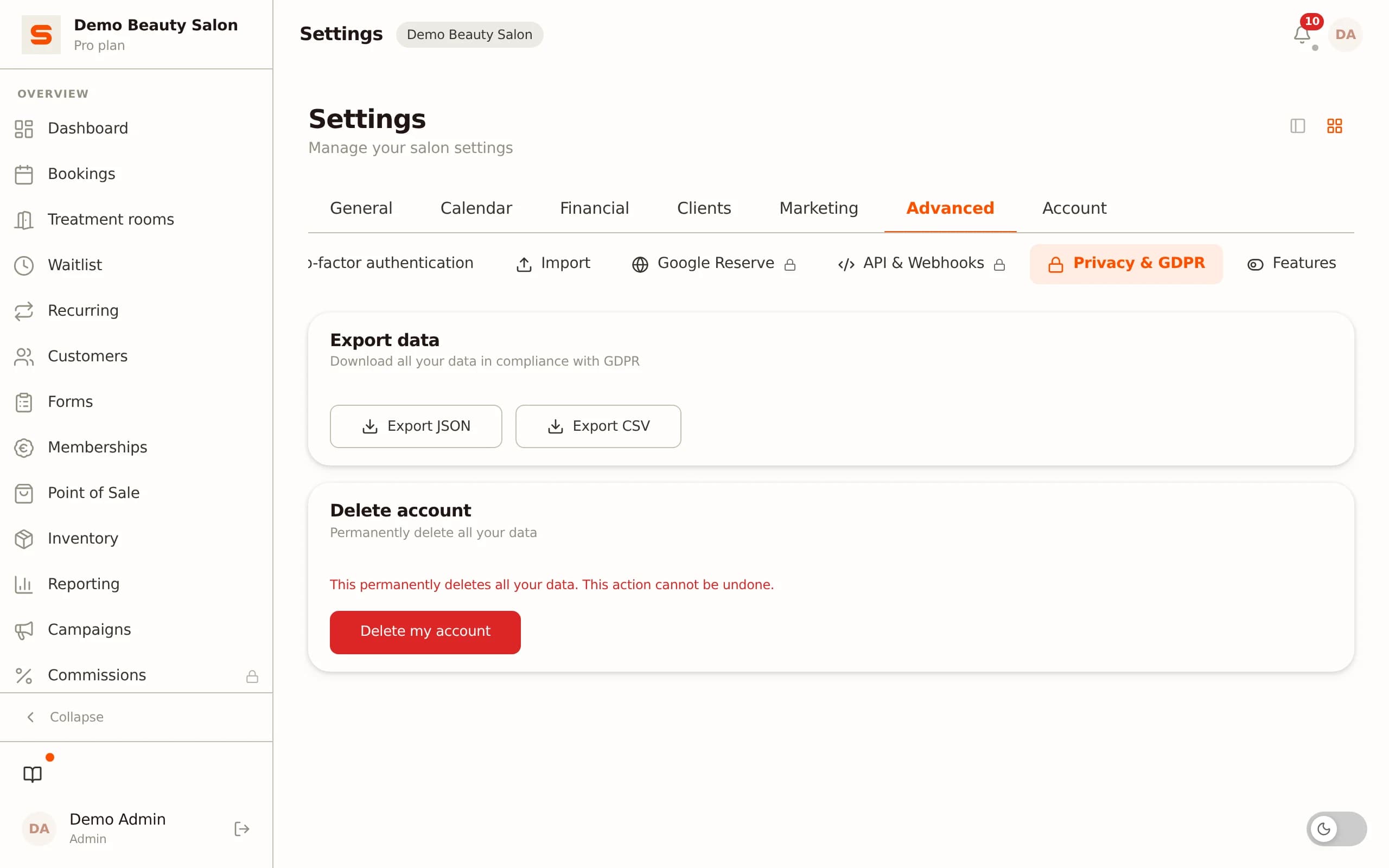
That separation is exactly what GDPR Art. 9 requires for special categories of personal data. Every access to the vault is logged, the data is processed within the EU, and a retention period applies so data does not linger indefinitely. For a clinic that is not a luxury but an obligation - and a strong reason not to work with an ordinary spreadsheet or a free calendar app, where sensitive data floats around unseparated and unsecured.
Honest again: this is a GDPR-safe vault for health notes, not a full medical record with diagnoses and treatment protocols. For recording intake, allergies, consent and points of attention per client it is excellent; for regulated medical documentation it is not intended.
Intake and consent forms
Before an aesthetic treatment you want to know in advance whether there are any contraindications, and you want provable consent. A paper form that disappears into a folder is the weakest link: untraceable, unsecured and not linked to the right client.
Digital intake beforehand. With digital intake forms you let the client fill in what is relevant in advance: allergies, medication use, skin condition, previous treatments and expectations. The client can do this at home via a link, or at the front desk on a tablet. The answers land directly on the client card, and health-relevant answers go into the encrypted vault rather than an open notes field.
Recording consent before the treatment. A consent form records that the client has been informed about the treatment and agrees to it. Because the intake and the consent are stored digitally and time-stamped, you can always demonstrate later what was agreed - important if a complaint or dispute ever arises.
Different per treatment. A microneedling intake calls for different questions than a simple facial. Forms you can configure per treatment type prevent you from bothering clients with irrelevant questions, or missing an important contraindication. See the digital intake forms to learn how to set them up.
Point of sale, deposits and payments
Clinics generally have higher treatment prices than an average salon, and longer time slots. A no-show therefore costs more: an empty hour on an expensive chair is a direct loss. That makes the payment side more important here than anywhere else.
Deposits and no-show fees. When booking online you can set a required deposit (Pro), or a no-show fee (from Starter) that is charged automatically on a no-show or late cancellation. You can set this per treatment type, so an expensive course requires a higher deposit than a short treatment. It also filters out the non-serious bookings.
Checkout with treatments and products. A settlement in a clinic often contains a combination: a treatment plus a homecare product. The point of sale processes those combinations in a single transaction, splits the VAT automatically and produces a correct receipt.
Payments into your own account. Salonnare works with iDEAL, Bancontact, card and cash via Mollie and Stripe, and those payments arrive directly in your own bank account. No intermediary sits between you and your money holding it back - only Salonnare's own platform fee of 0.5% (min. €0.30) per online payment. You pay a fixed, transparent monthly price - no marketplace commission on your bookings. See online payments and deposits for the details.
Reporting and insight
Steering by the numbers is no side issue in a clinic. You want to know which treatments are profitable, which practitioner brings in how much revenue and how well your clients return for their follow-up sessions.
Revenue per treatment and per practitioner. The reports show your revenue per day, week, month or quarter, broken down by treatment, by staff member and by payment method. That way you see which treatments carry your revenue and which mainly consume time.
Occupancy and repeat visits. For a clinic, return per client is an important gauge: after session one, does someone actually make the follow-up appointment? The figures on repeat visits and the rebook nudge help you complete the course instead of letting it lapse after a single session.
Margin per treatment. By factoring in product usage and time spent, you get a picture of your real margin per treatment - not your gut feeling, but a number. That is the basis for better prices and a smarter treatment menu. See the reporting and dashboards to view which overviews are available as standard.
What to look for when choosing
Not every package that calls itself "clinic software" suits an aesthetic clinic in the EU. Work through these points when choosing.
Handling of health data. Can the system store sensitive data encrypted and separated, with access per staff member (RBAC), and does that meet GDPR Art. 9? An ordinary note or tag is not enough.
Deposits and no-show policy. Can you set a deposit or no-show fee per treatment type? For expensive, long treatments that is essential.
Treatment plans and packages. Does the system support recurring appointments and prepaid courses, and can you see the progress per client?
EU data processing and your own payout account. Is your data processed within the EU, and do payments arrive in your own account without a marketplace commission per booking (just a platform fee of 0.5%, min. €0.30, per online payment)?
Transparent pricing and languages. A fixed monthly price is more predictable than a percentage on every booking. And if you work with an international team or clients, multilingual support (Salonnare works in 9 languages) is a practical plus.
Honesty about the medical line. Be critical of providers who suggest their salon software is a full medical record. Salonnare deliberately positions itself as salon software with a GDPR vault, suited to aesthetic clinics - not as a medical records system. That clarity prevents wrong expectations. Still unsure about the broader functionality? Read more about software for your beauty salon.
Conclusion: choose software that fits a clinic
A beauty clinic asks more of software than an average salon: treatments across multiple sessions, sensitive health data that has to be stored encrypted and separated, provable consent up front and a payment process that catches expensive no-shows. The right software brings that together in one system, so you do not scatter your administration across loose tools and paper folders.
Salonnare covers that operational and administrative side completely, with an encrypted health-data vault (GDPR Art. 9), permissions per staff member, EU data processing, deposits against no-shows, payments into your own account and a fixed monthly price with no marketplace commission (plus a platform fee of 0.5%, min. €0.30, per online payment).
The honest part remains: it is salon software, not a medical records system - for regulated medical documentation you need a dedicated system. For the calendar, client records, consent and point of sale of an aesthetic clinic, it is exactly what you are looking for.
You start for free: the Free plan costs 0 euro (1 staff member, 50 bookings per month), Starter is 29 euro and Pro 59 euro per month. Create a free account at salonnare.com/free and set up your first treatments and client records (intake forms come with Starter) - you do not need a credit card to begin.
Frequently asked questions
Is Salonnare a medical records system or EHR?
No. Salonnare is salon software with an encrypted vault for health data that meets GDPR Art. 9, not an electronic health record (EHR) or medical records system. It is well suited to an aesthetic clinic performing cosmetic, non-medical treatments: you safely record intake, allergies, consent and points of attention per client. For regulated medical care with a formal patient record you will need a dedicated medical system alongside it.
Can I keep treatment plans with multiple sessions?
Yes, in practice you can, although there is no formal treatment plan module. You book a series of follow-up appointments in one go, sell a course as a prepaid package that is deducted per session, and follow progress via the full history on the client card. The rebook reminder automatically nudges clients to schedule their follow-up session, so a course is seen through to completion.
How securely are health notes stored?
Health notes live in a separate vault, apart from the ordinary client notes. The content is encrypted with AES-256-GCM, access is managed per staff member (only those with explicit permission see the notes), every access is logged and the data is processed within the EU. A retention period also applies. This setup is built around the requirements of GDPR Art. 9 for special categories of personal data.
Can I ask for deposits on expensive treatments?
Yes. You can set a required deposit (Pro) or a no-show fee (from Starter) per treatment type, authorised when booking online and charged automatically on a no-show or late cancellation. For a clinic with long, expensive time slots that matters: a no-show there costs more than a short appointment. Payments run via iDEAL, Bancontact, card and cash and arrive directly in your own bank account.
What does it cost and how do I start?
Salonnare has a permanently free Free plan (0 euro, 1 staff member, 50 bookings per month), Starter at 29 euro per month and Pro at 59 euro per month - a fixed price with no marketplace commission on your bookings (plus a platform fee of 0.5%, min. €0.30, per online payment). You begin by creating a free account at salonnare.com/free, setting up your treatments and client records and, from Starter, configuring your intake forms. No credit card is needed to start.