



VAT rates for hair salons: which rate applies to your treatments and products?
Hairdressers and salon owners regularly face the same question: which VAT rate applies to this receipt? For a simple cut the answer often seems obvious, but as soon as a retail product is sold alongside the service, or a colour treatment with included dye passes the till, it gets less straightforward. A wrong rate on a single receipt is rarely a disaster, but a structural error in how you account for VAT can lead to back-payments and penalties when the tax authority looks closer. This article explains the principles that apply to salons, gives a practical breakdown of services versus retail products, and describes how to set up your till so that mixed transactions are split correctly and automatically. This is not tax advice - VAT rates and rules differ from country to country, so always confirm the exact rate that applies in your jurisdiction with your local tax authority or an accountant. What follows are concrete, practical handles for daily use behind the till.
The core principle: services and retail products are often treated differently
In most VAT systems there is a distinction between the labour-based service you provide as a hairdresser and a physical product you sell to take home. Depending on the country, hairdressing services may fall under a reduced rate or under the standard rate, while retail products almost always carry the standard rate.
The rate that applies to your services depends on your country. In some markets hairdressing is treated as a labour-intensive service eligible for a reduced VAT rate; in others, hairdressing is taxed at the standard rate just like any other service. There is no universal percentage that applies everywhere, so the single most important step is to confirm with your local tax authority which rate applies to hairdressing services where you operate, and which rate applies to products you resell.
What usually counts as a "hairdressing service": cutting, washing, blow-drying, colouring, perms, highlights, keratin treatments, beard trimming and shaving, and styling as part of an appointment. Retail products - shampoo, conditioner, masks, styling products, extensions sold to take home - are sold goods and almost always carry the standard product rate.
For beauty salons that also offer skincare, waxing or nail treatments, the rate can differ again per treatment type. When in doubt about a specific treatment, ask an accountant or your tax authority rather than guessing.
Practical breakdown: services versus retail products
The list below covers the most common situations in a salon. Treat it as a starting point: it tells you which items behave as a *service* and which behave as a *retail product*. The exact percentage attached to each category depends on your country - fill those in based on your local rules.
Services (the rate that applies to hairdressing in your country): - Cut (wash, cut and blow-dry included) - Dry cut or trim - Hair colouring or highlights (including the dye used as part of the treatment) - Perm or relaxer - Keratin treatment - Beard trim or shave - Styling as part of a booked appointment - Children's cut - Bridal or occasion hair styling
Retail products (standard product rate): - Shampoo, conditioner or hair mask sold at the till - Styling products: wax, gel, mousse, hairspray - Extensions the client takes home - Hair dye the client applies themselves - Professional products you sell as a reseller
Special case: products that are part of a service
If you use dye, developer or other products *as part of* a colour treatment and they are included in the treatment price, the whole amount usually follows the rate of the service - the products are "ancillary to the service". This only applies when the products are not invoiced or sold separately, but included in the treatment price.
It becomes different when you list the product separately on the receipt alongside the service. Then you apply the split: the service at the service rate, the product at the product rate. The precise treatment of ancillary supplies can vary by country, so confirm the local rule if you build mixed prices.
Mixed receipts: how to split correctly
In practice many salon visits end with both a treatment and a product purchase. A client has a cut and also takes home a bottle of shampoo. This kind of mixed receipt needs to be split correctly.
The core rule is simple: every line on the receipt carries its own VAT rate. So you charge: - The treatment (cut, colour, etc.) - at the service rate - The separately sold product (shampoo, wax, etc.) - at the product rate
The receipt shows both amounts, including a VAT breakdown per rate. The client pays one total, but the underlying VAT split is visible in the receipt detail. That matters for your VAT return: you report turnover per rate.
Where it goes wrong in practice is with owners who set their till to a single flat rate for everything, or who bundle products and services together without keeping the split. Understandable on a busy day, but it produces a VAT return that does not reflect reality.
Another pitfall is "absorbing" product prices into the treatment price without specifying it. If you charge a client for a colour treatment "including a take-home care mask", you treat that mask as ancillary to the service. If you charge separately for the treatment and the mask, the mask is a retail product. Either approach can be valid - but be consistent and lock it into your till configuration so every staff member rings it up the same way.
How Salonnare configures the till per VAT rate
In Salonnare you set the correct VAT rate per service and per product, so the POS module applies the correct split automatically on every checkout. You do not have to calculate or correct anything by hand at the till.
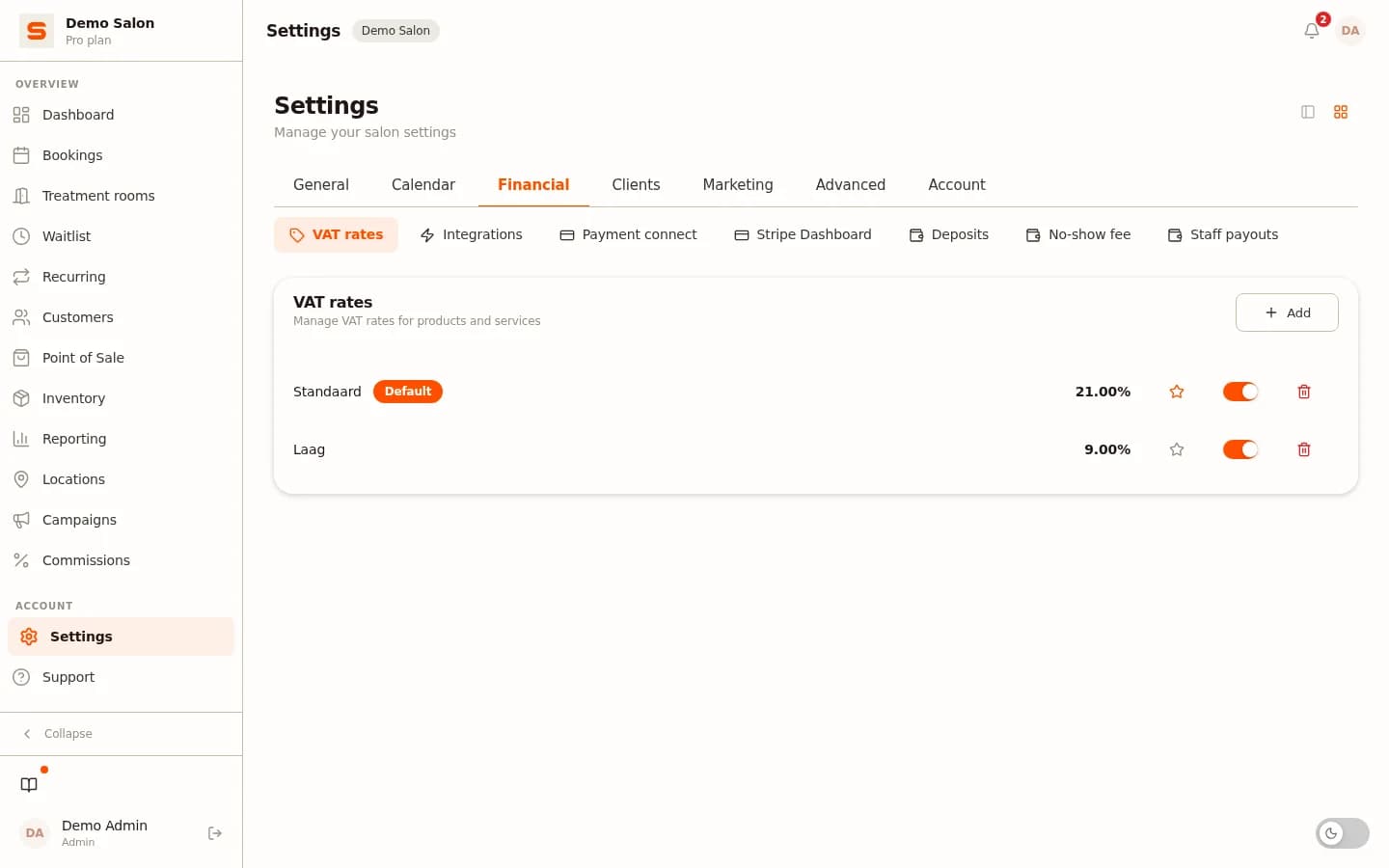
Set rates per service and product
Via Settings - Services and Settings - Products you choose the VAT rate per item. Set treatments to your service rate and standalone products to your product rate. Once configured, it is applied automatically on every till transaction. A hairdresser ringing up a cut and a shampoo at the same time gets the correct combined receipt with the VAT breakdown immediately.
Receipt with VAT breakdown
Every receipt Salonnare generates shows the VAT amounts per rate in the footer: how much VAT was charged at each rate. This applies to both the printable version and the digital receipt emailed to the client. For the client it is transparent; for your VAT return it forms the basis for the total due per rate.
Turnover overview per VAT rate
From the Starter plan, the reporting overview shows, per period, how much turnover was realised per VAT rate.
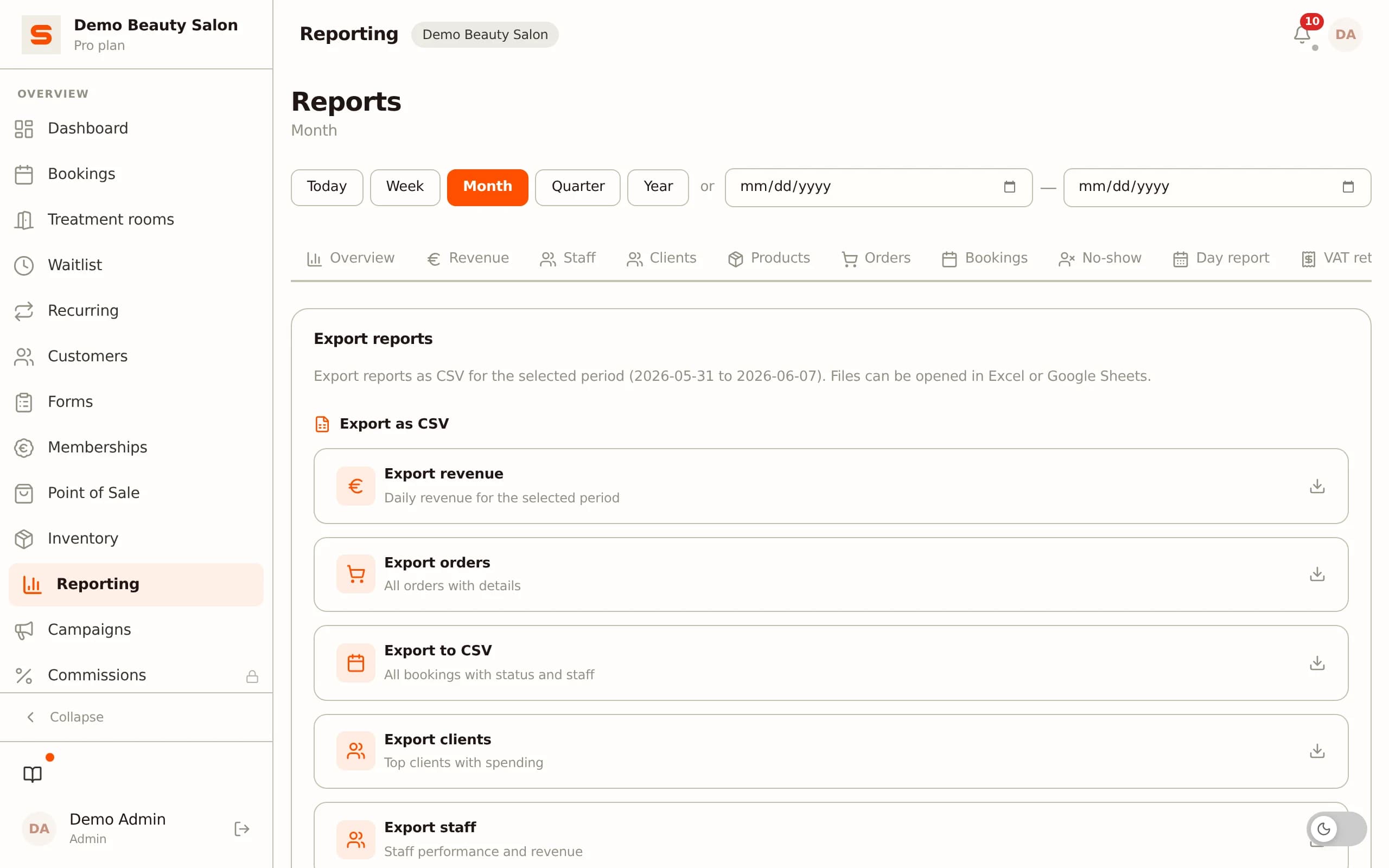
That overview maps directly onto the structure of your VAT return, so you can fill in the boxes based on the figures from the till - without adding things up by hand.
If you are unsure whether your till configuration is correct, the free plan is a good moment to run a test checkout with a mixed receipt: one treatment and one product. Check that the receipt shows the right split before you go live with clients.
Three practical tips to avoid VAT mistakes
Even when the theory is clear, mistakes creep into daily practice. These are the three most common causes and how to avoid them.
1. Check the till configuration when you add new services
Every time you add a new service or product to your offering, check the matching VAT rate in the till. Default settings are not always right - especially if you took over a till from someone else or implemented a new system without reviewing every item.
2. Train staff on the split at point of sale
A staff member who sells a product alongside the treatment must enter that product as a separate line - not merge it into the treatment price. That sounds obvious, but under pressure at a busy counter it regularly goes wrong. Cover it briefly when onboarding new staff.
3. Run a sample check every reporting period
For your VAT return you need turnover figures per rate. Each period, review a few receipts and check that the VAT split is correct. Do not wait until your accountant asks - it is harder to correct then. Five minutes of sampling per period saves a lot of work later.
Want your till to apply the right VAT split automatically? Start for free at salonnare.com/en/free - no credit card required. The till with a VAT rate per line is in the free plan; reports per VAT rate and the accounting export come with the Starter plan (€29 per month).
Frequently asked questions
Does a reduced VAT rate apply to hair treatments?
It depends entirely on your country. In some markets hairdressing is treated as a labour-intensive service that qualifies for a reduced VAT rate; in others it is taxed at the standard rate like any other service. There is no single answer that applies everywhere. Confirm the rate that applies to hairdressing services in your jurisdiction with your local tax authority or an accountant.
Do I have to issue a receipt to private clients?
In most jurisdictions you are required to issue a receipt for payments by consumers, and a proper VAT invoice for business clients who need it for their own bookkeeping. In Salonnare every POS transaction automatically generates a receipt with the required details, including a VAT breakdown per rate - both as a printout and as a digital receipt by email.
How do I handle VAT correctly when I also sell gift cards?
Gift cards often have their own VAT treatment. For a multi-purpose voucher redeemable against various services and products, VAT is typically accounted for at the moment of redemption, based on what is actually purchased - not when the voucher is sold. The exact rule varies by country, so confirm it locally. See also our article on gift cards in salons for a fuller explanation and the practical bookkeeping consequences.
Does the same rate apply when I work at the client's home?
In most systems the VAT rate for a service is tied to the nature of the service, not to where you perform it. Whether you carry out the treatment in the salon, at the client's home or on location at an event, the rate for the service stays the same. Confirm the local rule if you operate across borders.
What do I do if I have used the wrong VAT rate in the past?
If you have structurally used an incorrect rate, there are two situations: under-declared VAT can lead to a back-payment; over-declared VAT can usually be reclaimed via a correction. In both cases it is wise to report it to your tax authority yourself before they discover it - that gives a more favourable position and avoids penalties. An accountant can help you assess the scope and choose the right approach.