



Starting a beauty salon: the complete guide for beginners
 Starting your own beauty salon is the logical next step for many beauty therapists: no more employment, but your own clients, your own rates and your own space. At the same time there is more to it than just treating people - a business plan, a financial plan, registering your business, a location, insurance and the right software. This guide walks you step by step through everything you need to start a beauty salon, from the first plan to your first client. By the end you will know which choices to make and how to start professionally from day one - without your start-up costs getting out of hand.
Where do you start? The steps in order
Starting a beauty salon comes down to roughly eight steps. They are listed below in order so you get an overview straight away; the rest of this article works each step out in more detail.
1 - Write a business plan. Describe your concept, your target audience, your services and what sets you apart.
2 - Draw up a financial plan. Work out what you need to start and at what point you break even.
3 - Register your business. Choose a legal form (usually a sole trader) and register; your VAT number follows.
4 - Choose and fit out a location. From home, your own premises or a chair in an existing salon.
5 - Arrange insurance and permits. Think of liability cover and the hygiene rules for your treatments.
6 - Set up your software. A calendar, online booking, a till and client records - from day one.
7 - Win your first clients. A Google Business Profile, Instagram and an online booking link.
8 - Keep your admin up to date. Store receipts and invoices for your VAT return.
The order is not fixed - your business plan and financial plan often take shape together - but it helps to tackle the big picture this way. Start small: you do not need everything to be perfect on day one.
Business plan and financial plan
A beauty salon business plan does not have to be a thick report, but it does force you to sharpen your choices before you spend money: what do you offer, for whom, at what price, and why do clients choose you over the salon around the corner? Include at least these parts: a short summary, your experience, your target audience, your service list with rates, a look at the competition and your marketing approach.
The beauty salon financial plan translates that into figures and consists of four budgets: the investment budget (what you need one-off: fit-out, equipment, stock, a starting buffer), the funding budget (how you pay for it), the operating budget (revenue and costs per year) and the cash flow budget (whether there is enough in your account month by month).
A practical starting point is your break-even: divide your fixed monthly costs (rent, insurance, software) by your average revenue per treatment. That tells you how many clients you need per month before you turn a profit. If you choose software with a fixed, low monthly price instead of a percentage per booking, that calculation stays predictable as you grow.
Registering: business register, VAT and insurance
Before you can invoice your first client, your business has to exist officially. In most countries you register with a trade or business register and choose a legal form. For most starting therapists a sole trader (or its local equivalent) is the logical choice: simple, cheap and suited to working alone.
Shortly after registering you receive a VAT number from the tax authority.
Beauty treatments usually fall under the standard VAT rate, which you file periodically through your VAT return. Also arrange your insurance: public liability cover pays for damage you might cause to a client, and depending on your treatments professional indemnity or legal expenses cover is wise.
Finally, mind the hygiene rules. General hygiene requirements apply to many regular treatments, while skin-piercing techniques (permanent make-up, microneedling) come with stricter rules and sometimes a permit from the health authority.
The exact procedure differs from country to country, but the building blocks - registering in the trade register, a VAT number and the right insurance - are comparable everywhere. Check the specific rules where you live before you open.
Location and fit-out
Where you work determines a large part of your start-up costs. There are broadly three routes. A home salon is the cheapest option, but check that your local zoning rules allow a business at home. Renting your own premises gives more visibility and room to grow, but with fixed monthly costs your revenue has to cover straight away. Or you rent a chair or room in an existing salon: low threshold, you share costs and footfall - ideal for starting out.
For the fit-out you will at least need a good treatment chair or couch, lighting, mirrors, a wash point and storage. Count on sterilisation and hygiene supplies and the equipment your treatments require too. You do not have to buy everything new at once; many starters begin with second-hand furniture and invest later, once revenue allows.
Sketch out your layout before you buy, so you keep a grip on your investment budget.
Software from day one: calendar, till, online booking and client records
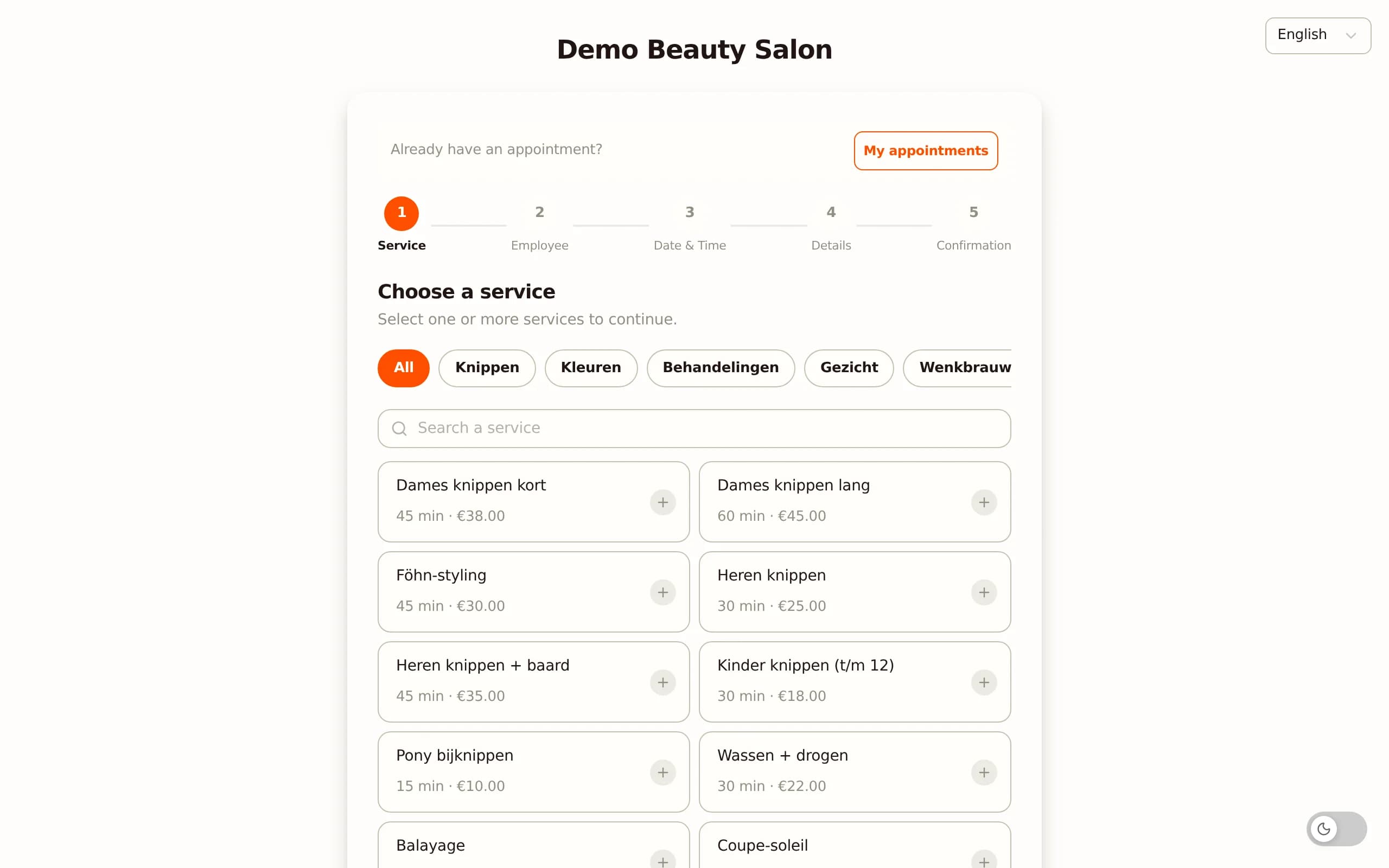
Many starting salons handle their appointments with a paper diary at first. That works for the first few weeks, but as soon as you get more clients you end up with double bookings, missed appointments and admin that no longer adds up. Starting with good software right away builds a professional way of working from day one - without having to migrate everything later.
Four things you really need. An online calendar with every appointment in one place, so you never double-book. An online booking page that lets clients book themselves, even outside opening hours - linked to your website, your Google Business Profile and your Instagram bio. A till to check out with a correct receipt and the right VAT per service. And client records with contact details, treatment history and notes.
Salonnare brings this together in a system you can start with for free. The Free plan is permanently free for 1 staff member and 50 bookings per month - enough to run as a starting salon at no monthly cost.
Grow past that limit and you move to Starter (29 euros) or Pro (59 euros), at a fixed monthly price with no marketplace commission per booking - only a platform fee of 0.5% (min. €0.30) per online payment. Payments run via iDEAL (Mollie) and card (Stripe) straight to your own account, your data sits on EU servers and the software is available in nine languages.
Winning your first clients and marketing
Your salon is fitted out and your software is ready - now you need clients. The first ones almost always come from your own network and from local visibility. Start with a Google Business Profile: free, and crucial for being found when someone in your town searches for "beauty salon". Fill it in completely, add photos and put a direct booking link on it.
Instagram and Facebook are indispensable for the beauty industry: show your work with photos of treatments (with the client's consent), share before-and-after images and put a booking link in your bio. An opening offer helps to fill your calendar quickly and get word of mouth going.
Ask happy clients for a Google review; for a new salon that is the single strongest marketing tool there is. Combine that with automatic appointment reminders and rebooking requests - good software sends those on its own - and you steadily build a loyal client base.
Keeping your admin and bookkeeping up to date
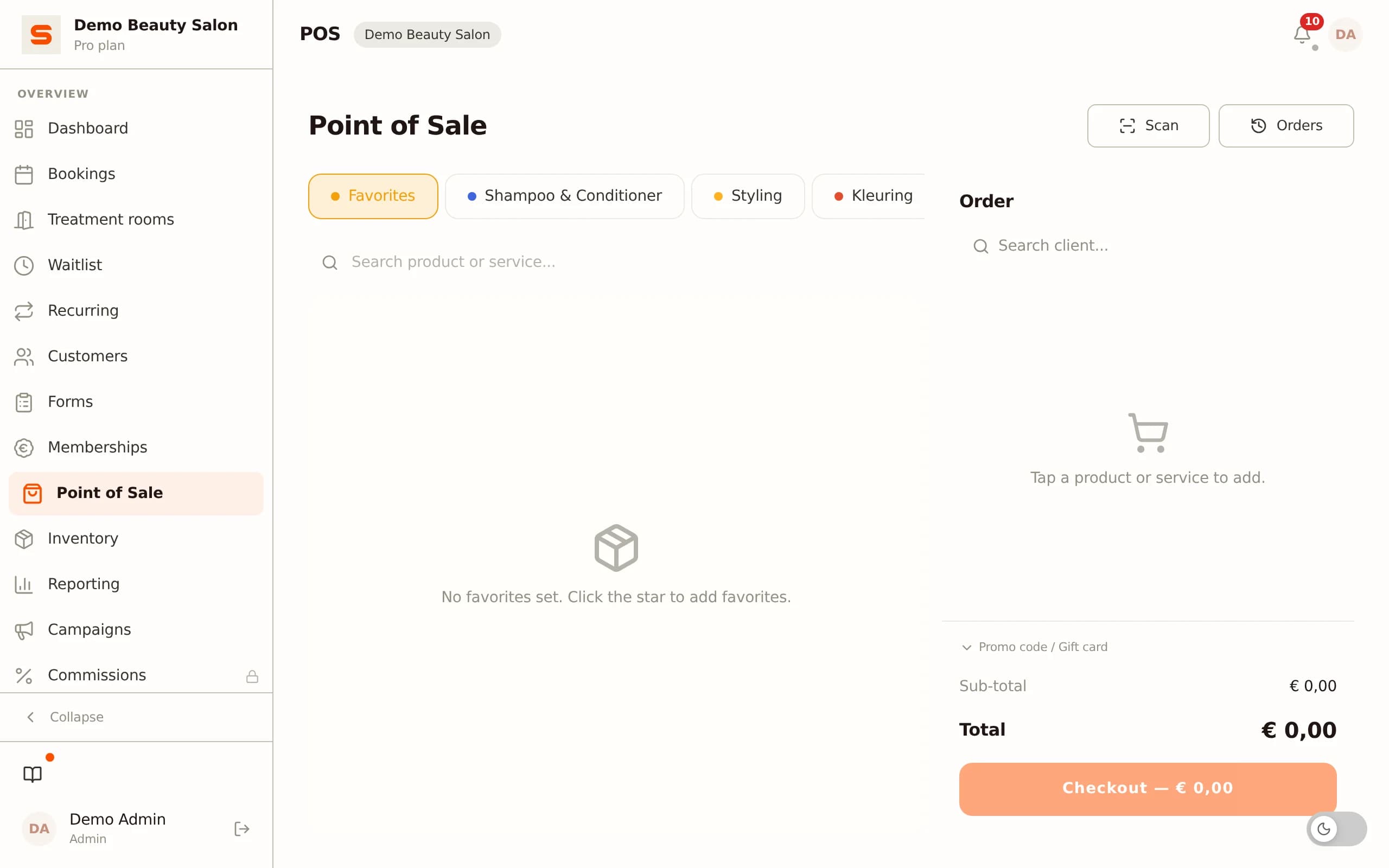
Sound admin is not a luxury but an obligation: the tax authority expects you to track your income and expenses and to keep your receipts and invoices. Setting that up well from the start saves you a lot of stress around your VAT return.
The basics are simple: record every sale and every appointment, keep your purchase invoices and track your revenue per VAT rate. If your till is linked to your calendar, most of that happens automatically - every completed treatment becomes a transaction with the correct VAT, and your daily overview totals everything per rate.
Many starters work with an accountant for the filings but keep the day-to-day recording in their own salon software. That is the cheapest and most up-to-date combination: you record on the go, your accountant picks up the exports. Want to go deeper?
Read our guide on software for your beauty salon.
Growing: staff and rates
Once your salon runs well, the question becomes how you grow further. You have two levers for that: your rates and your team.
Rates. Many starters price too low out of fear of scaring clients off. Work out what a treatment really costs you in time, products and fixed costs, and make sure your price sits comfortably above that. A modest annual price rise is normal and healthy. Working with treatment packages or a loyalty card raises your average spend without having to recruit new clients every time.
Staff. If your calendar is structurally full, it is time to hire your first employee or bring in a freelancer. An important question then: who may see which client data? With permissions per staff member (RBAC) you give everyone exactly the access that fits their role - a new colleague sees the calendar, for example, but not your revenue figures. As you grow from 1 to several staff, you scale up in Salonnare from Free to Starter or Pro without switching systems.
Conclusion
Starting a beauty salon comes down to a handful of well-made choices: a clear business plan, a realistic financial plan, a correct registration, a location that fits your budget, and software that keeps your admin in order from day one. Start small, keep your start-up costs in check and build a loyal client base step by step.
Salonnare helps you start professionally with no financial risk: online booking, a calendar, a till for cash and card, and client records - permanently free to begin with, with iDEAL straight to your own account from Starter. See the pricing or create a free account today at salonnare.com and set up your salon this week. No credit card needed.
Frequently asked questions
How much does it cost to start a beauty salon?
It depends heavily on your location. A home salon or a rented chair in an existing salon can be set up for a few thousand euros in fit-out and equipment. Renting your own premises pushes the start-up costs and fixed monthly outgoings up considerably. On top of the fit-out, budget for stock, insurance, marketing and a buffer for the first few months. You do not have to skimp on software: with Salonnare's free Free plan (0 euros, 1 staff member, 50 bookings per month) you start at no monthly cost.
Do I need a qualification to open a beauty salon?
That varies by country. In some countries beauty therapy is not a protected profession and no formal qualification is legally required, while others require a recognised diploma to perform esthetic treatments. In practice clients and insurers expect a recognised training regardless, and skin-piercing treatments (such as permanent make-up or microneedling) come with separate hygiene rules and sometimes a permit. Always check the requirements that apply where you live.
Can I start a beauty salon from home?
Yes, that is a popular and affordable way to begin. First check that your local zoning rules allow a business at home and that you have a separate room you can fit out hygienically. You register your business as any salon would and keep your admin the same way. An online booking page and a Google Business Profile make sure clients can find you and book easily, even from home.
What software do I need as a starting salon?
At a minimum an online calendar, an online booking page, a till and client records. Those four together form the professional base that prevents double bookings, missed appointments and messy admin. Salonnare brings them together in a system you can start for free and that grows with you, with online payments via iDEAL and card (from Starter) straight to your own account and your data on EU servers.
How do I write a financial plan for a beauty salon?
A financial plan usually has four parts: an investment budget (what you need one-off), a funding budget (how you pay for it), an operating budget (your expected revenue and costs per year) and a cash flow budget (whether there is enough in your account each month). Also calculate your break-even: how many treatments you need per month to cover your fixed costs. Choose software with a fixed monthly price instead of a percentage per booking, and that calculation stays predictable.