



Payment methods for your salon: iDEAL, card, cash and online prepayment
The payment methods you offer in your salon decide how smoothly checkout runs - and how much of your revenue you actually keep. Most clients want a choice: card at the desk, iDEAL for an online booking, or simply cash. A payment setup that offers that choice without handing a slice of every transaction to a middleman is worth a lot to a salon. This article is specifically about payment methods: the ways your client can pay. That is not the same as a deposit, which is a no-show safeguard where the client locks in part of the amount in advance. Payment methods cover the whole checkout moment, regardless of when or how the client pays. We walk through iDEAL, card, cash and online prepayment, explain how VAT splitting and payouts work, and what to know when choosing a payment system for your nail salon or hair salon.
The best payment setup for your salon
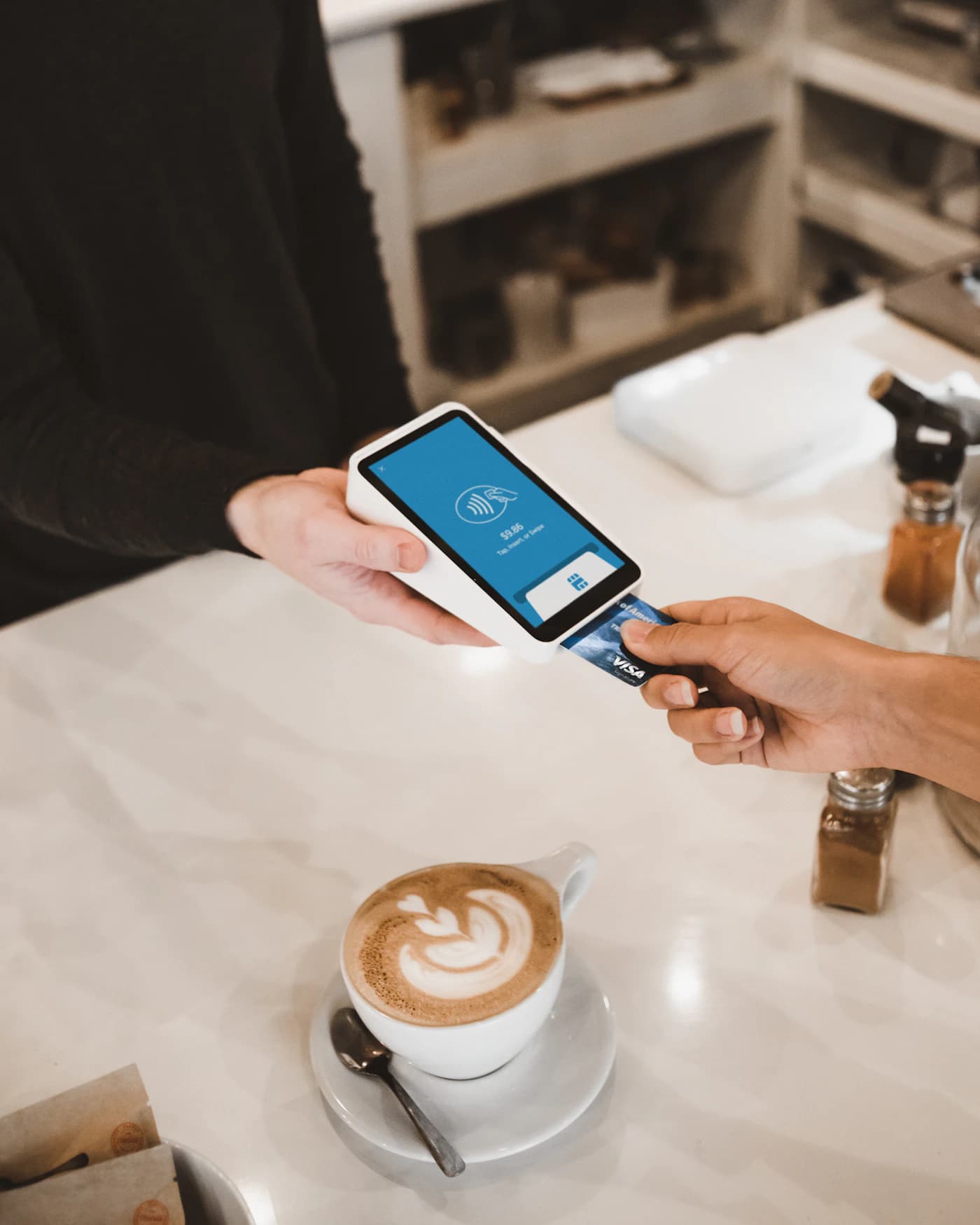
The short answer: offer iDEAL, card and cash, have payments land straight in your own account, and pick a system with a fixed monthly price instead of a percentage per booking. That combination covers almost every client and keeps your margin intact.
Why these three? iDEAL is by far the most popular way to pay online in the Netherlands and is essential the moment you let clients prepay at booking. Card is the norm at the desk: fast, familiar and no change needed. And cash still matters to a share of clients, especially for smaller amounts and tips. With these three you leave almost no one out.
Why to your own account? Some booking platforms collect the payment themselves first and only pass the money on to you later - sometimes weeks later. That costs you cash flow and oversight. A setup where the money lands directly in your business account through your own payment account is better, because you always know what has come in.
Why no marketplace commission per booking? With a platform that charges a commission per appointment, you pay along on every booking - and it adds up exactly on your most popular treatments. Salonnare uses a fixed monthly price (Free 0 euro, Starter 29 euro, Pro 59 euro) and keeps no percentage of your bookings for a marketplace. On top of your payment provider's own transaction costs, you do pay Salonnare's own platform fee of 0.5% (min. €0.30) per online payment.
Accepting iDEAL through Mollie or Stripe
iDEAL is the standard for online payment in the Netherlands. If you let clients pay at the moment of booking, or send a payment request afterwards, you want them to settle with their own bank without any fuss. For that you connect your salon to a payment provider.
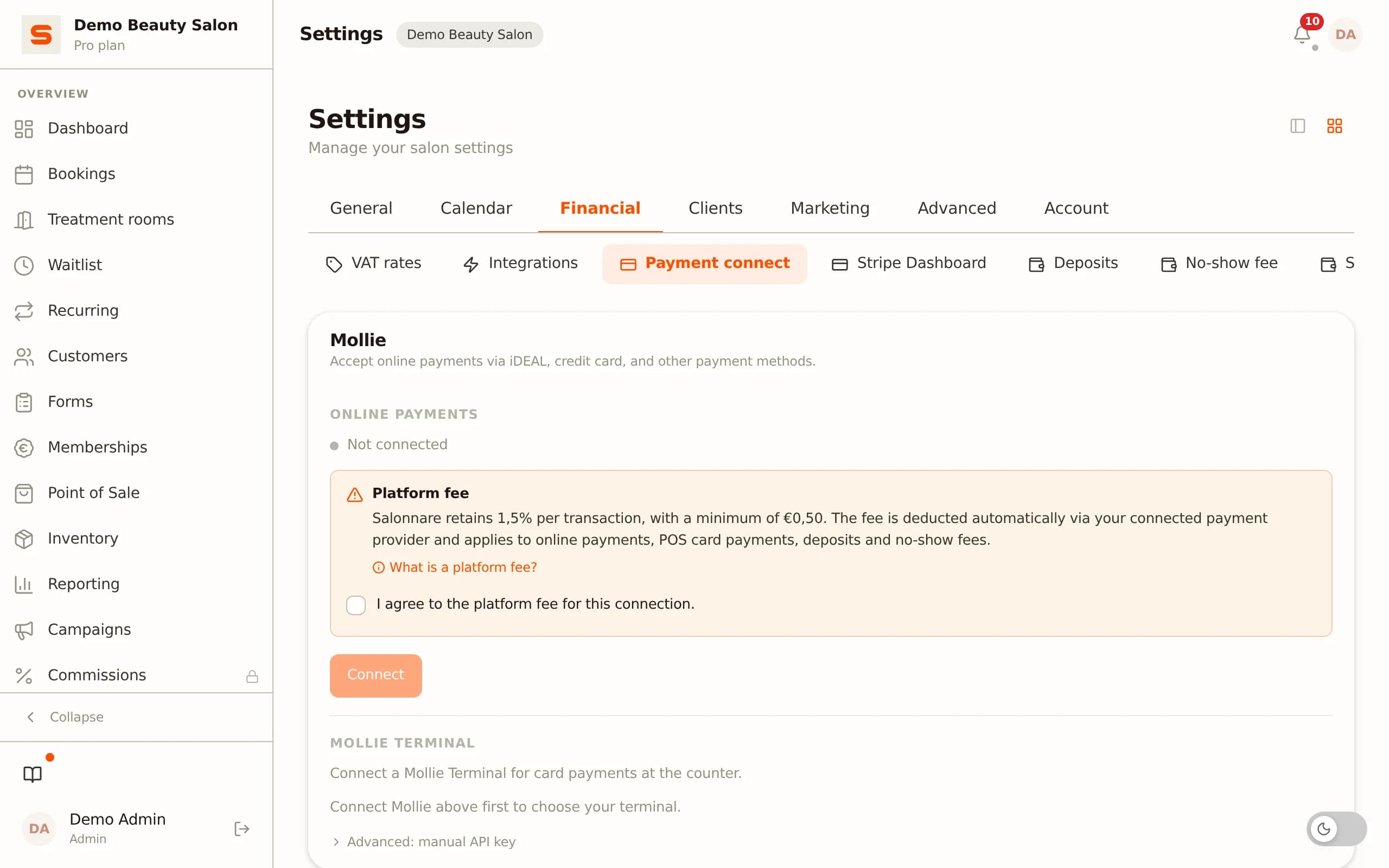
Mollie and Stripe. In Salonnare you connect your own Mollie or Stripe account. Both support iDEAL, and the amount lands in the bank account attached to that account - yours, not Salonnare's. That way you keep full control over your cash flow and your bookkeeping.
Where iDEAL helps. Think of a client who books a facial online and pays right away, or a gift card you sell through a payment link. The payment is recorded against the right appointment or order, so you have nothing to track down later. The difference from a loose payment request through your banking app is that the link with your calendar and till stays intact.
Bancontact for Belgian clients. If you serve clients just across the border, Mollie and Stripe also support Bancontact, the Belgian counterpart to iDEAL. So you do not need a separate solution for clients from abroad. See every option on the page about online payments for salons.
Card payments at the counter with a terminal (SumUp)
For checkout at the desk after a treatment, card is still the most-used method. A client who has just had a cut or treatment wants to pay quickly and without change. For that you need a card terminal that connects to your till.
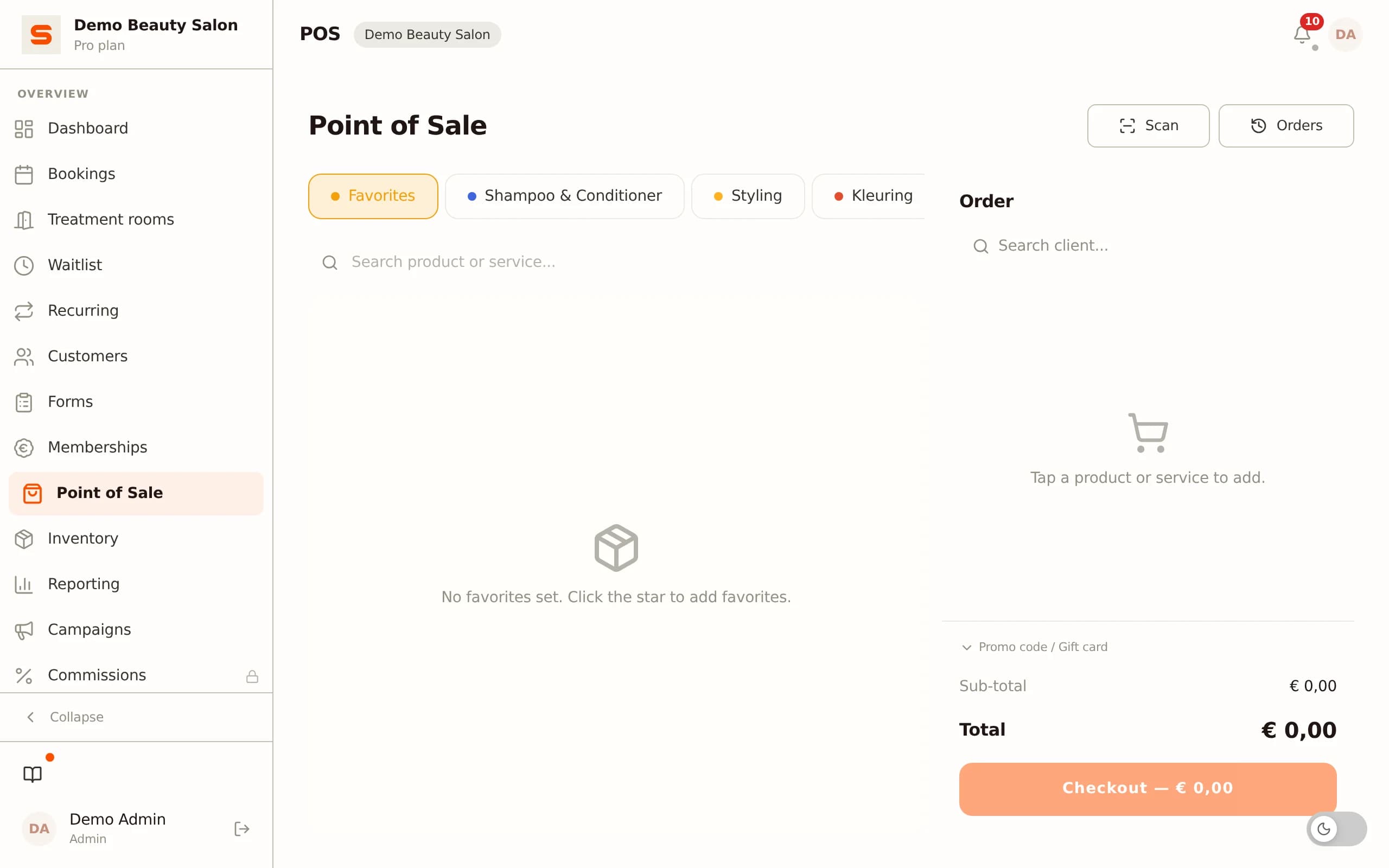
A terminal that fits your salon. A compact card reader such as SumUp's is a low-threshold choice for many small salons and freelance stylists: you buy the terminal once and then pay only per transaction, with no fixed monthly contract. For larger salons a Mollie terminal can make more sense, because it runs seamlessly on the same payment connection you also use online.
Card in the checkout. In Salonnare's till you simply pick the payment method at checkout: card, cash, iDEAL or gift card. The treatment and the amount are already prepared from the appointment, so you only confirm. The receipt is automatically linked to the client and the day, so your daily close adds up by itself.
Cash stays possible. Not every client pays by card. You register cash payments in the till as a separate method, so your cash count and your daily overview always balance. A mixed payment - part card, part cash - is no problem either.
Online prepayment at booking
Besides paying at the desk, you can also let clients pay at the moment they book. That is a payment method in its own right, and different from a deposit: with prepayment the client settles the full treatment online before arriving, whereas a deposit is only a part and mainly serves to discourage no-shows.
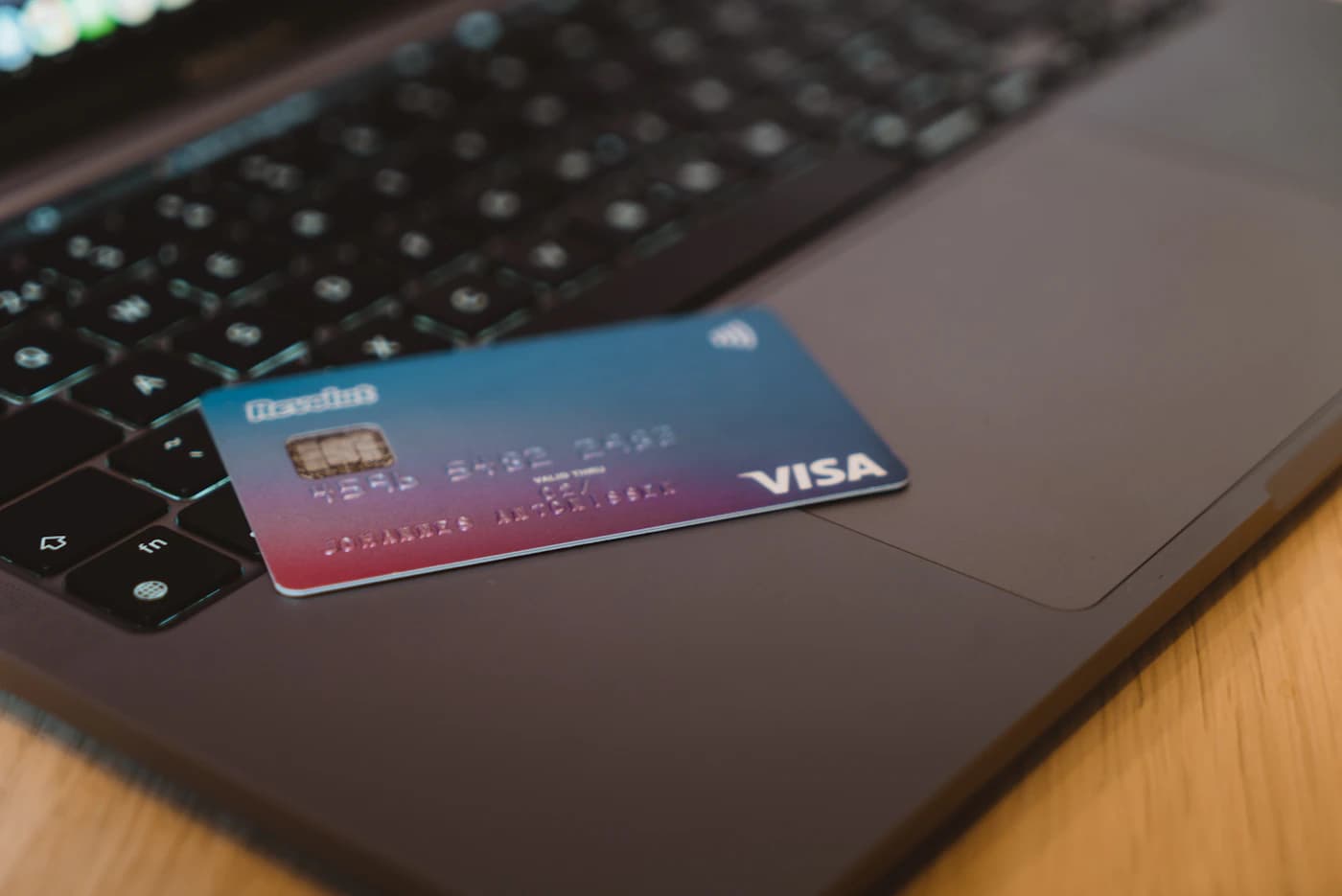
When prepayment helps. For treatments with a lot of preparation or costly materials - an extensive colour treatment, an acrylic set, a long facial - prepayment gives certainty. The revenue is locked in before the appointment starts, and at the desk nothing is left to do but wave the client off.
How it works. When booking online the client picks a treatment and settles it straight away through iDEAL or card. The payment lands in your own account and is linked to the appointment. If the client does not show up, you set your own refund policy.
Prepayment versus a deposit. If you do not want clients to front the full amount but do want a barrier against no-shows, you use a deposit: a fixed amount or percentage locked in beforehand and settled against the final bill later. Both run through the same payment connection. Which you choose depends on your treatments and your client base - you can even set it per service.
Automatic VAT splitting on the receipt
A payment method is only complete when the receipt it produces also holds up for your bookkeeping. In many countries a receipt for a service provider must show VAT separately, and salons often work with several rates at once.
Services and products mixed together. A treatment falls under a different VAT rate than a retail product you sell. If a client settles a colour treatment together with a bottle of shampoo and a gift card, the receipt has to split those items correctly. Working it out by hand is error-prone and eats time at your quarterly return.
How Salonnare handles it. Each service and product is given the right VAT rate once. At checkout the till automatically splits the total into the underlying VAT amounts, regardless of the payment method chosen. The receipt shows the amount excluding VAT, the VAT per rate and the total - exactly what the tax rules ask of service providers.
Ready for your accounts. Because every checkout is recorded with the right VAT, you can export your revenue per period to your accounting tool or accountant without any recalculating. That saves hours at the end of each quarter. See how the salon point-of-sale combines payment and administration.
Payouts to your own account versus commission models
The biggest difference between payment systems is not in the methods they accept, but in what happens to your money afterwards. Broadly there are two models, and the difference adds up to serious amounts.
Model 1: payouts to your own account. You connect your own payment account (Mollie or Stripe) to your salon software. Your client's payment lands in your account, minus the provider's own transaction costs and the platform fee mentioned below. Your software - Salonnare in this case - costs a fixed monthly price and takes no marketplace commission from your revenue (just a platform fee of 0.5%, min. €0.30, per online payment). This is the model that protects your margin.
Model 2: commission per booking. Some marketplaces and booking platforms earn a percentage of every appointment that runs through them, on top of any transaction costs. That can look attractive for new clients, but with existing, returning clients you pay a commission again and again for revenue you would have had anyway.
Do the maths. Say you turn over 6,000 euro a month. A platform that charges 3 percent per booking costs you 180 euro a month - more than the most expensive fixed monthly price, and it grows as you grow. A fixed price costs the same whether you have 20 or 200 clients. For a growing salon that difference is substantial over a year.
What Salonnare does. Salonnare follows model 1: a fixed monthly price with no marketplace commission on your bookings - only a platform fee of 0.5% (min. €0.30) per payment - and payments that land straight in your own account. The data sits on EU servers and the software is available in nine languages, so an international team can work with it too.
What to watch for when choosing payment methods
Before you commit to a payment system for your salon, run through these points. They decide whether the system saves you time and money in the long run or costs you.
1 - Does it support iDEAL and card as standard? For the Dutch market these are the two indispensable methods. A system that only offers credit card or iDEAL by a detour is awkward in practice.
2 - Where does the money land? Check whether payments arrive in your own account and how quickly. A payout that takes weeks squeezes your cash flow.
3 - What are the real costs? Look beyond the monthly price: is there a percentage per booking, and what are the provider's transaction costs? Add both up to compare.
4 - Is the payment linked to the appointment? A payment that is automatically booked against the right appointment or order saves manual re-typing and mistakes in your revenue records.
5 - Does the receipt hold up for the tax office? The receipt must identify your business, show the date and time, specify the services and state VAT separately. Check that beforehand.
6 - Can you combine several payment methods? A client who pays partly with a gift card and partly by card should be handled in a single checkout.
7 - Test with real transactions. Ask for a trial period and run the full flow: card, iDEAL, redeeming a gift card, a daily close. Only then do you see whether it holds up in practice.
Conclusion: pick methods your clients already know
The best payment setup for a salon is not complicated: iDEAL and card for your clients' convenience, cash for those who want it, and online prepayment where it gives you certainty. More important than the number of methods is what sits behind them: payouts to your own account, a fixed monthly price with no marketplace commission per booking, and a receipt that holds up for the tax office by itself.
With Salonnare you connect your own Mollie or Stripe account, settle iDEAL, card and cash in the same till as your calendar, and keep almost your full margin: no marketplace commission, just a platform fee of 0.5% (min. €0.30) per online payment. You start for free on the Free plan (0 euro, 1 staff member, 50 bookings a month); as you grow you pick Starter (29 euro) or Pro (59 euro).
Create a free account at salonnare.com/en/free and set up your payment methods in a few minutes.
Frequently asked questions
Which payment methods do I need at a minimum in my salon?
For the Dutch market iDEAL and card are indispensable, topped up with cash for smaller amounts and tips. iDEAL is mainly for online payments and prepayment at booking; card for checkout at the desk. With these three you leave almost no client out. Gift cards and, for international clients, credit card or Bancontact are handy additions but not a basic requirement.
What is the difference between a payment method and a deposit?
A payment method is how your client pays: iDEAL, card, cash or online prepayment. A deposit is not a separate method but a moment: at booking the client locks in part of the amount, usually to discourage no-shows. That deposit is simply settled through one of the payment methods (usually iDEAL) and offset against the final bill later. So you can use prepayment or a deposit, but both run through the same payment connection.
Do I pay a percentage on every booking with Salonnare?
No marketplace commission. Salonnare uses a fixed monthly price (Free 0 euro, Starter 29 euro, Pro 59 euro) and keeps no percentage of your bookings or revenue for a marketplace. On top of your own payment provider's transaction costs (Mollie, Stripe or your card terminal), you do pay Salonnare's own platform fee of 0.5% (min. €0.30) per online or card payment. With a platform that charges commission per appointment, you pay along again and again on your most popular treatments.
Does the money from iDEAL and card payments land in my own account?
Yes. You connect your own Mollie or Stripe account to Salonnare, and payments land in the bank account attached to that account - your business account, not Salonnare's. Only the provider's transaction costs and Salonnare's platform fee of 0.5% (min. €0.30) per online payment are withheld. That way you keep control of your cash flow and do not have to wait for a middleman to pass on your revenue.
Does the till split VAT on the receipt automatically?
Yes. You give each service and product the right VAT rate once. At checkout Salonnare automatically splits the total into the underlying VAT amounts, regardless of the payment method. The receipt shows the amount excluding VAT, the VAT per rate and the total, as the tax rules ask of service providers. You export your revenue per period to your accounting tool with no manual calculation.