



Salon loyalty program: customer retention that lasts
A salon that has to win new clients every month just to survive has a leak in the bucket. Real continuity comes from regulars: someone who returns three or four times a year pays the full treatment price each time - and refers friends in between. But regulars do not become regulars on their own. They need a reason to come back to you instead of trying the new salon around the corner or accepting a marketplace deal. A loyalty program gives that reason a concrete structure: clients build up points with every visit, reach a tier that earns them something, and watch their history with you grow visibly. Not random discounts that eat into your margin, but a system that rewards repeat behaviour directly. This article describes how a loyalty program works in practice for salons, which mistakes you want to avoid, and how to set it up technically without needing a separate tool for it.
Customer retention versus winning new clients
Attracting new clients typically costs considerably more than keeping existing ones - that is a basic principle in marketing. For salons this is even more concrete than in most other industries: a new client who finds you through Google still has to get to know you, has to build trust in your quality, and rarely spends more than the base package on a first visit. A returning client knows what she wants, books extra services more often, cancels less and responds faster to a reminder.
Three figures are relevant if you want insight into the value of retention for your salon:
Visit frequency. How often does an average client come per year? For hair salons this typically sits at six to eight visits (every six to eight weeks), for beauty salons at four to six. Every extra visit per client per year is direct revenue growth without acquisition costs.
Average spend per visit. Returning clients know your services and are more likely to choose combinations. A client who knows she is almost at the next tier adds a treatment or product more readily to cross the threshold.
Referrals. Loyal clients who are enthusiastic talk about your salon - that is not something you can force, but it is a pattern you can reinforce by making loyalty an explicit theme.
A loyalty program addresses all three: it gives clients a reason to come back more often, higher tiers encourage higher spending, and it gives clients something tangible to talk about.
How a loyalty program works: points, tiers and rewards
The basic structure of a loyalty program for salons consists of three layers that build on each other.
Points
With every paid treatment or purchase the client earns a number of points, proportional to the amount. A treatment of €60 gives 60 points; a product of €25 gives 25 points. Points are stored in the client profile and are visible to both the client and the staff member at checkout.
Tiers
Based on the total points earned, a client reaches a higher level. A simple and workable example: Base (0-499 points), Silver (500-1,499 points), Gold (1,500 points and up). Higher tiers bring structural benefits, such as an increased point rate per euro, priority when the calendar is full, or a fixed discount percentage on products.
Rewards
Points only become valuable once there is something in return. Common options are: redeeming points for a discount voucher (€10 per 500 points), a free treatment after reaching a certain balance, or a birthday gift for active participants.
The key is simplicity. Salons that set up an overly complex system - with multiple point categories, short expiry periods, complicated redemption rules - see low participation. Clients must understand at a glance what they earn and when they can claim something. Also give your tiers names that fit the atmosphere of your salon: "Bronze / Silver / Gold" works, "Level 1 / Level 2 / Level 3" feels impersonal.
Five pitfalls with salon loyalty programs
Loyalty programs that do not work almost always carry one of the following mistakes. If you recognise one or more in your current approach, that is the starting point for improvement.
1. Rewards that are never reachable. If a client needs 5,000 points for a reward and earns 60 points per visit on average, she has to make more than 80 visits. That is not motivating - it works against you. Make sure the first meaningful reward is reachable after six to eight visits. A client who knows she is almost there comes back faster than someone for whom the finish line is out of sight.
2. Points that expire without warning. A client who has saved points and loses them because she has not been in for a year feels punished instead of rewarded. Opt for no expiry date or - if you consider an expiry date commercially necessary - send a reminder by email at least four weeks in advance.
3. Only discounts, no sense of status. Discount programs are interchangeable: every competitor can offer something similar. A client who is "Gold" at your salon has a feeling of recognition that is harder to imitate. Make sure higher tiers also have non-monetary benefits: priority when the calendar is full, first notice of new services, or a personal touch on a birthday.
4. Staff who do not actively use the system. A loyalty program only works once every client knows it exists. That requires active communication at the till, not just a small line of text on the website. Train staff to mention the balance at every checkout: "You now have 380 points - 120 to go until Silver." That is one sentence that makes clients aware of their progress.
5. No visibility for the client. Clients must be able to see their balance - by email after every transaction or via the booking confirmation. If the balance is invisible outside the salon, the program does not exist for the client. Communicate the point balance actively: in the confirmation email after checkout, and in the reminder for the next appointment.
How Salonnare sets up the loyalty program
In Salonnare the loyalty program is built into client management, the POS checkout and the booking flow - without you needing an external tool for it.
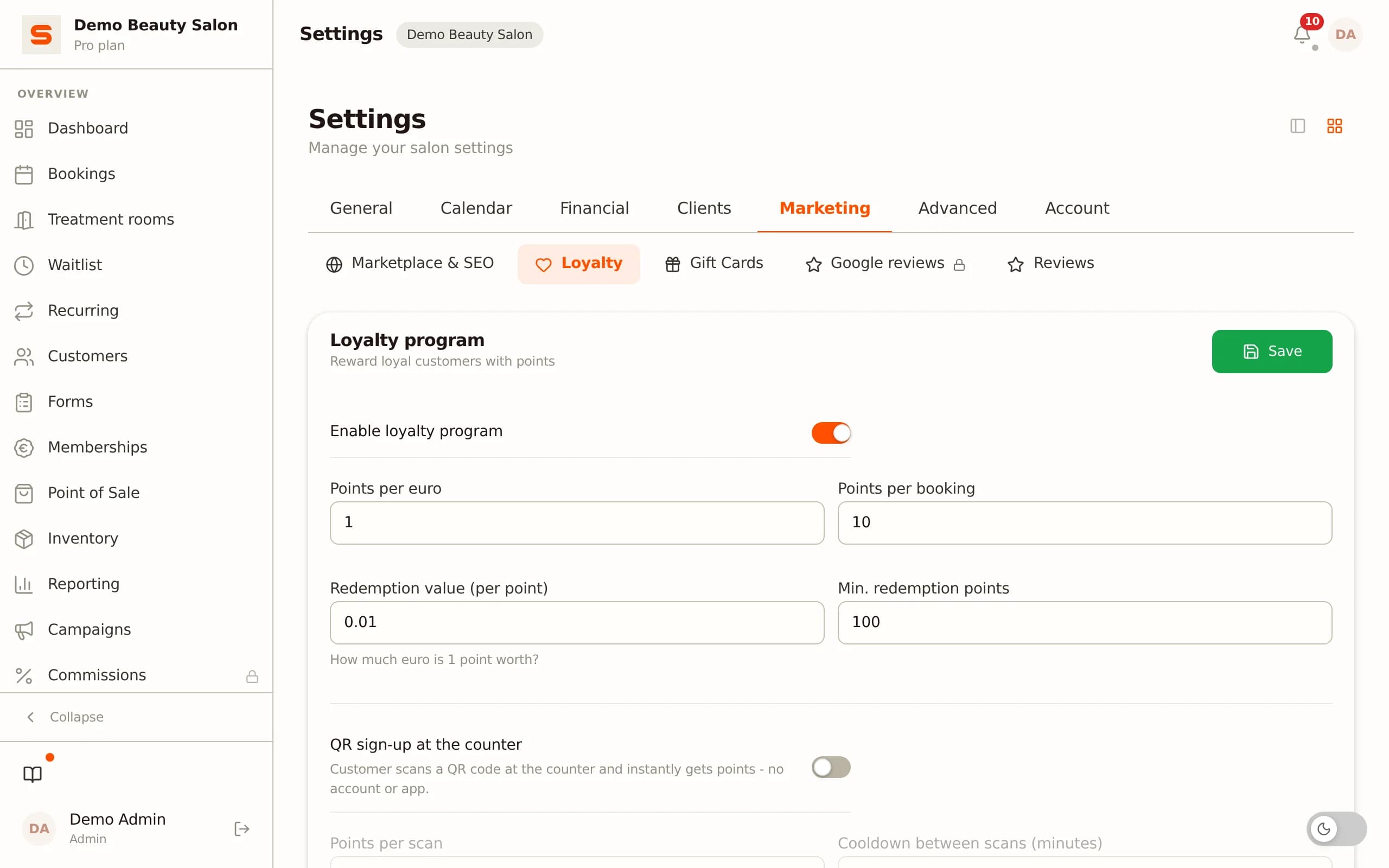
Settings per salon
Via Settings - Loyalty you set the basic parameters: how many points per euro, how many points make a full card and what that card is worth as a discount. Once you save the settings, new transactions are processed and credited automatically.
Defining tiers
You create the tiers yourself with a name, a minimum total spend and a badge colour. Salonnare shows the tier on the client profile; the point rate is the same for every tier, so which benefits a tier brings (a gift, priority, a personal touch) is up to you.
Processing points automatically at POS checkout
As soon as a booking is settled via the POS, the points earned are credited automatically to the client profile. The current balance and the active tier are immediately visible in the client profile alongside the payment history. Staff do not have to register anything manually.
Enrolling clients via QR code
To enrol clients, Salonnare generates a QR enrollment code that you can print or place on your counter. Clients scan the code with their phone and enrol themselves in the program - without you having to do anything manually per client or process a separate form.
Balance visible in the client profile
Staff see the current point balance, the active tier and an overview of recent transactions for every client. That way you immediately know when someone is close to a tier transition and can act on it during the conversation: "You are almost there - would you perhaps like to add a care treatment too?" That is not an artificial sales trick, it is relevant information at the right moment.
Existing clients you want to include in the program retroactively can be given a starting point balance manually via the client profile. This way loyal clients do not have to start from zero at the launch of the program.
Starting a loyalty program: three practical steps
A loyalty program that works is something you build up step by step. Here is an approach that works for most salons.
Step 1: Choose a simple model and set it up. Start with one point rate (1 point per €1), two or three tiers and one reward option (voucher at X points). Make the first reward reachable after five to seven average visits. After three months you evaluate participation and redemption behaviour - then you adjust.
Step 2: Launch actively, not passively. A loyalty program that sits quietly on the website does not exist for your clients. Tell every client about the program at the next checkout, mention it in the confirmation email and hang the QR enrollment code visibly in the salon. Plan a specific launch week during which staff actively introduce the program to every client.
Step 3: Measure and adjust. Reserve fifteen minutes once a quarter for a loyalty review: how many clients are enrolled, how many points have been earned, how many rewards have been redeemed, and are there clients who are close to a tier transition but have not come back? That last group is a concrete reason for a targeted reactivation email.
Customer retention is a process, not a campaign. Whoever consistently takes small steps - sending a reminder, a staff member who mentions the balance, a reachable first reward - builds noticeably more repeat visits over a year than whoever waits for the perfect launch.
Want to run all of this without a separate loyalty tool? Start for free at salonnare.com/en/free - no credit card required - and switch to the Starter plan (€29 per month) when you want to use the loyalty programme.
Frequently asked questions
How many points per euro is a good starting value?
A common starting rate is 1 point per €1 spent, with a first reward at 500 points - equivalent to €10-€15 discount after roughly €500 total spend. That is attractive for clients without weighing heavily on your margin. Adjust the rate after three months based on participation and redemption frequency: if hardly anyone reaches the first reward, the rate is too low or the threshold too high.
Are loyalty points taxable?
Points that are redeemable for a discount on a treatment are treated for tax purposes as a discount on revenue at the moment of redemption - not as separate income when earned. Points that expire without being redeemed generally do not lead to a tax liability. The exact treatment depends on your accounting system and your setup. Discuss this with your accountant, especially if you link points to external gift cards or physical products.
Can I add existing clients to the loyalty program retroactively?
Yes. Via the client profile in Salonnare you can manually set a starting point balance for existing clients. A practical approach at launch: assign loyal clients a starting point balance straight away that corresponds to their historical spend. That way they do not start from zero, the recognition feels immediate and there is a concrete reason to actively inform them about the new program.
What if a client wants to redeem her points but the voucher is not in the system?
Salonnare makes it possible to credit or deduct points manually in the client profile, so you can act flexibly with exceptions. Always make sure, though, that there is a pre-communicated redemption rule - clients who cannot cash in their points lose trust in the program. The simplest safety valve: set up one basic voucher that is always redeemable at the till.