



How to choose salon software in 2026: the complete guide
The range of salon software has grown considerably in recent years. There are now dozens of platforms claiming to handle everything: appointments, point of sale, staff, marketing and more. But more choice does not make the decision easier - quite the opposite. Salons that rush into the most popular platform often hit limits within a few months that they never anticipated: a till that does not connect to local payment methods, a staff module that is too limited for their shift schedule, or an opaque pricing model where every extra feature costs separately. A good decision does not start with a demo, but with an honest picture of what your salon actually needs. This article helps you make that assessment. You will read which questions to ask before you switch, which features are essential for most salons, and where the pitfalls hide that only become visible later.
Five questions to ask before you request a demo
Most salon owners begin their search with a Google query or a recommendation from a colleague. That is a fine starting point, but going straight to a demo without your own analysis means letting the presentation lead you rather than your own needs. Ask yourself these five questions first.
1. What are your three biggest daily frustrations? Not "what would be handy", but what concretely costs you time or money right now. Double bookings? Too many no-shows? A till that does not match how you want to take payment? Software that solves those specific problems is worth more than a platform that does everything a little bit.
2. How many staff members will use it and what are their roles? A solo hairdresser has different needs than a salon with seven stylists and a front desk. Check whether the platform distinguishes between roles - owner, staff member, administration - and whether you can set access rights per person. A staff member who can accidentally reach the bookkeeping, or export client data, is a security risk.
3. How do clients currently move through your booking flow? Do clients mainly book via Instagram, via your own website, via Google, or still by phone? Make sure the software connects to the channels where your clients already are. An online booking module that only works as a separate link and cannot be easily integrated into your website or Google profile creates unnecessary friction.
4. What are the real total costs? Many platforms advertise an attractive entry price but charge extra for modules such as inventory, email marketing or multiple locations. Ask for a complete overview of the costs for your specific usage - including transaction fees on payments through the platform. A platform that takes a percentage of every paid booking quickly costs more for a busy salon than a platform with a fixed monthly rate.
5. How is switching handled if you want to move later? This is the question nobody asks in the excitement of a fresh start. Yet it is crucial: can you export your client data, booking history and product list? In what format? Platforms that do not offer a full data export create a lock-in that you only feel once you want to leave.
Which features are essential for every salon
Not every salon has the same needs, but there are features that form the foundation for virtually every salon. If a platform falls short on one of these points, that is a reason to keep looking.
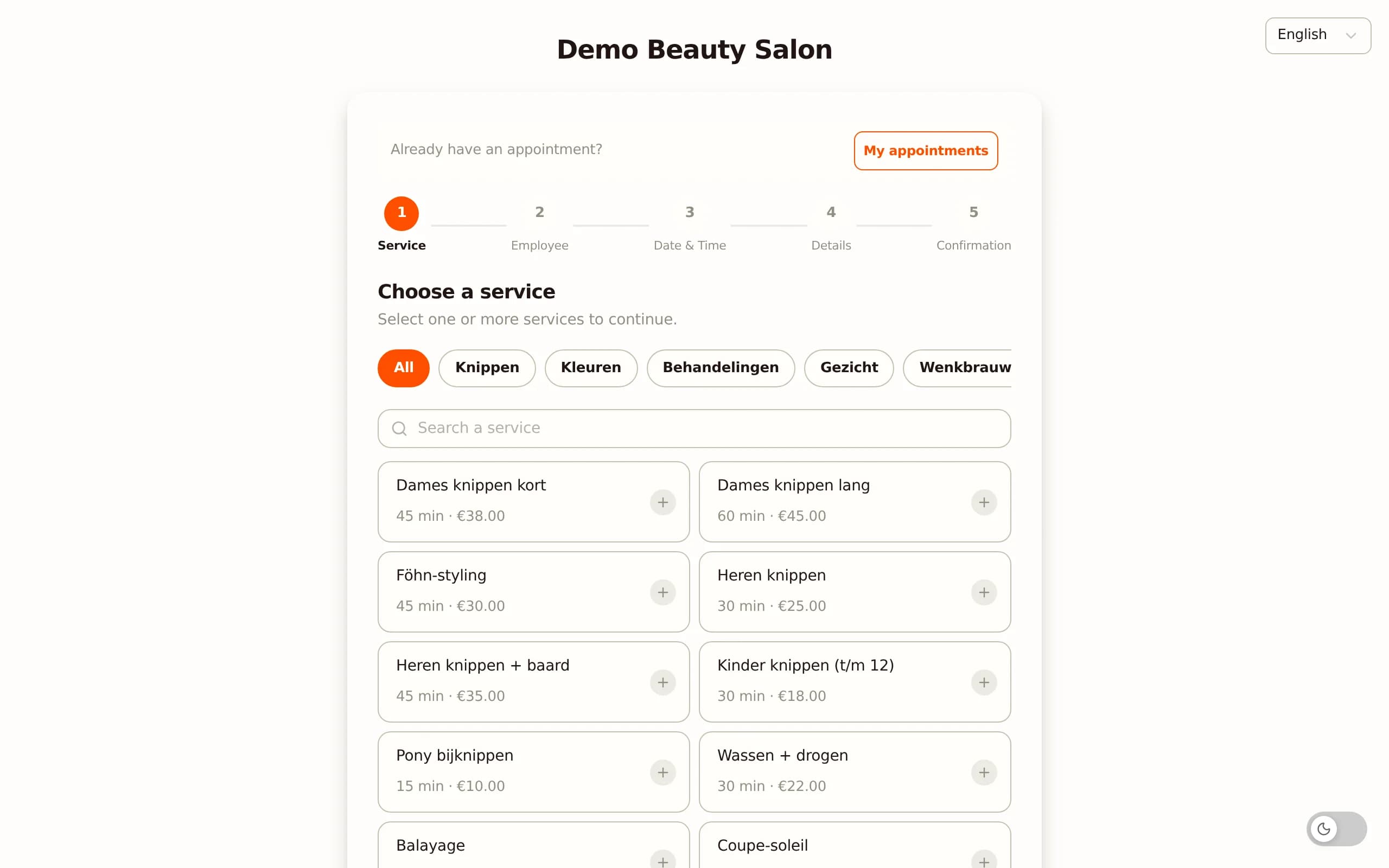
Online bookings 24/7 Clients increasingly book outside opening hours. A booking system that shows real-time availability, allows multiple services in one booking and automatically sends a confirmation email is the standard in 2026 - not an extra.
A till that matches your local market Clients expect to be able to pay by card, online and in cash. Also check how receipts are stored and whether the system connects to your accounting software. A POS module that forces you to use a separate provider for payments doubles the administration.
Staff planning and work schedules As soon as you have more than two staff members, keeping track of schedules and availability by hand becomes a full-time job. Look for a system that automatically translates schedule changes into availability in the calendar, so clients can never book a slot when a staff member is off.
Commission and revenue overview per staff member If staff work on commission or as freelancers, you need a system that automatically tracks how much revenue each person generates - per service, per period. Calculating by hand at the end of the month costs time and regularly leads to disputes.
GDPR compliance Salons process clients' personal data: name, contact details, treatment history and sometimes health-relevant information such as allergies or skin conditions. Check whether the software states where data is stored, who has access, how long data is retained and how you can comply with access and deletion requests. A platform that gives no clear answer here shifts the compliance risk onto you.
Three pitfalls that only show up after you switch
A demo or a first look at a platform mainly shows its best side. The friction you only encounter after months of daily use stays invisible at the start. So watch out, in practice, for three pitfalls.
Pitfall 1 - Speed as you scale A platform that runs smoothly with ten clients and two staff members can become sluggish with a hundred clients and a full calendar. Do not just test in an empty environment - ask about the experiences of salons of a size comparable to where you want to be in a year.
Pitfall 2 - Customer support when things go wrong A till that freezes on a Friday afternoon, a booking that appears twice in the calendar, a staff member who cannot log in - these situations demand fast support. Ask in advance how support works: email only or also phone/chat, in which time zone, and in which language. English-only support is a real barrier if your staff do not speak English.
Pitfall 3 - Hidden price increases Some platforms start cheap but raise prices after a year or move features to a higher tier. Read the contract for the term, notice period, automatic renewal and the conditions for price changes, and test with a free plan before you commit to anything.
How Salonnare meets the most common needs
Salonnare was built for beauty and hair salons, with the practical needs of day-to-day salon management as its starting point - not a generic SaaS platform adapted after the fact.
Online booking and multi-service appointments Clients can book multiple services in a single appointment via the public booking page - each service optionally linked to a different staff member. The page is linkable from your website, Google profile or Instagram bio and works on mobile without a separate app. Availability is calculated in real time based on the work schedules.
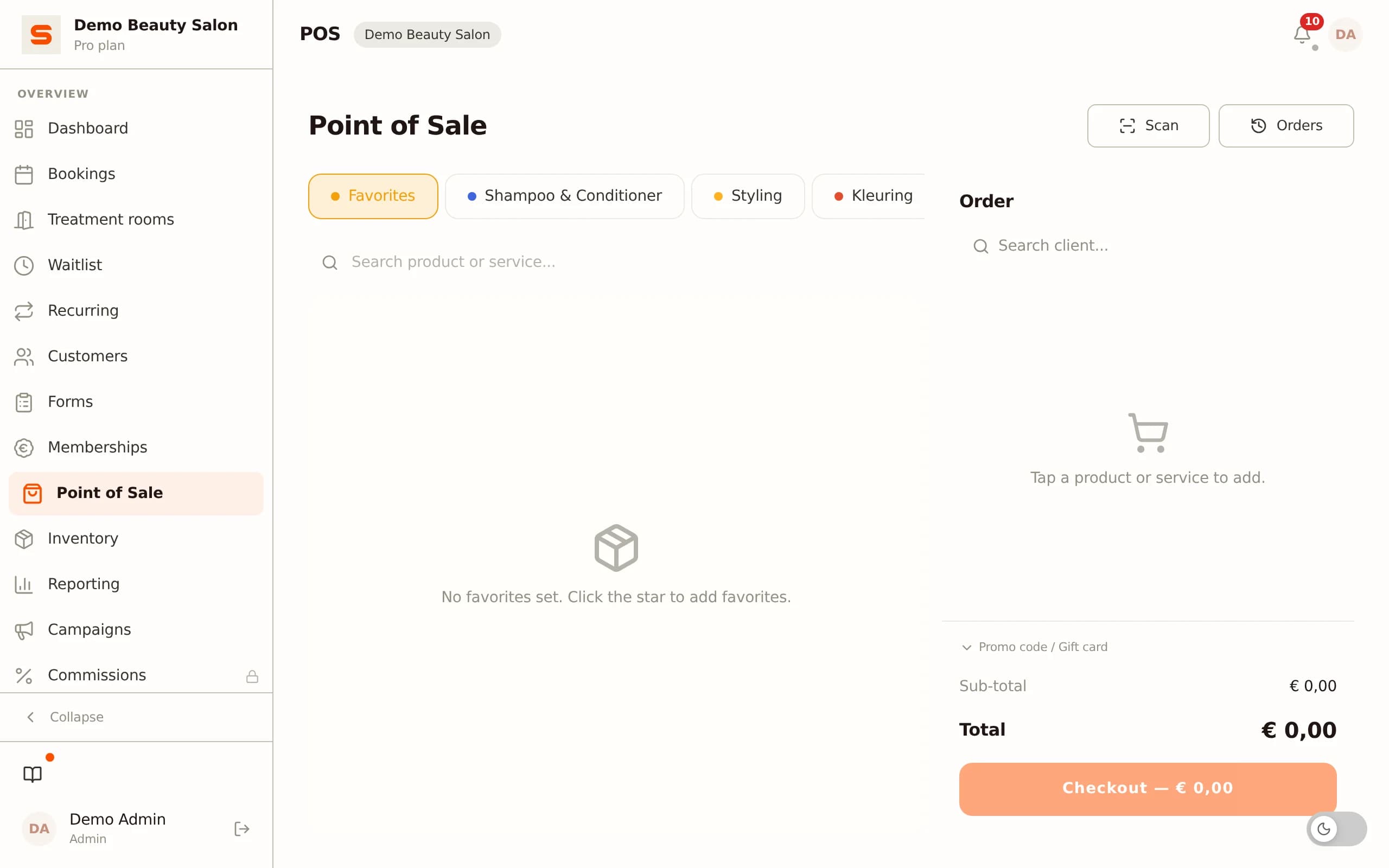
A till with local payment methods The POS module supports card, online and cash payments. In the Pro plan, Salonnare also calculates commission per staff member, which you export as a CSV or SEPA file for the payout.
Staff planning and role management Schedules, availability per staff member and access rights are set separately. A staff member only sees their own calendar; an owner has access to the full overview. When a schedule changes, availability in the booking module adjusts automatically.
GDPR compliance built in Salonnare meets GDPR obligations for beauty salons, including an encrypted health-data vault for special categories of personal data - relevant for salons that keep clients' allergies, medication lists or skin conditions on record. Data is held on servers within the EU. Client data can be exported, edited and deleted via the client profile.
Inventory and gift cards Product stock is tracked per sale; when a threshold is reached, an alert appears. Gift cards are sold and redeemed through the till with automatic balance tracking - no separate administration alongside the system.
Sign in with an existing account Staff and owners can log in with their Google or Microsoft account, without having to remember a separate password. This lowers the barrier when onboarding new staff and reduces the chance of weak passwords.
Frequently asked questions
Do I really need to choose a platform built specifically for salons?
Not necessarily, but it saves a lot of configuration work. Generic business software or general booking apps often require customisation to work the way a salon needs: multiple services per appointment, per-staff availability, till flows that mix products and services, and compliance with industry-specific GDPR requirements. Salon-specific software has that logic built in as standard.
How long does it take on average to move a salon to new software?
With a CSV import of client data and services, the basic setup in a medium-sized salon can be done in half a day. What takes more time: onboarding staff, entering schedules and fine-tuning the online booking page. Plan on one to two working days for a salon of up to five staff members. Schedule a switch during a quiet period of the year - not just before the holidays or in the first week of January.
Is cloud-based software safe for client data?
That depends on the provider. Check where the servers are (EU = within GDPR jurisdiction), whether data is encrypted at rest and in transit, how backups work and who has technical access to your data. Ask the provider for a data processing agreement - as a salon you are legally required to have one if you process personal data through a third party.
Does Salonnare have a trial period?
No, there is no countdown trial. Salonnare has a free plan with no time limit: via salonnare.com/en/free you start and keep working for free as long as you like, with no expiry date and without having to enter a payment method straight away. You get access to the core functionality - online booking, point of sale, client management and email reminders (inventory management comes with the Starter plan) - so you can take your time trying out the daily flow in practice. If you need more later, you upgrade to a paid plan whenever it suits you.
What if my salon grows later and I add more locations?
Check in advance whether the platform supports multiple locations under one account and how the pricing structure changes then. Some platforms charge per location, others per user, others a fixed rate regardless of scale. For a salon considering growth into multiple branches, this is one of the first questions to ask before you sign.