



How to calculate staff commission on repeat appointments
A new client brings a first appointment, and often a series of follow-up treatments. If you calculate staff commission, decide up front whether those repeat visits count. This article keeps the first booking and repeat appointments apart and works through real numbers.
Keep the first booking and repeat visits apart

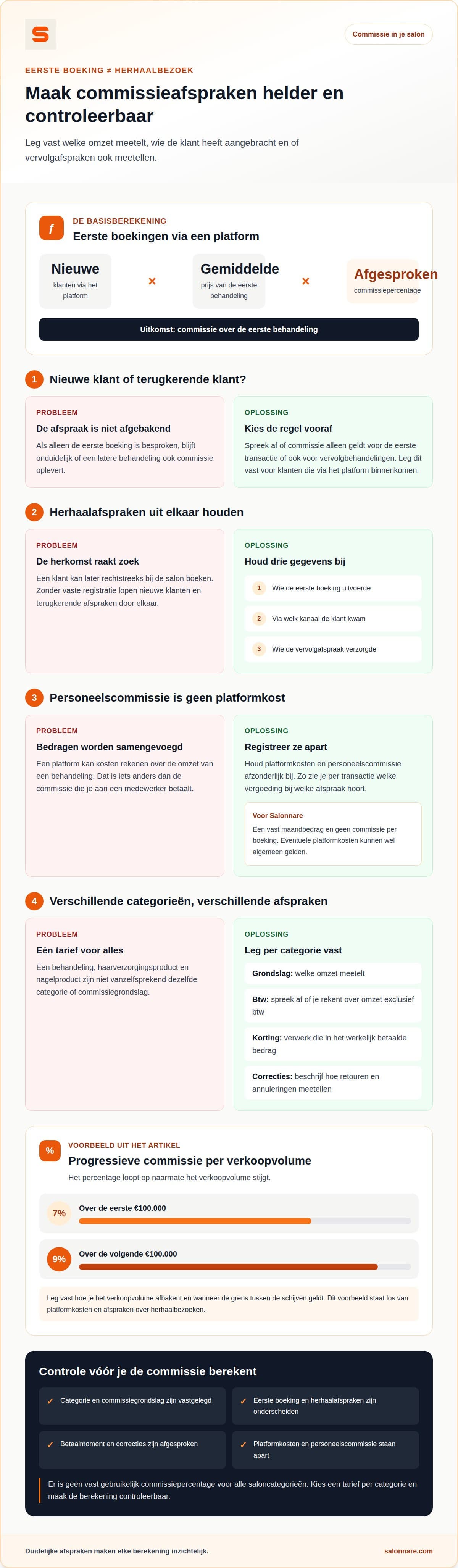
The basic formula is simple: number of new clients × average price of their first treatment × commission rate. That sum covers the first appointment only. What happens afterwards needs its own agreement.
- First appointment only: the stylist earns commission on the first treatment, nothing after. - Repeat visits too: commission continues when the same client returns, perhaps at a lower rate. - Switching stylists: decide who gets the commission if a client returns to a colleague.
Record who did the first treatment, which channel the client came from and who did the follow-ups. Use the same definitions every month, or new and returning clients blur together.
Worked example: 10 new clients and their repeat visits
Numbers you can check yourself. All amounts exclude VAT.
1. First treatment: 10 new clients × €45 average = €450 revenue. At 20% commission: €450 × 0.20 = €90. 2. Repeat visits: each client returns 3 times at €45. That is 30 visits × €45 = €1,350. At 5% for repeat visits: €1,350 × 0.05 = €67.50. 3. Total: €90 + €67.50 = €157.50 commission on this group of new clients.
Without a repeat-visit rule it stays at €90. The €67.50 difference is exactly what to discuss with your team.
Keep payment costs separate. When a client pays €45 online or by card, Salonnare takes a 0.5% fee with a €0.30 minimum. 0.5% of €45 is €0.225, so the €0.30 minimum applies. That is a cost for the salon, not part of your employee's commission. Record both amounts separately.
Rates per category and the calculation base
There is no standard commission rate for salon staff. Set the rate per category, such as treatments, hair products and nail products, and consider treatment time, products used and the employee's role in the sale.
Also agree:
- whether you calculate on the amount excluding VAT (21% Dutch VAT is never a commission base); - how discounts, returns and cancellations count: calculate on the amount actually paid; - when you pay out and how you handle corrections; - whether a target bonus comes on top.
With a progressive scheme the rate rises with volume, for example 7% on the first €100,000 and 9% on the next €100,000. Describe how you define the volume. For employees in the Netherlands, the statutory minimum wage still applies: commission does not replace it.
For more on per-employee calculations, read commission calculation for hair salons.
How Salonnare helps
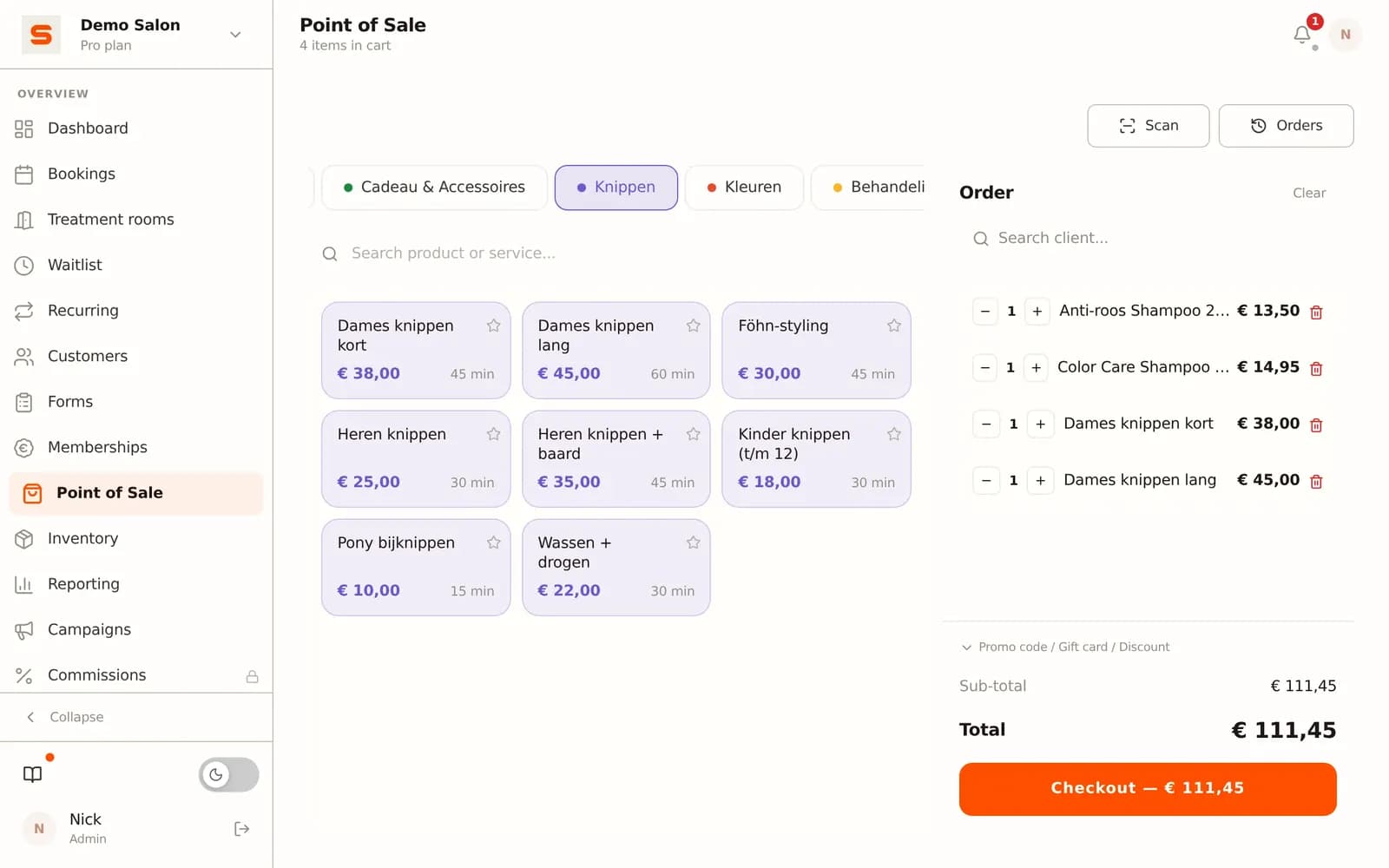
With the POS with VAT handling you record every sale per employee and per category. The commissions page shows how to track agreements per employee. You can place online booking on your own website and via Google. Salonnare charges no marketplace commission on new clients. A 0.5% transaction fee (minimum €0.30) does apply to online and card payments.
Free costs €0 per month, Starter €9.99 and Pro €14.99 per month, excl. VAT and cancellable monthly. See pricing.
Make commission a routine: put the agreements somewhere you and your team can find them, note changes immediately and discuss them before they take effect.
Salon admin that adds up
Start free with Salonnare and keep sales and appointments per employee in order.
Start freeFrequently asked questions
How do you count commission on new clients?
Track new clients separately and calculate commission under your agreement. Multiply the number of new clients by the average price of their first treatment and the rate. Leave repeat appointments out unless you have agreed they count.
Why pay commission?
Commission rewards measurable contributions such as performing treatments or selling products. Be clear about which behaviour you want to reward, because a scheme that only pushes retail can neglect other work.
How do you calculate commission for salon employees?
Multiply the agreed revenue base by the commission rate and add fixed payments separately. Define which treatment or sale counts, how you treat discounts and when you pay out. Record the employee and category per transaction.