



Announcing a price increase to clients: timing, wording and how many you can afford to lose
Ideally you announce a price increase 4 to 6 weeks before the new rate starts. Say what changes, by how much and from which date. This article shows how to do that, how to explain the value, and with a worked example how many clients you can lose before you are actually worse off.

Should you announce a price increase, and when?

Yes, tell clients before new prices apply, so they do not discover the rate at their next appointment. A usual notice period is 4 to 6 weeks, 2 to 3 months for regulars, and 60 to 90 days for annual contracts.
Pick a date that is easy to remember, such as the start of a year or quarter. Write down which prices change, from when, and the new rate. Give the reason briefly, for example higher rent or material costs. You do not need to apologise. A concrete example: "From 1 January this treatment costs €55."
With an existing contract, check the agreed terms first and make your announcement fit them.
Choose channels that suit your client contact: talk to clients in person during an appointment, follow up by email, and update your website and social media. Use the same date and explanation everywhere.
Show what clients get for the new price
Clients judge a rate not only by the amount but by what they get in return. Be concrete about what your treatment includes: personal attention, a result that fits their wishes, advice for home.
Where possible, pair the increase with something clients notice straight away, such as extra time for advice. A better experience does not always need a new component; clearer explanation can add value too.
Be precise about price and offer. If a course goes from 10 sessions to 8, spell out what is included and what clients can add. Record client preferences so your service stays personal. For setting the new price itself, see how to calculate the price of a salon treatment.
Worked example: how many clients can you lose?
Many owners fear an increase will cost clients. Check it with numbers you can fill in yourself. Say a treatment costs €50 now, you do 100 per month and materials cost €10 per treatment.
- Revenue now: 100 x 50 = €5,000 per month. - Margin now: 50 - 10 = €40 per treatment, so 100 x 40 = €4,000. - New rate: €55 (+10%), margin €45 per treatment. - Break-even on margin: 4,000 / 45 = 88.9. You need 89 treatments, so you can lose 11 (11%). - Break-even on revenue: 5,000 / 55 = 90.9, so 91 treatments; that is 9 fewer (9%).
Margin is the fairer measure, because fewer treatments also use less material. Fixed costs such as rent are kept equal in this example. Freed-up time can also be filled again. More on margin in calculating profit margin per treatment.
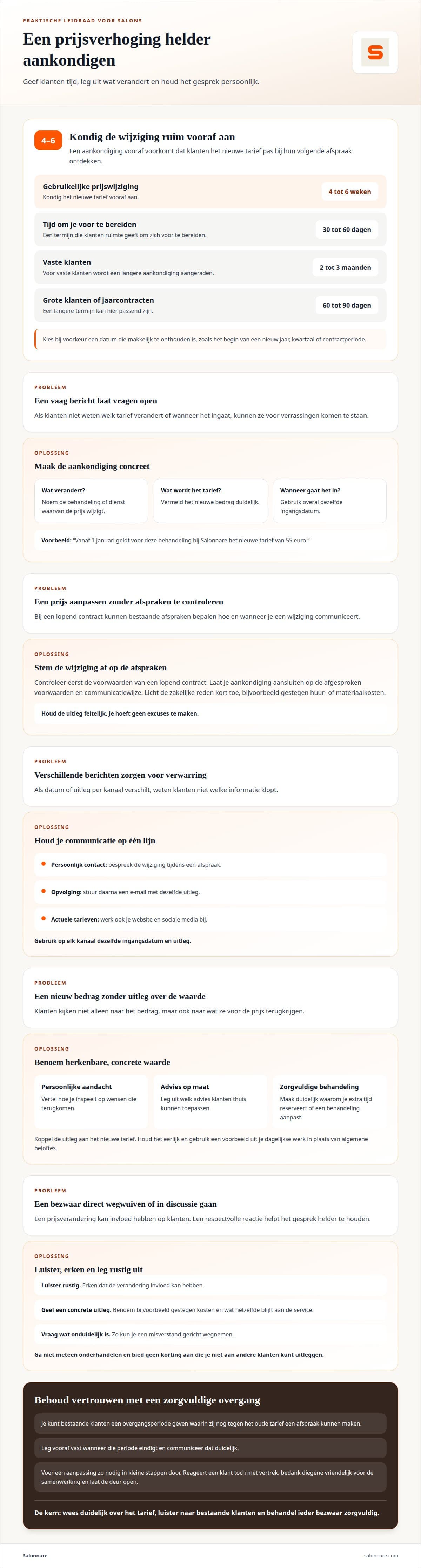
Keeping clients through a price increase
A new price does not automatically mean losing loyal clients. Offer existing clients a transition period in which they can still book at the old rate. Fix the end date in advance and communicate it clearly.
Keep the explanation factual: suppliers, rent or materials have become more expensive and you protect quality. Clients do not need to see a full business calculation.
When clients object, listen calmly, acknowledge the change may affect them, then give a short, concrete explanation. Do not start negotiating at once. Ask which part is unclear.
If a client leaves anyway, thank them kindly and leave the door open. Avoid a discount you could not explain to other clients. Keep track of reactions to spot recurring questions. If needed, raise prices in small steps instead of one big jump.
How Salonnare supports this
Salonnare lets you manage bookings, client records, stock and payments on one platform. You keep client preferences and handle rates and VAT clearly through the POS. The online booking widget shows clients current treatments and prices on your own website. Health data is stored in a separate encrypted GDPR vault.
Salonnare does not replace a personal conversation, but it helps keep the information behind client contact in order. Start free with Salonnare.
Pick one step now: discuss the new rates with your team and agree how you answer client questions. After the change, plan a fixed moment to review reactions: which questions return and which treatments do clients rebook?

About the author
Nick van Iersel · founder of Salonnare (VanIersel Development, Waalwijk)
Nick builds Salonnare together with the salons that use it. He writes about scheduling, point of sale, privacy and everything a salon runs into as a business.
More about Nick and his articles →Keep your rates and clients in order
Manage appointments, client records and POS in one place. The free plan costs €0 per month.
Start free with SalonnareFrequently asked questions
Do you have to announce a price increase?
Yes. Clients should know which rate applies before they choose or book a treatment. Also make exceptions clear, such as how you handle a punch card already bought or a treatment booked earlier.
When should you tell clients about a price increase?
As soon as the new rates are fixed and before clients book again. Think of clients who visit less often; they may otherwise miss the change. Make sure the information is visible when they consider a treatment.
How do you announce a price increase?
Keep the message easy to understand. Say which treatments change and which stay the same, with the start date and new amount. A short reason helps clients put the change in context.
How does a price anchor work when you raise prices?
A price anchor is a reference point clients use to judge a price. You can show a basic treatment next to a more extensive one and explain what each includes. Use only real options and make sure the comparison is accurate.
Which legal rules apply to price increases and price communication in the Netherlands?
With running contracts a price increase is not always simply possible. Clients must have been able to read the terms before agreeing. An increase can be invalid if consumers may not end the agreement because of it. If in doubt, ask a lawyer.