



Tax and bookkeeping for your salon: what you actually need to get right
Most salon owners started out of love for cutting, colouring, nails or skincare - not for bookkeeping. Yet administration is exactly the part that can derail a tax audit or, the other way round, protect your peace of mind. The law does not demand complex accounting from a small business, but it does demand a complete and verifiable record. This article lays out what the tax authority expects from a salon: which documents you must keep, how VAT returns work, when the small-business scheme is worth it, and how to make the whole process as light as possible so you have time left for your clients again. This is general guidance, not bespoke tax advice - that belongs with your accountant - but it is the foundation every salon owner should know. The specifics use the Dutch system as the worked example; the principles apply across most EU countries.
What records are legally required for a salon?
Tax authorities rarely prescribe a fixed format for your bookkeeping - they prescribe a result: your records must be organised so that an inspector can establish your rights and obligations within a reasonable time. Translated to salon practice, that means:
A complete revenue record. Every treatment and every product sale must be traceable. If you use a point-of-sale system, the cash journal is your foundation. If you take part card, part cash, both streams must reconcile with your bank statements and your cash book.
All purchase invoices. Backbar products, retail stock, equipment, rent, insurance, software subscriptions - any expense for which you want to deduct costs or VAT requires a valid invoice in your business name.
Bank statements and a cash overview. Your business account and - if you accept cash - a daily cash sheet. Note the difference between your cash sheet and your actual cash; structural cash discrepancies are a red flag in an audit.
Payroll records if you employ staff. Employment contracts, payslips, the payroll declaration and pension documents.
The tax documents themselves: your VAT returns, your income-tax or corporate-tax return, and the annual figures.
None of it has to be on paper. A digital record is fully valid, provided the data stays authentic, legible and complete throughout the retention period.
The retention obligation: how long must you keep everything?
The general retention period in the Netherlands is seven years. It applies to your general ledger, your accounts-receivable and accounts-payable records, your purchase and sales records, your stock data and your payroll.
There is one important exception: data on real estate (for instance if you buy your salon premises) must be kept for ten years, because the VAT adjustment period for property runs longer.
The seven years start counting after the end of the financial year the documents relate to. So an invoice from 2026 is kept until the end of 2033. Digital retention is allowed and, frankly, advisable: a solid backup of your accounting package and your POS data is safer than a box of fading receipts. Just make sure a scanned invoice properly replaces the original - do not keep a half-digital, half-paper mess where nobody knows which is the source document.
Practical tip: at each year-end, create one closed digital folder per financial year (revenue, purchases, bank, cash, tax documents) and store it somewhere with automatic backup. Then your archive is ready if the tax authority ever knocks, and you never have to go searching.
VAT for the salon: rates and returns
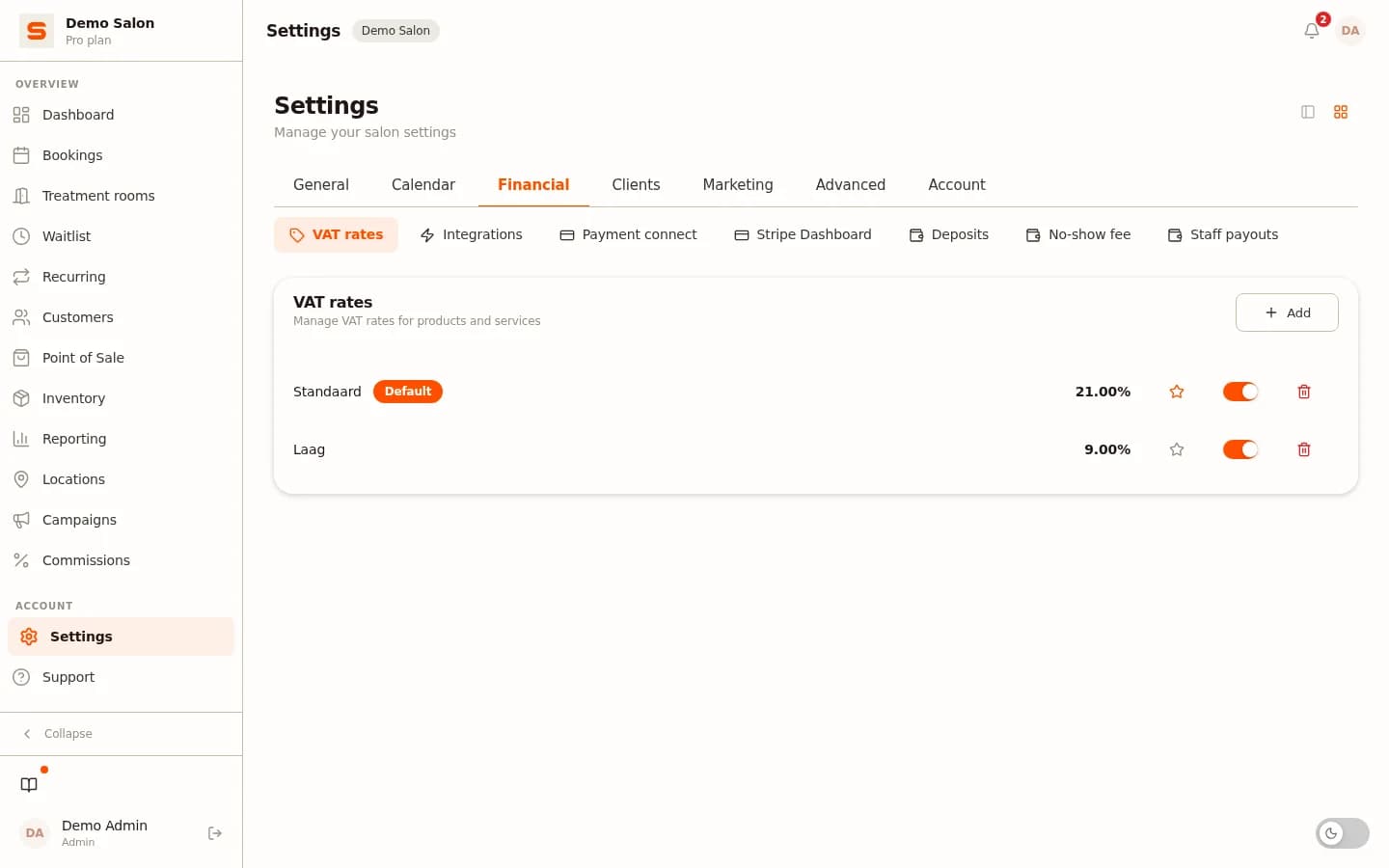
In the Netherlands a salon generally deals with two VAT rates that you must keep clearly apart.
The standard rate of 21% applies to the retail products you resell and to beauty treatments that are not characteristic hairdressing work. The shampoo a client takes home, facials, make-up, colour advice and nail work: all 21%. Beauty salons and nail studios therefore generally apply 21% on their treatments.
The reduced rate of 9% applies in the hairdressing trade to the characteristic hairdressing services - cutting, washing, blow-drying, colouring, perming and shaving - as well as to the products the hairdresser consumes during the treatment. Note: this reduced rate covers the hairdressing services themselves, not the retail products you resell and not beauty treatments, which stay at 21%. The line between what does and does not qualify for the hairdresser rate is not always sharp in practice; when in doubt, this is exactly a question for your accountant or the tax authority, because a wrong rate choice compounds across every invoice.
The return is usually filed quarterly (some businesses monthly or annually). You calculate the VAT your clients paid, deduct the input VAT - the VAT you paid yourself on purchases and costs - and remit the difference. Always file and pay on time: a late return triggers a penalty even if you owe nothing.
The key to a smooth VAT return is that your POS already records the VAT rate per line. Then the quarterly total falls out automatically and you never have to reconstruct the rate per treatment after the fact.
The small-business scheme: when is it worth it?
The small-business scheme (in the Netherlands, the KOR) is a VAT exemption for businesses with annual turnover up to 20,000 euro. If you opt in, you charge no VAT to clients and stop filing VAT returns - but you also cannot deduct the input VAT on your purchases.
Who benefits? Mostly a starting or small-scale salon with predominantly private clients and few large investments. Your clients effectively pay no VAT, which makes you slightly more competitive, and your admin burden drops sharply because the quarterly return disappears.
When not? If you make large investments (a new fit-out, expensive equipment), you want to reclaim the VAT on them - and under the scheme you cannot. Likewise, if you have many business clients who deduct VAT anyway, the scheme gives them no benefit and leaves you only the downside of non-deductible input VAT.
Mind the rules: you register with the tax authority, the scheme starts at a fixed date, and you are committed for at least three years (unless you exceed the turnover threshold, in which case you automatically revert to standard VAT). Before you choose, run both scenarios once with your accountant; the difference can be hundreds of euros a year. Thresholds and exact mechanics vary by country, so check the local rules if you operate outside the Netherlands.
Deductible costs: what can you claim?
Costs you incur for your business lower your profit and therefore your tax bill. For a salon these are the most common deductions:
Backbar and retail stock - every product you buy to use or resell.
Rent and energy for your salon space, plus cleaning and minor fit-out.
Equipment and tools - scissors, hood dryers, treatment chairs, a new till. Large investments are usually depreciated over several years rather than written off at once; your accountant sets the depreciation period.
Software subscriptions such as your booking and POS system, your accounting package and your website.
Insurance (business liability, contents), bank charges and the transaction fees on card and online payments.
Professional training and continuing education that maintains your craft.
Workwear, provided it is genuine business clothing - a uniform or a jacket with your logo counts, your everyday wardrobe does not.
Mind the line with private use. Lunch on a working day is private; a business lunch with a supplier is partly deductible. A phone you use for both business and private is claimed pro rata. Keep the invoice for every cost item and separate private and business strictly through a dedicated business account - not a legal requirement for a sole trader, but it makes your records and any audit far simpler.
Common mistakes that trigger an audit
Tax authorities look hardest at cash flows and at logic in the figures. These mistakes stand out fastest:
Unexplained cash discrepancies. A till that does not match recorded revenue is suspicious. Keep a daily cash sheet and note deviations immediately.
Low revenue against a full diary. If your calendar is packed but your revenue is low, an inspector sees it in the ratio between booked hours and declared turnover. A complete booking system that records every appointment protects you here: you can substantiate your revenue.
Private spending claimed as business costs. Groceries, your private holiday, clothing you also wear off duty - claim these and the tax authority not only corrects the amount but looks harder at everything else.
Missing receipts. No invoice means no deduction. A box of faded thermal receipts is not bookkeeping. Photograph or scan every receipt right away.
Consistently applying the wrong VAT rate. Charge a wrong rate structurally and the back-assessment compounds across every year within the term.
The common thread: a complete, digital record in which revenue, appointments and payments reconcile removes nearly all of these risks. Not because you have anything to hide, but because you can show everything.
How Salonnare lightens your salon bookkeeping
The weight of bookkeeping is not in the law but in the manual work: retyping receipts, calculating daily revenue, reconstructing the VAT rate after the fact. Salonnare takes that manual work off your hands by making your booking and POS system the source of truth.
Every appointment and every sale is recorded automatically with the correct price and the correct VAT rate. Payments via iDEAL, card and cash flow through the same system, so your revenue stream reconciles in a single overview - exactly the alignment a tax authority wants to see between diary, till and bank.
For your VAT return you export, per period, an overview with revenue split by rate; no more puzzling treatment by treatment. Your product sales, your service revenue and your payment methods are kept separate, so your accountant receives a clean file instead of a spreadsheet full of cross-references.
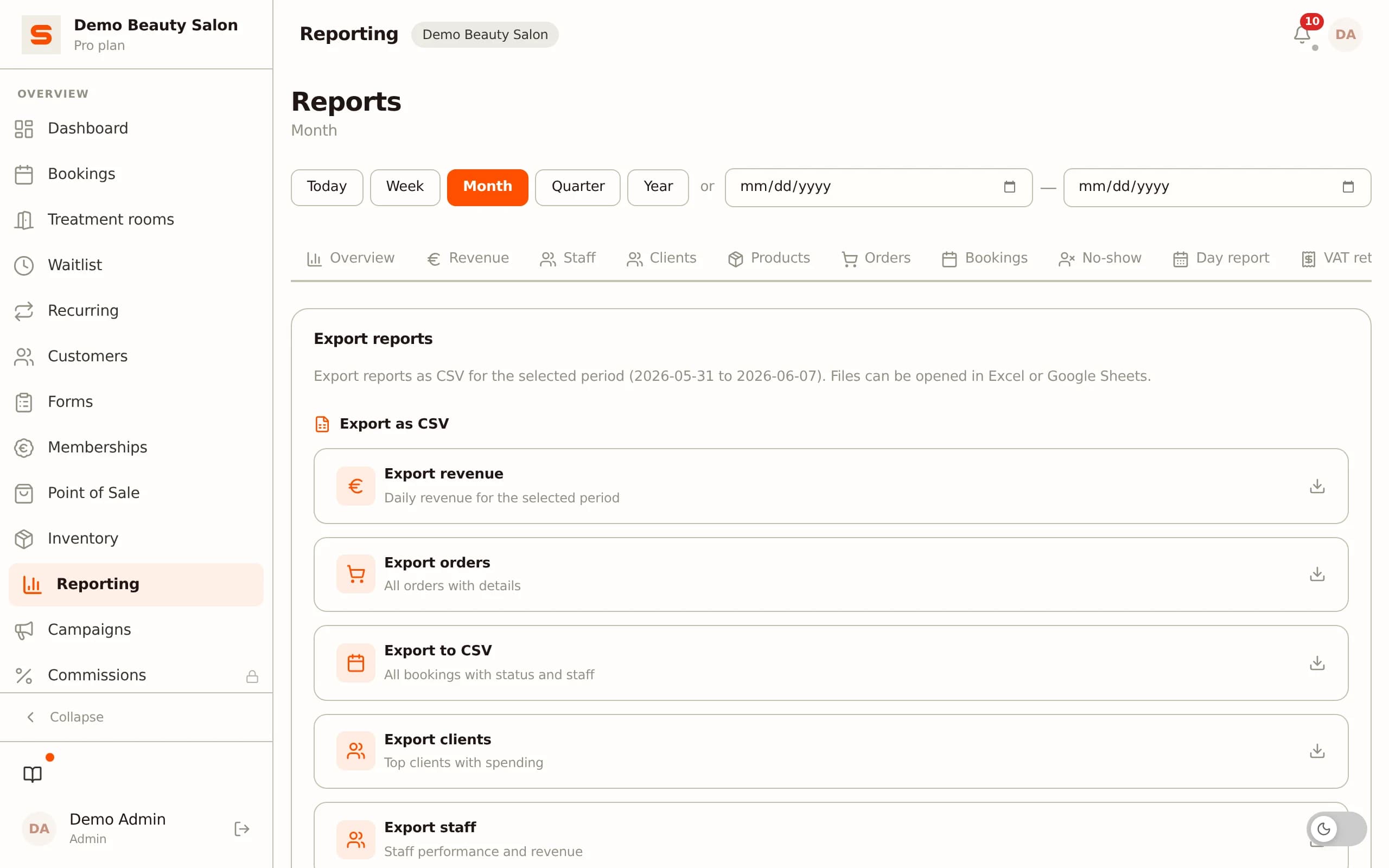
Because all data is stored digitally and in structured form, you naturally meet the retention obligation: your archive is always complete and retrievable. And because every appointment is on record, you can always substantiate your revenue - the best insurance against awkward questions in an audit.
You remain responsible for your returns and your accountant for the tax advice, but the gathering work - the part that costs the most time and frustration - is then done.
Frequently asked questions
How long must I keep my salon records?
The general retention obligation in the Netherlands is seven years, counted from the end of the financial year the documents relate to. For real-estate data - for instance if you buy your salon premises - the period is ten years. Digital retention is allowed, provided the data stays complete, legible and authentic. Thresholds differ slightly between countries, so check your local rules if you operate outside the Netherlands.
Which VAT rate applies to a hair salon?
In the hairdressing trade in the Netherlands, the characteristic hairdressing services - cutting, washing, blow-drying, colouring, perming and shaving - fall under the reduced rate of 9%, as do the products the hairdresser consumes during the treatment. Retail products you resell and beauty treatments (facials, make-up, nail work) fall under the standard rate of 21%. Beauty salons and nail studios therefore generally apply 21% on treatments. Because the line is not always sharp, a borderline case is best put to your accountant or the tax authority.
When is the small-business VAT scheme worth it for my salon?
The scheme is a VAT exemption for businesses with annual turnover up to 20,000 euro in the Netherlands. It mostly suits a small-scale or starting salon with private clients and few large investments. If you make large investments or have many business clients, standard VAT is usually better because you can reclaim input VAT. Run both scenarios before you choose, since you are committed for at least three years. Thresholds vary by country.
Can I keep my records fully digital?
Yes. Tax authorities accept a fully digital record, provided the data stays authentic, legible and complete throughout the retention period. A scanned or digital invoice may replace the paper version. Keep a reliable backup of your accounting package and your POS data; a digital archive is safer and faster to search than a box of receipts.
How does Salonnare help with my bookkeeping?
Salonnare records every appointment and sale automatically with the correct price and VAT rate, so your revenue, diary and payments reconcile. For your VAT return you export an overview of revenue per rate, and your accountant receives a clean, structured file. The software replaces neither an accountant nor tax advice, but it removes the time-consuming gathering work. Start for free at salonnare.com/en/free.