



Preventing No-Shows: How Salons Sharply Cut Missed Appointments
The average salon loses a significant chunk of booked revenue to no-shows. On a €3,500 monthly turnover that can easily add up to hundreds of euros walking out the door every month - not as discount, but as empty chairs. Worse: a no-show takes two hours out of your schedule that cannot be resold, so the real damage exceeds the missed treatment price. At the same time, salons know that being too aggressive drives clients away: 100% prepayment scares too many off, and aggressive no-show invoicing leads to bad reviews. The question is not whether to act on no-shows, but how to do it smartly without losing clients. This guide describes three interventions that together remove a large share of no-shows in practice: a reasonable deposit, automatic reminders at the right time, and a transparent repeat-offender policy clients understand. No theory - a practical approach, example wording, and worked examples.
Why no-shows happen (and what clients actually think)
No-shows often happen because clients simply forget their appointment or because of unclear communication, not out of malice. Clients book 3-4 weeks ahead, forget, get an unclear reminder and think "I will cancel tomorrow" - but never do. A share are last-minute cancellations they avoid out of shame or not knowing how. Only a small group deliberately skip.
This changes your strategy: you do not need to punish clients, you need to make forgetting impossible and cancelling easy. You do that with three contact moments (24h, 2h, plus a clear reschedule link in every email) and a light financial commitment that is enough to create commitment without killing booking intent.
Salons relying only on no-show fees see limited results - those who book without commitment skip anyway, leaving you with the choice between invoicing (bad review) or absorbing the loss. Front-end prevention beats back-end repression.
Deposit: the reasonable percentage
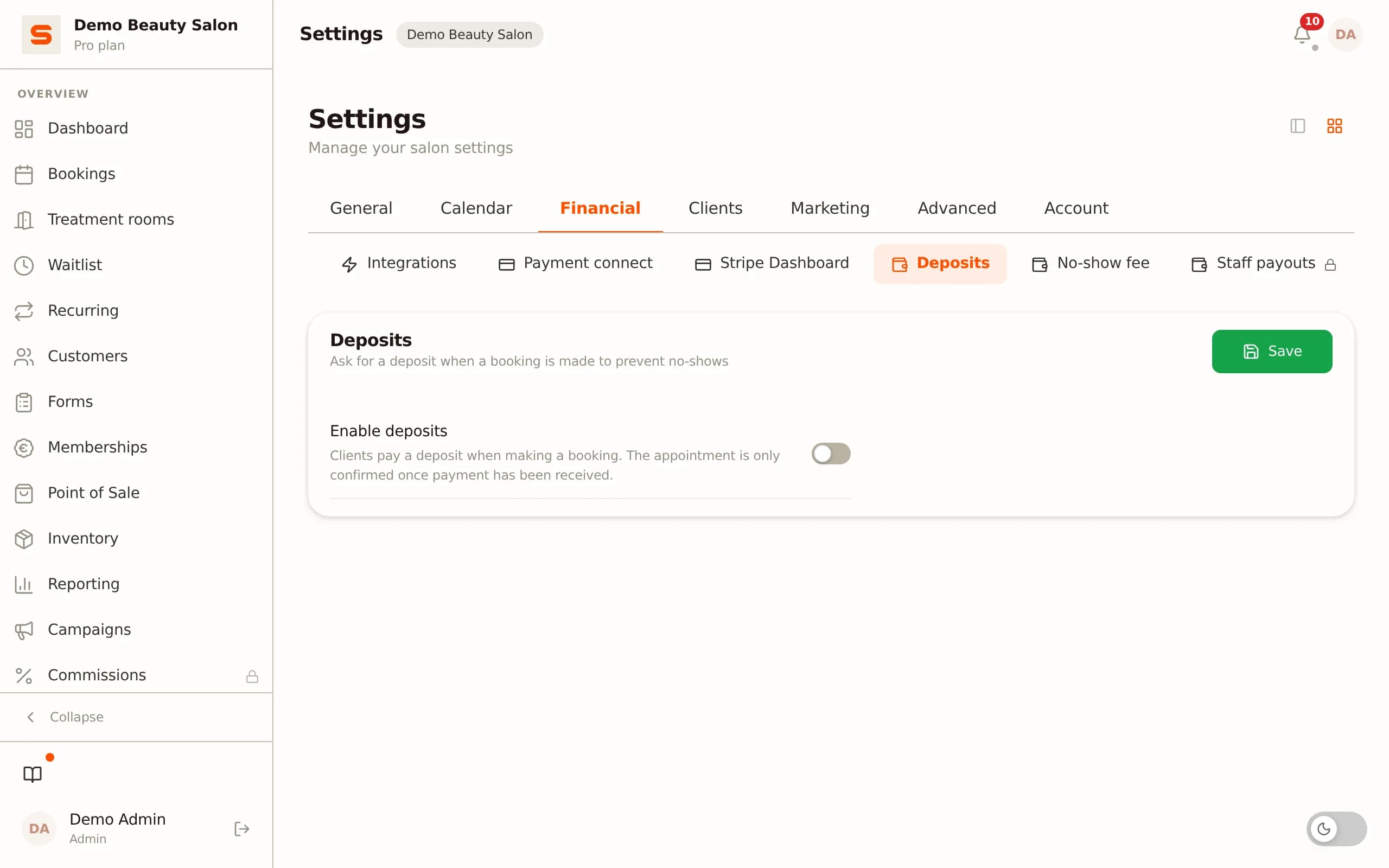
The single most effective measure is a 25-30% deposit at booking. Not 100% (that scares off too many potential clients), not a flat €5 (too low for €100 services), but a percentage that creates enough commitment to prevent forgetting without being a barrier for new clients.
For a €45 haircut the client pays €13.50 upfront - small effort, no barrier. For a €120 colour treatment that is €36 upfront - significant enough to take seriously.
Do not apply this to loyal clients: in Salonnare you can toggle deposits per client segment, so trusted regulars do not need to prepay. New clients and first-time visitors always do.
Salons applying this consistently see their no-show rates drop sharply within a few months, with barely any booking-drop on new clients - a net win of hundreds of euros per month. Want to know exactly what no-shows cost your salon? Work it out with the free no-show calculator and see how much you keep with a deposit.
Reminder cadence: three touchpoints at the right moments
One reminder is too few, four is too many (irritation). The optimal cadence: confirmation right after booking (email with .ics calendar file so the appointment lands in their phone calendar), reminder 24 hours before (SMS or WhatsApp - open rate 95% vs 25% for email), and a short reminder 2 hours before with a direct reschedule link.
The 24h reminder always contains: time, stylist name, address, and a prominent "Need to change? Pick a new time" button leading directly to your rebook page. Make rescheduling easier than not showing up.
Salons switching from email-only to SMS+email combo see a noticeable drop in no-shows from this change alone. WhatsApp Business often works even better but requires an approved template and small per-message costs (€0.03-€0.07). For a salon with 80 bookings/month that is €2-€6/month - negligible against saved no-show revenue.
Repeat-offender policy: what to do after the first no-show
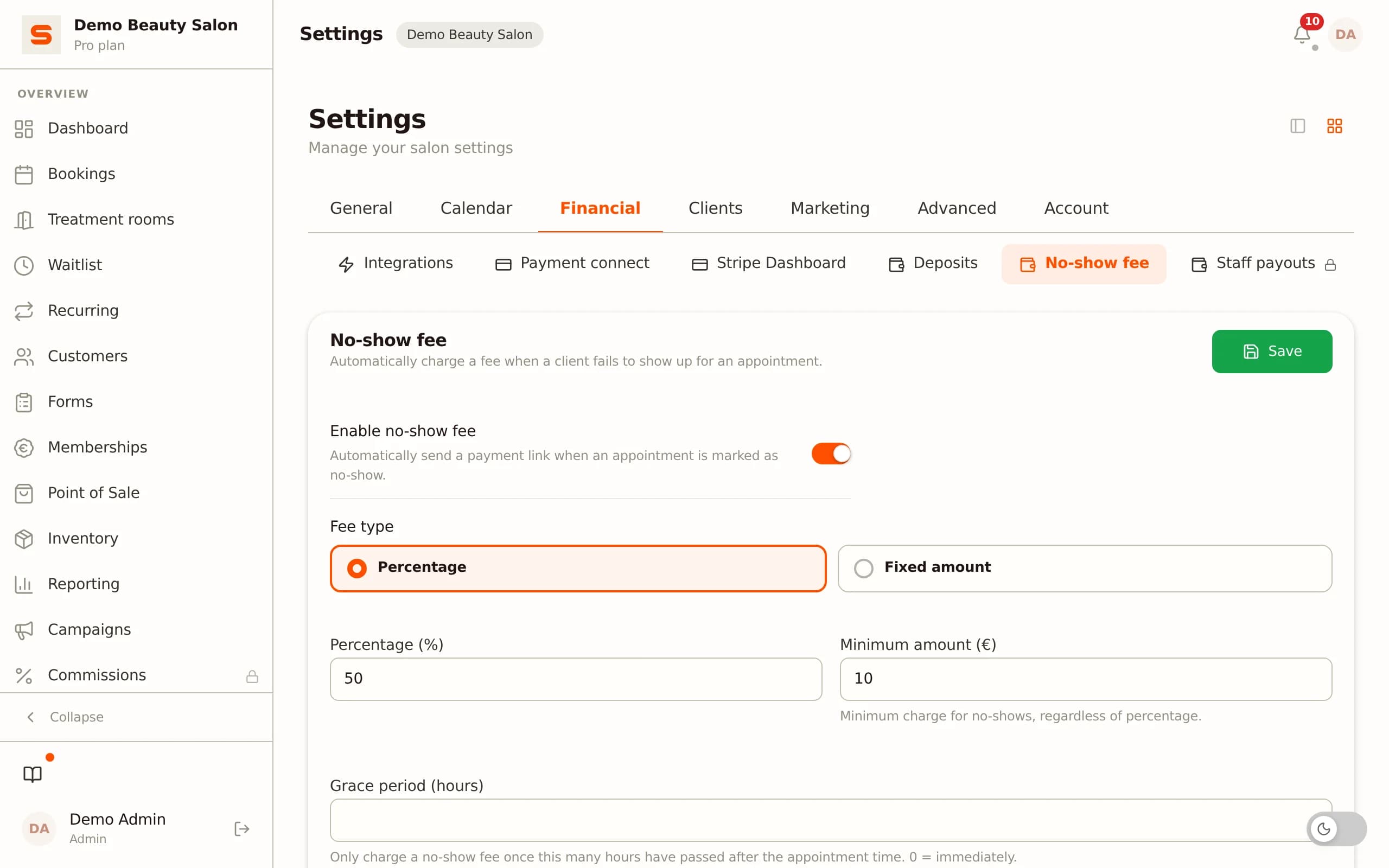
A transparent policy clients understand gives you both legal and emotional grounds to act consistently. Communicate in your booking confirmation and on your site: "First no-show: free, we just ask for a call before next booking. Second no-show within 6 months: 50% of treatment price charged. Third no-show: only bookings with 100% prepayment." This feels fair because it leaves room for human error and only escalates with pattern behaviour.
In Salonnare you can keep a per-client no-show counter that is automatically visible at their next booking - so you immediately see whether this is the second or third time. To invoice a no-show: send a Mollie payment request right after the missed appointment (€22.50 for the half €45 cut).
Most pay without dispute because the policy was known, some reply with apologies and offer to prepay the next, and a small group protest or vanish - that last group is not the client base you want. Always document briefly in a notes field why a fee was applied, in case anyone disputes later.
Measure and adjust: monthly no-show review
What you do not measure you cannot improve. Reserve 15 minutes a month for a no-show review: how many no-shows this month, what percentage of total bookings, what patterns (specific days, treatments, client segments)? Salonnare has a built-in no-show report under Reports → No-shows with monthly graph and breakdown per stylist and service.
Many salons discover patterns they can act on: Monday morning has 3x as many no-shows as Friday afternoon (consider no unconfirmed Monday morning bookings), colour treatments on Saturday with new clients show 15% no-show (raise deposit to 50% for that combination). Set a target: under 3% total no-show rate is good, under 2% is excellent.
Above 5% indicates a system fault (reminders not sent, deposits accidentally off, clients receiving wrong time due to time zone bug). Monthly reviews catch this early before it costs months of revenue.
Salonnare handles deposits directly to your own account, sends automatic reminders at all three touchpoints, and includes this no-show report built in - at no extra cost. With a permanent free plan and a fixed monthly price with no marketplace commission on your bookings - just a 0.5% platform fee (min. €0.30) per payment - you keep more of every euro you earn. Try Salonnare for free
Frequently asked questions
Does requiring a deposit scare clients away?
At 25-30% usually barely. A small upfront payment adds a light barrier, but most clients who genuinely want to come do not drop off because of it - especially at salons, where the relationship is more personal than, say, in hospitality. The trade-off is what you get in return: a limited number of clients who decide not to book, against a clear drop in no-shows. A worked example: a salon with 100 bookings/month and previously 12 no-shows × €45 = €540 loss. If a deposit brings that down to, say, 3 no-shows, you are left with €135 loss plus a handful fewer bookings - on balance you keep hundreds of euros per month.
When is the best time to send reminders?
Confirmation immediately (within 5 minutes of booking, still top-of-mind), 24 hours before around 6-7pm (people plan their next day in the evening), and 2 hours before. Avoid reminders before 8am or after 9pm - irritates clients. For Monday appointments, send the 24h reminder Sunday evening.
Are no-show fees legally enforceable?
Yes, provided you communicated them upfront in your booking terms (visible at booking acceptance). Most jurisdictions allow reasonable damages clauses. "Reasonable" means: not exceeding actual lost revenue, room for excused reasons (illness with proof). Keep your booking confirmation for at least 1 year as proof of agreement.
Does SMS or WhatsApp work better for reminders?
WhatsApp has higher open rates (98% vs 95% SMS) and clients can reply directly to cancel. Drawback: requires an approved Business template via Meta and a WhatsApp Business API connection - not plug-and-play, you need an external sending service. Salonnare has a built-in WhatsApp Business sender (optional per salon); for SMS you plug in an external service. Reminders are delivered by email by default. For SMS, plug in an external service like MessageBird, Twilio or a local provider, separate from your salon software. For most smaller salons, email reminders plus a phone confirm-call for first-time clients work fine; SMS/WhatsApp pays off from 200+ bookings per month or for luxury salons where clients expect it.